Skip to content
Psi & Hose

Air Compressors

Best air compressor for an auto repair shop

A shop compressor is not a garage compressor with a bigger tank. It is a different pump, a different circuit and a different duty cycle, and the number that decides it is CFM at 90 PSI.

By Ryder M.Last updated Published
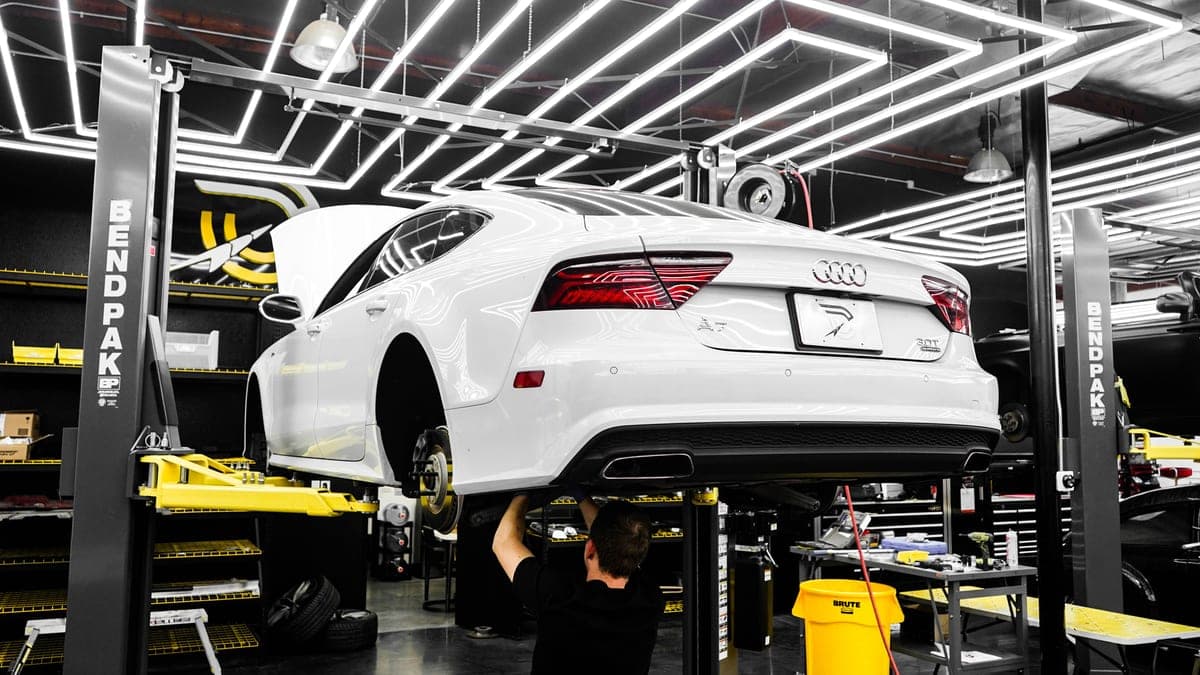
A vehicle on a lift in a working automotive repair shop

Some links on this page are affiliate links. If you buy through one, Magoo Media Group earns a commission from the retailer at no extra cost to you. It never changes which product we rank first - how this site is funded.

Read this first

What changes when the work is continuous

A home garage runs air in bursts: break four lug nuts, inflate a tire, blow out a brake assembly. A working shop runs air continuously, and often two tools at once. That single difference invalidates almost all consumer compressor advice, because burst work is solved by tank volume and continuous work is only ever solved by pump output.

The arithmetic is unforgiving. A 6-inch dual-action sander draws in the 6 to 10 CFM range for as long as the trigger is down. A cut-off tool is similar. A production spray gun is around 8 CFM continuous and an undercoat gun is far higher. None of those numbers are served by any 120V portable compressor made, regardless of how many gallons the tank holds.

So the shop question is not which pancake to buy. It is where on the 5 to 12 CFM ladder your tool list actually sits, and whether you have the electrical supply to reach it. Both answers are usually further up than people expect, and the second one is the expensive part.

Published air demand at 90 PSI
ToolCFM @ 90 PSIAt loadDutyWhat the number means
Impact wrench, 1/2"4 - 522BurstThe most misunderstood number on this chart. Ingersoll Rand publishes 4.2 CFM average for the 231C and 22 CFM at load. The average assumes you hold the trigger for a second or two at a time. A 6-gallon pancake at 2.6 CFM does break lug nuts; it simply cannot keep the trigger down.
Impact wrench, 3/4"6-BurstPast the point where a portable garage compressor is the right answer. If you genuinely need 3/4-inch drive, budget for the compressor before the wrench.
Air ratchet, 3/8"3 - 4-IntermittentIngersoll Rand publishes 3 CFM average at 90 PSI for the 105-D3; Engineering ToolBox lists 4 CFM for the class. A ratchet is the sneaky one: you hold the trigger far longer than with an impact, so it punishes a small tank harder despite the lower headline number.
Die grinder, 1/4"5 - 6-ContinuousIngersoll Rand lists 5 CFM; Engineering ToolBox gives a 4-6 CFM band. Continuous duty, so a 6-gallon pancake gives you a handful of seconds before pressure drops and the tool slows.
Cut-off tool, 3 inch4 - 10-ContinuousEngineering ToolBox publishes a wide 4-10 CFM band because cut-off tools vary enormously. Whichever end yours sits at, it runs continuously, so size for the top of the band.
Orbital / DA sander, 6 inch10 - 9-ContinuousIngersoll Rand lists 10 CFM for a body orbital sander; Engineering ToolBox gives 6-9 CFM for the class. A sander runs continuously by nature, so there is no burst allowance to hide behind. This is the job that genuinely needs a big compressor.
Vertical disc sander / polisher20-Continuous20 CFM continuous. No portable garage compressor of any tank size will run this. If body work is the plan, price a 60-gallon two-stage before anything else.
Paint spray gun, production / HVLP8 - 7-ContinuousIngersoll Rand lists 8 CFM for production spraying; Engineering ToolBox gives 3-7 CFM for small hand-operated sprayers. Check the gun's own spec sheet - HVLP demand varies more than any other tool class on this chart.
Sandblaster / blast cabinetNot published-ContinuousEngineering ToolBox gives 6-400 CFM - a range so wide it is really a statement that the nozzle orifice sets the demand, not the cabinet. A small siphon gun sits near the bottom; a pressure pot with a 1/4-inch nozzle is industrial. We publish no single number because no source does.

Where two references publish different figures, both are shown rather than averaged into a number nobody published. Primary sources: Ingersoll Rand air consumption chart, Engineering ToolBox air tool consumption, and per-tool manufacturer specifications.

Ranked by delivered CFM

The picks

Quick picks

#ProductBest forScorePrice
1
A large stationary vertical sixty-gallon air compressor in a workshop
Industrial Air ILA3606056 60-gallon11.5 CFM @ 90 / 60 gal / 155 PSI11.5 CFM at 90 PSI. Included as the reference point for what continuous sanding and blasting actually costs.
Body work, blasting, or running two tools at once8.1/10★★★★☆

#ad Disclosure - we do not publish prices we cannot verify

2
A thirty-gallon belt-drive air compressor with a cast iron pump
DEWALT DXCMLA1983054 30-gallon5.7 CFM @ 90 / 30 gal / 155 PSI5.7 CFM, 30 gallons, oil-lubricated cast iron and belt drive. Where a garage compressor stops being disposable.
A permanent garage compressor you expect to keep for a decade7.9/10★★★★☆

#ad Disclosure - we do not publish prices we cannot verify

3
A ten-gallon vertical oil-free air compressor on wheels in a workshop
California Air Tools 10020C5.3 CFM @ 90 / 10 gal / 125 PSI / 70 dBA5.3 CFM at 70 dBA with a published 70/30 duty cycle. The first unit here that runs a continuous-duty tool.
Running a ratchet, die grinder or touch-up gun without waiting6.2/10★★★☆☆

#ad Disclosure - we do not publish prices we cannot verify

4
A twenty-gallon vertical air compressor standing against a garage wall
Husky C201H 20-gallon4 CFM @ 90 / 20 gal / 175 PSI / 83 dBA4.0 CFM with 20 gallons at 175 PSI. The cheapest way to buy STORAGE rather than flow.
Burst automotive work where tank volume, not CFM, is the limit6.3/10★★★☆☆

#ad Disclosure - we do not publish prices we cannot verify

Scores are computed from manufacturer-published specs by the rubric on our methodology page. Nothing here has been bench-tested, and we do not publish prices we cannot verify.

Pick 1 - Industrial Air ILA3606056

8.1/10★★★★☆

Industrial Air ILA3606056 60-gallon

Best for: Body work, blasting, or running two tools at once

Verdict

11.5 CFM at 90 PSI. Included as the reference point for what continuous sanding and blasting actually costs.

What it does well

  • 11.5 CFM at 90 PSI and 13.4 at 40 - clears an orbital sander with margin
  • Cast-iron twin-cylinder pump on a 60-gallon vertical tank
  • 3.7 HP on 240V

What it will not do

  • 240V and stationary: this is an electrical project, not a purchase
  • Overkill for anyone whose honest tool list is nailers, tires and a 1/2-inch impact - which is most people reading this
How this 8.1 was calculated
MetricScoreWeightBasis
Air flow10.040%11.5 CFM at 90 PSI, on a 0.7-6 CFM scale
Stored air10.025%60 gal x 155 PSI = 9300, on a 125-3,500 scale
Noise5.015%Manufacturer publishes no dBA figure - scored a neutral 5, not a guess
Portability5.010%No weight published - scored a neutral 5
Spec transparency3.310%2 of 6 useful figures published (CFM at 90, CFM at 40, dBA, duty cycle, recovery, weight)
A large stationary vertical sixty-gallon air compressor in a workshop

Licensed stock photo - illustrative of the category, not a photo of this unit

#ad Disclosure - we do not publish prices we cannot verify

Published specs

Industrial Air ILA3606056 60-gallon published specifications
CFM @ 90 PSI11.5
CFM @ 40 PSI13.4
Tank60 gal
Max pressure155 PSI
NoiseNot published
Duty cycleNot published
RecoveryNot published
PumpOil-lubricated
Motor3.7
WeightNot published
Power240V

Source: Industrial Air ILA3606056 - product specifications

Pick 2 - DEWALT DXCMLA1983054

7.9/10★★★★☆

DEWALT DXCMLA1983054 30-gallon

Best for: A permanent garage compressor you expect to keep for a decade

Verdict

5.7 CFM, 30 gallons, oil-lubricated cast iron and belt drive. Where a garage compressor stops being disposable.

What it does well

  • 5.7 CFM at 90 PSI and 7.0 at 40 - clears ratchets, die grinders and touch-up spraying
  • Oil-lubricated belt drive runs cooler and slower than a direct-drive oil-free pump
  • 120/240V, so it can move to a 240V circuit later

What it will not do

  • Oil-lubricated means an actual maintenance routine: check and change the oil
  • 155 PSI on 30 gallons stores less than 175 PSI on 20 in some comparisons - check the math, not the tank
How this 7.9 was calculated
MetricScoreWeightBasis
Air flow9.440%5.7 CFM at 90 PSI, on a 0.7-6 CFM scale
Stored air10.025%30 gal x 155 PSI = 4650, on a 125-3,500 scale
Noise5.015%Manufacturer publishes no dBA figure - scored a neutral 5, not a guess
Portability5.010%No weight published - scored a neutral 5
Spec transparency3.310%2 of 6 useful figures published (CFM at 90, CFM at 40, dBA, duty cycle, recovery, weight)
A thirty-gallon belt-drive air compressor with a cast iron pump

Licensed stock photo - illustrative of the category, not a photo of this unit

#ad Disclosure - we do not publish prices we cannot verify

Published specs

DEWALT DXCMLA1983054 30-gallon published specifications
CFM @ 90 PSI5.7
CFM @ 40 PSI7
Tank30 gal
Max pressure155 PSI
NoiseNot published
Duty cycleNot published
RecoveryNot published
PumpOil-lubricated
Motor1.9
WeightNot published
Power120/240V

Source: DEWALT DXCMLA1983054 30-gallon compressor - product specifications

Pick 3 - California Air Tools 10020C

6.2/10★★★☆☆

California Air Tools 10020C

Best for: Running a ratchet, die grinder or touch-up gun without waiting

Verdict

5.3 CFM at 70 dBA with a published 70/30 duty cycle. The first unit here that runs a continuous-duty tool.

What it does well

  • 5.3 CFM at 90 PSI clears every published figure for ratchets, die grinders and touch-up spraying
  • 70 dBA at that output is unusual - most 5+ CFM units are far louder
  • Publishes a real 70/30 duty cycle and a 25-second recovery from 95 to 125 PSI

What it will not do

  • 82.5 lb and 14 A - it needs its own circuit and it is not a carry-it-upstairs machine
  • 125 PSI max, so a bigger tank at higher pressure still stores more per fill
How this 6.2 was calculated
MetricScoreWeightBasis
Air flow8.740%5.3 CFM at 90 PSI, on a 0.7-6 CFM scale
Stored air3.325%10 gal x 125 PSI = 1250, on a 125-3,500 scale
Noise5.615%70 dBA, on a 58-85 dBA scale
Portability1.110%82.5 lb, on a 20-90 lb scale
Spec transparency10.010%6 of 6 useful figures published (CFM at 90, CFM at 40, dBA, duty cycle, recovery, weight)
A ten-gallon vertical oil-free air compressor on wheels in a workshop

Licensed stock photo - illustrative of the category, not a photo of this unit

#ad Disclosure - we do not publish prices we cannot verify

Published specs

California Air Tools 10020C published specifications
CFM @ 90 PSI5.3
CFM @ 40 PSI6.4
Tank10 gal
Max pressure125 PSI
Noise70 dBA
Duty cycle70/30 (manufacturer-published)
Recovery120 s empty to full; 25 s recovery 95 to 125 PSI
PumpOil-free
Motor2.0
Weight82.5 lb
Power110V, 14 A

Source: California Air Tools 10020C - product specifications

Pick 4 - Husky C201H

6.3/10★★★☆☆

Husky C201H 20-gallon

Best for: Burst automotive work where tank volume, not CFM, is the limit

Verdict

4.0 CFM with 20 gallons at 175 PSI. The cheapest way to buy STORAGE rather than flow.

What it does well

  • 20 gallons at 175 PSI is roughly six times the stored air of a 6-gallon 150 PSI pancake
  • 4.0 CFM at 90 PSI and 5.2 at 40 - enough to recover between bursts instead of chasing you
  • Vertical footprint takes a corner instead of floor space

What it will not do

  • 83 dBA published and a 7-minute fill from empty - plan to switch it on before you start
  • Oil-free at 20 gallons means a shorter pump life than a cast-iron oil-lubricated unit
How this 6.3 was calculated
MetricScoreWeightBasis
Air flow6.240%4 CFM at 90 PSI, on a 0.7-6 CFM scale
Stored air10.025%20 gal x 175 PSI = 3500, on a 125-3,500 scale
Noise0.715%83 dBA, on a 58-85 dBA scale
Portability5.010%No weight published - scored a neutral 5
Spec transparency6.710%4 of 6 useful figures published (CFM at 90, CFM at 40, dBA, duty cycle, recovery, weight)
A twenty-gallon vertical air compressor standing against a garage wall

Licensed stock photo - illustrative of the category, not a photo of this unit

#ad Disclosure - we do not publish prices we cannot verify

Published specs

Husky C201H 20-gallon published specifications
CFM @ 90 PSI4
CFM @ 40 PSI5.2
Tank20 gal
Max pressure175 PSI
Noise83 dBA
Duty cycleNot published
Recoveryabout 7 minutes to fill from empty
PumpOil-free
Motor1.3 running
WeightNot published
Power120V

Source: Husky C201H 20-gallon compressor - retailer specification listing

The honest cut-off

The 120V ceiling, stated plainly

A 120V 15-amp circuit can deliver roughly 1,800 watts continuously, and after motor inefficiency that caps a single-stage pump at somewhere around 5 to 6 CFM at 90 PSI. That is a hard physical limit, not a brand limitation. The best 120V unit we catalog publishes 5.7 CFM at 90 PSI and runs on 120 or 240V; every unit above that figure is 240V only.

This is why a 60-gallon 240V machine at 11.5 CFM is not simply a larger version of a 20-gallon 120V machine at 4.0 CFM. It is nearly three times the air, because it has nearly three times the electrical supply. If your shop tool list includes a sander or a blast cabinet, the honest answer is that the compressor decision is really a wiring decision and you should price the circuit before the machine.

Adding a 240V circuit is licensed electrical work under the National Electrical Code, not a weekend job. We say that on every page where it comes up because it is the cost people leave out of the comparison and then discover after the compressor is delivered.

Published output and supply for the shop field
CompressorCFM @ 90CFM @ 40TankMax PSISupply
Industrial Air ILA360605611.513.460 gal155240V
DEWALT DXCMLA19830545.77.030 gal155120/240V
California Air Tools 10020C5.36.410 gal125110V, 14 A
Husky C201H4.05.220 gal175120V

Every figure is manufacturer-published. See the sources block below.

The spec nobody prints

Duty cycle is what separates a shop pump from a garage pump

Delivered CFM tells you what a compressor produces while it is running. Duty cycle tells you what proportion of the hour it is allowed to run. A shop needs both, and the second figure is published by almost nobody - of the units on this page, exactly one prints it.

That one publishes 70/30, meaning seven minutes of running in every ten is within specification, along with a 25-second recovery from 95 to 125 PSI. Those are the numbers you can actually plan a workflow around. For the rest, the inference you can safely draw is structural: an oil-lubricated cast-iron pump turning slowly is built for sustained running, and an oil-free direct-drive pump turning fast is not.

Two of the four picks here are oil-lubricated, and in a shop context that is the right direction. Oil-free is the correct choice in a wood shop where finish contamination matters; in an auto shop, where the tools are continuous and the pump will be hot, oil-lubricated longevity wins and the oil mist is handled downstream by filtration you need anyway.

Beyond the machine

Plumb the shop, do not chase it with a hose

A shop compressor is stationary, which means the air has to travel. Every foot of line and every coupler between the tank and the tool costs pressure, and a 1/4-inch coupler in a 1/2-inch line is a restriction that no amount of compressor capacity fixes. If you are buying 11.5 CFM, do not deliver it through fittings rated at a fraction of that.

Drop legs with a valve at the bottom of each one are the standard answer for condensate, and they cost almost nothing at build time. Water separation matters more in a shop than a garage simply because the pump runs more and makes more water, and water is the thing that rusts a tank from the inside.

Size the hose to the tool class, not to the compressor. A 3/8-inch hose is the general-purpose answer; a high-demand tool on a long run wants 1/2 inch. Our hose size chart gives the delivered-flow figures by diameter and length so you can check rather than assume.

Being honest

When a shop compressor is the wrong purchase

If your shop is one person doing brakes, suspension and tires, a 20 or 30-gallon unit is enough and the 60-gallon machine is capacity you are paying to store. Burst automotive work is genuinely well served at 4 to 5.7 CFM, and the money saved buys the filtration and the hose reel that make the system pleasant to use.

If you are considering a shop compressor because a garage unit feels weak, diagnose before you upgrade. Leaks, undersized hose and stacked adapters all present exactly as a compressor that cannot keep up, and all three are cheaper to fix than a new machine.

And if the trigger for this search was bodywork or blasting, be clear with yourself that those are the two jobs on the list that genuinely require the top of this page. Everything else on a repair order can be done for less.

FAQ

Questions people actually ask

What size air compressor does an auto repair shop need?

It depends on the highest continuous-duty tool on your list. Brakes, suspension, tires and impacts are burst work and are well served at 4 to 5.7 CFM at 90 PSI. Air sanders, cut-off tools, production spray guns and blast cabinets are continuous and need 8 CFM and up, which in practice means a 240V machine.

Can a 120V compressor run a shop?

Only a burst-work shop. A 120V 15-amp circuit caps a single-stage pump at roughly 5 to 6 CFM at 90 PSI, and the best 120V-capable unit we catalog publishes 5.7 CFM. Any tool needing sustained 8 CFM or more is beyond that ceiling regardless of tank size.

Do I need a 60 gallon compressor?

Only if you do bodywork, blasting, or run two air tools at once. The 60-gallon unit here publishes 11.5 CFM at 90 PSI, which is nearly three times a 20-gallon 120V machine - because it has nearly three times the electrical supply. For one person doing brakes and tires it is capacity you are paying to store.

Is an oil-lubricated compressor better for a shop?

Yes, in this context. An oil-lubricated cast-iron pump turning slowly is built for sustained running, which is exactly what shop work asks of it. The oil mist it can pass downstream is handled by the filtration a shop needs anyway, so the trade that rules oil out of a wood shop does not apply here.

What duty cycle should a shop compressor have?

As high as the manufacturer is willing to publish - which is usually nothing. Of the four units on this page, one publishes 70/30 along with a 25-second recovery from 95 to 125 PSI. Where no figure exists, read the construction instead: oil-lubricated cast iron turning slowly tolerates sustained running, oil-free direct drive does not.

Sources

Where these numbers come from

Accessed September 2026. If a figure on this page does not match the manufacturer's current sheet, tell us at contact@psiandhose.com and we will correct and date the change - see our editorial policy.

Read next