Skip to content
Psi & Hose

Hoses & Air Prep

Air hose size chart

The hose is the cheapest thing in your air system and the most common reason a tool feels weak. Here is the diameter each tool class needs, with the manufacturer minimums.

By Ryder M.Last updated Published
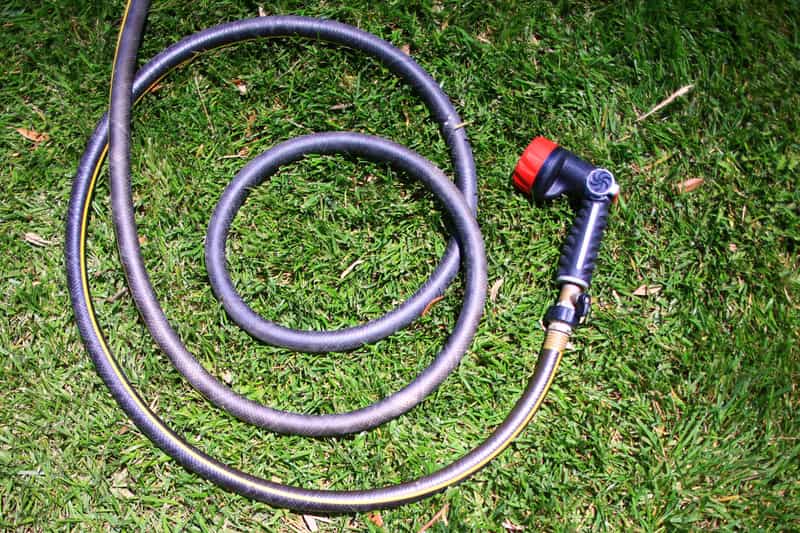
A coiled air hose lying flat on a garage floor

Some links on this page are affiliate links. If you buy through one, Magoo Media Group earns a commission from the retailer at no extra cost to you. It never changes which product we rank first - how this site is funded.

The physics, briefly

Why diameter beats length

Air moving through a hose loses pressure to friction against the wall. That loss rises steeply as internal diameter falls, because a narrower bore means more wall contact per unit of air moved. Length matters too, but doubling the diameter helps far more than halving the length.

The consequence is that an undersized hose behaves exactly like an undersized compressor. The tool sees less pressure than the regulator shows, so it runs weak, and every symptom points at the pump. People replace the compressor and the problem persists.

Ingersoll Rand puts a number on this: the 231C 1/2-inch impact wrench specifies a 3/8-inch minimum hose ID. That is a published specification on the tool, not a recommendation from us, and most compressor accessory kits ship a 1/4-inch hose.

The single cheapest upgrade in a garage

A 50-foot 3/8-inch hose and one matched pair of quality couplers frequently does more for how an air tool feels than several hundred dollars of extra compressor. Fix the plumbing before you blame the pump.

Diameter by tool class

The chart

Use the largest diameter the tool's inlet and your fittings allow. There is no penalty for oversizing a hose beyond weight and cost - a 1/2-inch hose on a brad nailer works perfectly, it is just unnecessarily heavy.

Hose internal diameter by tool class
Tool classRecommended IDWhy
Brad and finish nailers1/4"Demand under 2 CFM in bursts; a small hose is lighter and easier to handle on a ladder
Framing and roofing nailers3/8"Sustained nailing pace will sag pressure on 1/4-inch, especially over 50 ft
Tire inflation1/4"2 CFM at 30 to 60 PSI - the least demanding job there is
Blow gun1/4" or 3/8"2.5 to 3 CFM, but held open continuously it behaves like a bigger load
Impact wrench, 1/2"3/8" minimumSpecified by the manufacturer. 22 CFM at load will starve on 1/4-inch
Air ratchet, 3/8"3/8"Long trigger times mean sustained flow, so the hose is in play the whole time
Die grinder, cut-off tool3/8"Continuous duty at 4 to 10 CFM - every restriction shows
Orbital and disc sanders1/2"6 to 20 CFM continuous; anything smaller is the bottleneck, not the pump
Spray guns3/8" or 1/2"Pressure stability at the gun is what decides finish quality

Impact wrench minimum is the manufacturer's published figure. Other rows follow the demand figures in our CFM chart.

What we would buy

The picks

Quick picks

#ProductBest forScorePrice
1
A coiled hybrid polymer air hose lying flat on a garage floor
Flexzilla HFZ3850YW23/8" / 50 ft / 300 PSI at 70F300 PSI hybrid polymer that lies flat from -40F to 140F. The upgrade that makes a cheap compressor feel expensive.
The one hose to own in a cold or unheated garage8.0/10★★★★☆
Check price on Amazon

#ad Disclosure - we do not publish prices we cannot verify

2
A red rubber air hose with brass fittings on a workbench
Goodyear 12674 rubber air hose3/8" / 50 ft / 250 PSI250 PSI working, 1,070 PSI burst, EPDM rubber and brass ends. The hose that outlives the compressor.
A permanent hose that stays on the reel and never gets dragged into the cold7.3/10★★★★☆
Check price on Amazon

#ad Disclosure - we do not publish prices we cannot verify

3
Brass air fittings, couplers and plugs arranged on a bench
Milton 1/4" NPT M-STYLE coupler and plug kit1/4" NPT / M-STYLE (Industrial / Milton) / 300 PSI300 PSI, 40 SCFM, and the pattern most American garages already use. Standardize on one and stop adapting.
Making every tool in the garage fit every hose4.8/10★★☆☆☆
Check price on Amazon

#ad Disclosure - we do not publish prices we cannot verify

Scores are computed from manufacturer-published specs by the rubric on our methodology page. Nothing here has been bench-tested, and we do not publish prices we cannot verify.

Pick 1 - Flexzilla HFZ3850YW2

8.0/10★★★★☆

Flexzilla HFZ3850YW2

Best for: The one hose to own in a cold or unheated garage

Verdict

300 PSI hybrid polymer that lies flat from -40F to 140F. The upgrade that makes a cheap compressor feel expensive.

What it does well

  • 300 PSI maximum working pressure at 70F - higher than any compressor on this site produces
  • -40F to 140F flexibility: it still uncoils in an unheated garage in February
  • Zero-memory construction means it lies flat instead of fighting you, and 3/8" ID does not throttle an impact

What it will not do

  • Costs multiples of the PVC hose bundled in a compressor kit
  • The bright green is not subtle, which matters to precisely nobody using it
How this 8.0 was calculated
MetricScoreWeightBasis
Pressure headroom10.040%30070 PSI rating, on a 125-300 PSI scale
Flow capacity6.040%Flow not published for this class - scored a 6, which is what a correctly sized hose or fitting does not restrict
Spec transparency8.020%6 published specification figures
A coiled hybrid polymer air hose lying flat on a garage floor

Licensed stock photo - illustrative of the category, not a photo of this unit

Check price on Amazon

#ad Disclosure - we do not publish prices we cannot verify

Published specs

Flexzilla HFZ3850YW2 published specifications
Inside diameter3/8"
Length50 ft
Max working pressure300 PSI at 70F
Temperature range-40F to 140F
Fittings1/4" MNPT, anodized aluminum ends
MaterialHybrid polymer

Source: Flexzilla HFZ3850YW2 air hose - distributor specification listing

Pick 2 - Goodyear 12674

7.3/10★★★★☆

Goodyear 12674 rubber air hose

Best for: A permanent hose that stays on the reel and never gets dragged into the cold

Verdict

250 PSI working, 1,070 PSI burst, EPDM rubber and brass ends. The hose that outlives the compressor.

What it does well

  • 250 PSI working pressure with a 1,070 PSI burst rating - a 4:1 margin
  • -50F to 190F range and a Class C oil, weather and solvent resistant EPDM cover
  • Machined brass ends seal better and corrode less than aluminum or zinc

What it will not do

  • Rubber is heavy and it holds a coil memory - dragging 50 ft of it around is real work
  • Stiffer than hybrid polymer when the garage is cold
How this 7.3 was calculated
MetricScoreWeightBasis
Pressure headroom7.140%250 PSI rating, on a 125-300 PSI scale
Flow capacity6.040%Flow not published for this class - scored a 6, which is what a correctly sized hose or fitting does not restrict
Spec transparency10.020%7 published specification figures
A red rubber air hose with brass fittings on a workbench

Licensed stock photo - illustrative of the category, not a photo of this unit

Check price on Amazon

#ad Disclosure - we do not publish prices we cannot verify

Published specs

Goodyear 12674 rubber air hose published specifications
Inside diameter3/8"
Length50 ft
Working pressure250 PSI
Burst pressure1,070 PSI
Temperature range-50F to 190F
Fittings1/4" MNPT machined brass
CoverClass C oil, weather and solvent resistant EPDM

Source: Goodyear 12674 red rubber air hose - distributor specification listing

Pick 3 - Milton M-STYLE (210 / 711)

4.8/10★★☆☆☆

Milton 1/4" NPT M-STYLE coupler and plug kit

Best for: Making every tool in the garage fit every hose

Verdict

300 PSI, 40 SCFM, and the pattern most American garages already use. Standardize on one and stop adapting.

What it does well

  • 40 SCFM flow at 300 PSI max - far more than any compressor here delivers
  • M-STYLE (Industrial / Milton) is the most common pattern in US home garages, so tools match
  • Kits give you spare plugs, which is the part you actually lose

What it will not do

  • Mixing M-STYLE with the visually similar ARO or Lincoln patterns is the classic garage mistake - pick one and throw the others out
  • On a 1/2" line, 40 SCFM couplers become the restriction; step up to a G-style then
How this 4.8 was calculated
MetricScoreWeightBasis
Pressure headroom10.040%300 PSI rating, on a 125-300 PSI scale
Flow capacity0.040%40 SCFM, on a 40-100 SCFM scale
Spec transparency4.020%4 published specification figures
Brass air fittings, couplers and plugs arranged on a bench

Licensed stock photo - illustrative of the category, not a photo of this unit

Check price on Amazon

#ad Disclosure - we do not publish prices we cannot verify

Published specs

Milton 1/4" NPT M-STYLE coupler and plug kit published specifications
Thread1/4" NPT
PatternM-STYLE (Industrial / Milton)
Max pressure300 PSI
Air flow40 SCFM

Source: Milton Industries M-STYLE couplers and plugs - product specifications

Practical limits

Length, and the two ways to get it wrong

Too short and you drag the compressor around, which means you move it less and use it less. Fifty feet is the standard length for a reason: it reaches most of a two-car garage from one corner.

Too long and pressure drop compounds. A hundred feet of 1/4-inch hose on an impact wrench is a genuinely bad setup. If you need that reach, either go up a diameter or run hard line to a second drop point and keep the flexible hose short.

The best of both: a reel on the wall with 50 feet of 3/8-inch hose. The reel keeps it off the floor, the diameter keeps the flow, and 50 feet from a sensible mounting point covers a garage without a coil to trip over.

The last restriction

Fittings will undo your hose choice

A 3/8-inch hose feeding a tool through a chain of 1/4-inch adapters is a 1/4-inch system at that point. Milton publishes 40 SCFM for its standard 1/4-inch M-STYLE couplers, which is ample for any tool in a home garage - but each adapter in series adds a restriction and a leak path.

For genuinely high-flow work, Milton's 1/2-inch G-STYLE coupler publishes 99 SCFM. That is worth fitting on a 1/2-inch drop feeding a sander or a blast cabinet, and it is pointless on a 3/8-inch line where the hose is already the limit.

The rule that saves the most grief: standardize on one coupler pattern for the whole garage and throw the others away. M-STYLE, ARO and Lincoln patterns look similar and are not interchangeable, and a drawer with all three in it is a permanent source of leaks and swearing.

FAQ

Questions people actually ask

What size air compressor hose do I need for home use?

3/8-inch ID is the right default for a garage - it covers every tool up to a die grinder and does not starve an impact wrench. Use 1/4-inch only for nailers and tire inflation where light weight matters more, and 1/2-inch for sanders and spray work.

Does hose diameter really affect air tool performance?

Substantially. Ingersoll Rand specifies a 3/8-inch minimum hose ID for its 1/2-inch impact wrench, which tells you the manufacturer considers a smaller hose a limitation on the tool. An undersized hose produces exactly the symptoms of an undersized compressor.

Is a 50 foot air hose too long?

Not at 3/8-inch ID for normal garage tools - it is the standard length precisely because it reaches most of a two-car garage. A hundred feet of 1/4-inch hose on a high-demand tool is too long, and the fix is diameter rather than shortening.

Can I use two hoses joined together?

You can, and each joint is a restriction and a potential leak. Two 25-foot hoses joined perform worse than one 50-foot hose of the same diameter. If you join them, use quality couplers rather than adapters stacked in series.

What is the maximum pressure an air hose should be rated for?

Above your compressor's maximum tank pressure, with margin. Our picks are rated 250 and 300 PSI working, against tank ceilings of 120 to 200 PSI in our compressor roster - so both have real headroom. Never fit a hose rated below the tank's cut-out pressure.

Sources

Where these numbers come from

Accessed September 2026. If a figure on this page does not match the manufacturer's current sheet, tell us at contact@psiandhose.com and we will correct and date the change - see our editorial policy.

Read next