Skip to content
Psi & Hose

Air Compressors

Best compact air compressors

Compact is a storage decision, not a performance one. These five are ranked on what they weigh, what they stow into, and what they can still run when they get there.

By Ryder M.Last updated Published
A compact oil-free air compressor on a workbench beside a coiled air hose

Some links on this page are affiliate links. If you buy through one, Magoo Media Group earns a commission from the retailer at no extra cost to you. It never changes which product we rank first - how this site is funded.

Read this first

The short answer

The Makita MAC210Q is the compact air compressor to buy for most people: a 2-gallon twin-stack that publishes 2.0 CFM at 90 PSI, 135 PSI max, 60 dBA and 44 pounds, with a manufacturer-stated fill of roughly 65 seconds from empty. That is the best air-per-cubic-foot-of-storage trade in the roster. It will run a brad nailer indefinitely, a framing nailer at a working pace, and it stows on a shelf instead of owning a corner.

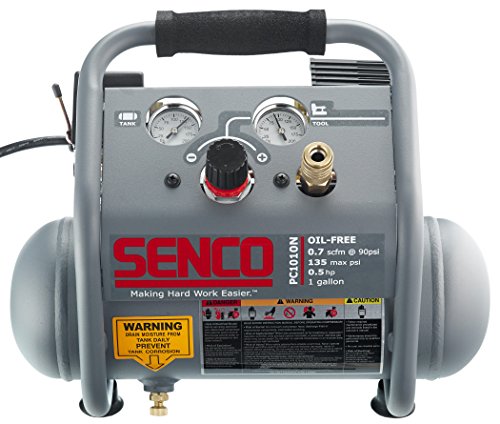
If compact means genuinely one-handed, the Senco PC1010N is the smaller honest answer at 1 gallon, 0.7 CFM at 90 PSI and 20 pounds. It is a trim-nailing machine and nothing else, and we would rather say that than dress it up. The Makita MAC100Q is the same size class at 25.5 pounds but publishes 58 dBA - the quietest figure on this page - and 135 PSI max rather than the Senco's 125.

The important thing to understand before you shop is that compact does not reduce what your tools demand. A half-inch impact wrench draws a published 4.2 CFM average at 90 PSI and spikes to 22 CFM on load; no machine on this page gets near either number. Compact buys you storage and portability. It buys you nothing on continuous-duty work, and a small tank makes the shortfall arrive sooner rather than making it smaller.

The five compact machines, on published specifications
TankCFM at 90 PSIMax PSINoiseWeight
Makita MAC210Q2 gal2.013560 dBA44 lb
Senco PC1010N1 gal0.712568 dBA20 lb
Makita MAC100Q1 gal0.713558 dBA25.5 lb
California Air Tools 8010A8 gal2.212060 dBA37.25 lb
Bostitch BTFP020126 gal2.615078.5 dBANot published

Every figure is the manufacturer's own published specification, linked in the sources block at the foot of this page. Bostitch does not publish a weight for the BTFP02012, so the cell says so rather than carrying a number we invented.

Compact is two different specs

Decide which one you are buying before you shop. Stowed volume is the box the machine occupies when it is not working - that favors the 1 and 2-gallon units. Carry weight is what you lift into a truck bed - that favors the Senco at 20 lb and the aluminum-tank California Air Tools at 37.25 lb over any 6-gallon steel pancake. The two lists are not the same list.

The criteria

How we ranked them

Four specifications, applied in this order, because that is the order in which they actually constrain a small machine.

First, CFM at 90 PSI. It is the only output figure that matters and the one every marketing panel hides behind peak horsepower. If the number does not clear your tool's published demand, nothing else on the spec sheet rescues the purchase.

Second, published weight and tank volume together. A compact compressor is bought to be moved or stowed, so the mass and the box are the specification rather than a footnote. Note how badly these two can diverge: the California Air Tools 8010A carries four times the tank volume of the Makita MAC100Q for twelve extra pounds, because its tank is aluminum rather than steel.

Third, noise, because a compact machine gets used indoors. Makita publishes 58 dBA for the MAC100Q and 60 for the MAC210Q; Bostitch publishes 78.5 for the BTFP02012. That gap is the difference between running a nailer in a finished basement and running one in the driveway. Decibels are logarithmic, so an 18-point spread is not an 18% difference - it is several times the perceived loudness.

Fourth, max PSI, read together with tank gallons. Stored usable air is pressure multiplied by volume, which is why the 1-gallon Makita at 135 PSI stores meaningfully more working air than the 1-gallon Senco at 125 PSI despite being the same size on a shelf.

  • CFM at 90 PSI against your tool list, before anything else
  • Published weight and tank volume as one pair, not two separate specs
  • Published dBA, because a compact machine is an indoor machine
  • Max PSI read with gallons, since that pair is your stored air
  • Oil-free throughout at this size - there is no oil-lubricated compact worth the routine

The picks

The five, ranked

Quick picks

#ProductBest forScorePrice
1
Makita MAC210Q Quiet Series product photo
Makita MAC210Q Quiet Series2 CFM @ 90 / 2 gal / 135 PSI / 60 dBA2.0 CFM at 60 dBA. The quiet option that can actually feed a framing nailer, not just a brad gun.
Quiet nailing at a real working pace3.8/10★★☆☆☆

#ad Disclosure - price as of November 14, 2026

2
Senco PC1010N product photo
Senco PC1010N0.7 CFM @ 90 / 1 gal / 125 PSI / 68 dBAGenuinely complete for exactly one job: trim nailing. 0.7 CFM and 20 pounds - and check the live price before you assume small means cheap.
Trim, cabinets and punch-list nailing2.6/10★☆☆☆☆

#ad Disclosure - we do not publish prices we cannot verify

3
Makita MAC100Q Quiet Series product photo
Makita MAC100Q Quiet Series0.7 CFM @ 90 / 1 gal / 135 PSI / 58 dBA58 dBA published - the quietest unit in this roster. Same 0.7 CFM as the Senco, with a roll cage and a higher ceiling.
Indoor finish work where noise decides the purchase3.1/10★★☆☆☆

#ad Disclosure - price as of November 14, 2026

4
California Air Tools 8010A product photo
California Air Tools 8010A2.2 CFM @ 90 / 8 gal / 120 PSI / 60 dBA60 dBA with 8 gallons and a published 30-60 minute continuous run limit. The honest quiet middle ground.
A garage where the compressor runs while you are standing next to it4.9/10★★☆☆☆

#ad Disclosure - price as of November 14, 2026

5
Bostitch BTFP02012 product photo
Bostitch BTFP020122.6 CFM @ 90 / 6 gal / 150 PSI / 78.5 dBA2.6 CFM at 78.5 dBA published - quieter on paper than most of the pancake class at the same output.
A pancake for someone who has to work near neighbors3.2/10★★☆☆☆

#ad Disclosure - we do not publish prices we cannot verify

Scores are computed from manufacturer-published specs by the rubric on our methodology page. Nothing here has been bench-tested. Prices are Amazon's own, refreshed daily, and never shown when we cannot verify them.

Pick 1 - Makita MAC210Q

3.8/10★★☆☆☆

Makita MAC210Q Quiet Series

Best for: Quiet nailing at a real working pace

Verdict

2.0 CFM at 60 dBA. The quiet option that can actually feed a framing nailer, not just a brad gun.

What it does well

  • 2.0 CFM at 90 PSI clears every nailer class on our CFM chart
  • 60 dBA published, against 78-82 dBA for the pancakes at similar output
  • Fills the 2-gallon tank from empty in about 65 seconds

What it will not do

  • 44 lb - heavier than a 6-gallon pancake with more tank
  • 2 gallons of storage means automotive burst work drains it fast
How this 3.8 was calculated
MetricScoreWeightBasis
Air flow2.540%2 CFM at 90 PSI, on a 0.7-6 CFM scale
Stored air0.425%2 gal x 135 PSI = 270, on a 125-3,500 scale
Noise9.315%60 dBA, on a 58-85 dBA scale
Portability6.610%44 lb, on a 20-90 lb scale
Spec transparency6.710%4 of 6 useful figures published (CFM at 90, CFM at 40, dBA, duty cycle, recovery, weight)
Makita MAC210Q Quiet Series product photo

Product image from the Amazon listing for this model

#ad Disclosure - price as of November 14, 2026

Published specs

Makita MAC210Q Quiet Series published specifications
CFM @ 90 PSI2
CFM @ 40 PSINot published
Tank2 gal
Max pressure135 PSI
Noise60 dBA
Duty cycleNot published
Recoveryabout 65 seconds from empty
PumpOil-free
Motor1.0
Weight44 lb
Power120V

Source: Makita MAC210Q - product specifications

Pick 2 - Senco PC1010N

2.6/10★☆☆☆☆

Senco PC1010N

Best for: Trim, cabinets and punch-list nailing

Verdict

Genuinely complete for exactly one job: trim nailing. 0.7 CFM and 20 pounds - and check the live price before you assume small means cheap.

What it does well

  • 0.7 CFM at 90 PSI is more than a brad nailer needs, and the tool weighs 20 lb
  • 68 dBA published - quiet enough to run indoors without ear protection being the issue
  • Nothing to maintain: oil-free, one gauge, one regulator

What it will not do

  • 1 gallon and 0.7 CFM will not run any automotive tool, and we will not pretend otherwise
  • 125 PSI max is the lowest ceiling in the roster, so tank storage is limited
How this 2.6 was calculated
MetricScoreWeightBasis
Air flow0.040%0.7 CFM at 90 PSI, on a 0.7-6 CFM scale
Stored air0.025%1 gal x 125 PSI = 125, on a 125-3,500 scale
Noise6.315%68 dBA, on a 58-85 dBA scale
Portability10.010%20 lb, on a 20-90 lb scale
Spec transparency6.710%4 of 6 useful figures published (CFM at 90, CFM at 40, dBA, duty cycle, recovery, weight)
Senco PC1010N product photo

Product image from the Amazon listing for this model

#ad Disclosure - we do not publish prices we cannot verify

Published specs

Senco PC1010N published specifications
CFM @ 90 PSI0.7
CFM @ 40 PSINot published
Tank1 gal
Max pressure125 PSI
Noise68 dBA
Duty cycleNot published
Recovery128 second pump-up time
PumpOil-free
Motor0.5 running / 1.0 peak
Weight20 lb
Power115V

Source: Senco PC1010 - product specifications

Pick 3 - Makita MAC100Q

3.1/10★★☆☆☆

Makita MAC100Q Quiet Series

Best for: Indoor finish work where noise decides the purchase

Verdict

58 dBA published - the quietest unit in this roster. Same 0.7 CFM as the Senco, with a roll cage and a higher ceiling.

What it does well

  • 58 dBA is the lowest published figure of any compressor we list
  • 135 PSI max gives you more usable storage than the 125 PSI class
  • 1,750 RPM motor and roll-cage construction

What it will not do

  • 0.7 CFM at 90 PSI - nailers and inflation only
  • Costs meaningfully more than a 6-gallon pancake that moves four times the air
How this 3.1 was calculated
MetricScoreWeightBasis
Air flow0.040%0.7 CFM at 90 PSI, on a 0.7-6 CFM scale
Stored air0.025%1 gal x 135 PSI = 135, on a 125-3,500 scale
Noise10.015%58 dBA, on a 58-85 dBA scale
Portability9.210%25.5 lb, on a 20-90 lb scale
Spec transparency6.710%4 of 6 useful figures published (CFM at 90, CFM at 40, dBA, duty cycle, recovery, weight)
Makita MAC100Q Quiet Series product photo

Product image from the Amazon listing for this model

#ad Disclosure - price as of November 14, 2026

Published specs

Makita MAC100Q Quiet Series published specifications
CFM @ 90 PSI0.7
CFM @ 40 PSI1.2
Tank1 gal
Max pressure135 PSI
Noise58 dBA
Duty cycleNot published
RecoveryNot published
PumpOil-free
Motor0.5
Weight25.5 lb
Power120V

Source: Makita MAC100Q - product specifications

Pick 4 - California Air Tools 8010A

4.9/10★★☆☆☆

California Air Tools 8010A

Best for: A garage where the compressor runs while you are standing next to it

Verdict

60 dBA with 8 gallons and a published 30-60 minute continuous run limit. The honest quiet middle ground.

What it does well

  • 60 dBA published at 8 gallons - you can hold a conversation over it
  • Aluminum tank at 37.25 lb with a wheel kit, so it moves easily and will not rust out
  • California Air Tools publishes fill, recovery and continuous-run figures, which most brands do not

What it will not do

  • 2.2 CFM at 90 PSI is LESS than a 2.6 CFM pancake - you pay for quiet, not for air
  • 120 PSI max is the lowest ceiling in the 6-gallon-and-up group, so storage is modest
How this 4.9 was calculated
MetricScoreWeightBasis
Air flow2.840%2.2 CFM at 90 PSI, on a 0.7-6 CFM scale
Stored air2.525%8 gal x 120 PSI = 960, on a 125-3,500 scale
Noise9.315%60 dBA, on a 58-85 dBA scale
Portability7.510%37.25 lb, on a 20-90 lb scale
Spec transparency10.010%6 of 6 useful figures published (CFM at 90, CFM at 40, dBA, duty cycle, recovery, weight)
California Air Tools 8010A product photo

Product image from the Amazon listing for this model

#ad Disclosure - price as of November 14, 2026

Published specs

California Air Tools 8010A published specifications
CFM @ 90 PSI2.2
CFM @ 40 PSI3.1
Tank8 gal
Max pressure120 PSI
Noise60 dBA
Duty cycleMax continuous running time 30-60 minutes (manufacturer-published)
Recovery165 s empty to full; 60 s recovery 90 to 120 PSI
PumpOil-free
Motor1.0 running / 2.0 peak
Weight37.25 lb
Power110V

Source: California Air Tools 8010A - product specifications

Pick 5 - Bostitch BTFP02012

3.2/10★★☆☆☆

Bostitch BTFP02012

Best for: A pancake for someone who has to work near neighbors

Verdict

2.6 CFM at 78.5 dBA published - quieter on paper than most of the pancake class at the same output.

What it does well

  • 78.5 dBA published, against 82 for the Craftsman at the same 2.6 CFM
  • High-efficiency cold-start motor, which matters in an unheated garage
  • 150 PSI, 6 gallons - standard useful storage

What it will not do

  • Still noticeably louder than the 58-70 dBA quiet class
  • 2.6 CFM is a nailing and inflation number, not a continuous-tool number
How this 3.2 was calculated
MetricScoreWeightBasis
Air flow3.640%2.6 CFM at 90 PSI, on a 0.7-6 CFM scale
Stored air2.325%6 gal x 150 PSI = 900, on a 125-3,500 scale
Noise2.415%78.5 dBA, on a 58-85 dBA scale
Portability5.010%No weight published - scored a neutral 5
Spec transparency3.310%2 of 6 useful figures published (CFM at 90, CFM at 40, dBA, duty cycle, recovery, weight)
Bostitch BTFP02012 product photo

Product image from the Amazon listing for this model

#ad Disclosure - we do not publish prices we cannot verify

Published specs

Bostitch BTFP02012 published specifications
CFM @ 90 PSI2.6
CFM @ 40 PSINot published
Tank6 gal
Max pressure150 PSI
Noise78.5 dBA
Duty cycleNot published
RecoveryNot published
PumpOil-free
MotorNot published
WeightNot published
Power120V

Source: Bostitch BTFP02012 pancake compressor - distributor specification listing

The verdict

What a compact compressor will and will not run

Here is the Makita MAC210Q against published demand for each tool class, with nothing rounded in our favor. Nailers clear it comfortably because they are burst tools - an 18-gauge brad nailer consumes a fraction of a cubic foot per shot and then nothing at all while you reposition. Tire inflation clears it, slowly. A 3/8-inch air ratchet is marginal at a published 3 CFM and will outrun the pump on a long run of fasteners.

Everything continuous fails, and it fails for a reason no tank size fixes. An orbital sander wants a published 9 to 10 CFM with the trigger held down. A 2-gallon tank at 2.0 CFM supplies that for a few seconds and then you are sanding at whatever the pump makes, which is a fifth of what the tool wants. The honest answer for that buyer is not a smaller machine with a bigger tank; it is a different machine on a different circuit.

Makita MAC210Q Quiet Series: what it runs

Delivered flow: 2 CFM at 90 PSI. We call a tool covered when delivered flow clears its highest published demand plus a 25% margin.

Runs it (3)

  • Brad nailer, 18 gaugeYes - needs 0.5 CFM, burst duty
  • Finish nailer, 15 gaugeIn bursts only - needs 1.8 CFM, burst duty
  • Framing nailer, 21 or 30 degreeIn bursts only - needs 2.5 CFM, burst duty

Does not run it (5)

  • Air ratchet, 3/8"No - needs 4 CFM, intermittent duty
  • Impact wrench, 1/2"No - needs 5 CFM, burst duty
  • Orbital / DA sander, 6 inchNo - needs 10 CFM, continuous duty
  • Tire inflationNo - needs 2 CFM, intermittent duty
  • Blow gun / dusting gunNo - needs 3 CFM, intermittent duty

Demand figures from the air tool CFM chart, which cites every one of them.

The data

Where the demand numbers come from

Compact machines live or die on one comparison - published tool demand against published pump output - so here is the demand side in full, with each figure attributed. Read the duty column as carefully as the CFM column. A burst tool and a continuous tool with the same average consumption are not the same load, and a small tank changes the answer for one and not the other.

The published averages for burst tools almost always assume a duty factor. The Engineering ToolBox table states its own basis openly: the ratings are computed at a 25% load factor, and full continuous performance requires four times the stated volume. That single sentence explains most of the disappointment people report with small compressors - they sized against the average, then used the tool continuously.

Published air demand at 90 PSI
ToolCFM @ 90 PSIAt loadDutyWhat the number means
Brad nailer, 18 gauge0.5-BurstThe most forgiving air tool there is. A nailer draws air only at the instant it fires, so almost any tank covers it. That is why a 1-gallon compressor is a genuinely complete tool for trim work rather than a compromise.
Finish nailer, 15 gauge1.8-BurstBostitch publishes 1.8 CFM of free air at 80 PSI for its BTFP72155 - the same tool now sold as the BTFP72156 kit - running 60 fasteners a minute - a fast, sustained trim pace, not casual use. At a realistic pace the draw is a fraction of that.
Framing nailer, 21 or 30 degree2.5-BurstEngineering ToolBox lists 2.5 CFM for a framing nailer on a 25% load factor. Metabo HPT publishes 0.09 SCFM at 100 PSI for the NR90AES1 on a per-cycle basis. The two describe the same tool at different firing rates, which is exactly why one CFM number for a nailer is misleading: nail pace sets the demand, not the badge on the tool.
Air ratchet, 3/8"3 - 4-IntermittentIngersoll Rand publishes 3 CFM average at 90 PSI for the 105-D3; Engineering ToolBox lists 4 CFM for the class. A ratchet is the sneaky one: you hold the trigger far longer than with an impact, so it punishes a small tank harder despite the lower headline number.
Impact wrench, 1/2"4 - 522BurstThe most misunderstood number on this chart. Ingersoll Rand publishes 4.2 CFM average for the 231C and 22 CFM at load. The average assumes you hold the trigger for a second or two at a time. A 6-gallon pancake at 2.6 CFM does break lug nuts; it simply cannot keep the trigger down.
Tire inflation2-IntermittentBoth references agree on 2 CFM. Note the working pressure: you are filling to 35 PSI, not 90, so almost every compressor delivers more than it needs to. Tires are why so many people overbuy - the job is easy and the marketing is not.
Blow gun / dusting gun2.5 - 3-IntermittentIngersoll Rand lists 2.5 CFM, Engineering ToolBox 3. Held open continuously - clearing a sprinkler line, blowing out a filter - a blow gun empties a 6-gallon tank surprisingly fast.
Orbital / DA sander, 6 inch10 - 9-ContinuousIngersoll Rand lists 10 CFM for a body orbital sander; Engineering ToolBox gives 6-9 CFM for the class. A sander runs continuously by nature, so there is no burst allowance to hide behind. This is the job that genuinely needs a big compressor.

Where two references publish different figures, both are shown rather than averaged into a number nobody published. Primary sources: Ingersoll Rand air consumption chart, Engineering ToolBox air tool consumption, and per-tool manufacturer specifications.

Worth a second look

The 8-gallon aluminum exception

The California Air Tools 8010A does not look compact on a spec sheet and belongs on this page anyway, because the only compact spec it loses on is tank volume. It publishes 37.25 pounds - lighter than the 44-pound 2-gallon Makita - because the tank is aluminum rather than steel, and aluminum also means it will not rust from the inside out when you forget to drain it.

It publishes 60 dBA, 2.2 CFM at 90 PSI and 3.1 at 40, a 165-second fill from empty and a 60-second recovery from 90 to 120 PSI. It also publishes something almost nobody else in this category does: a maximum continuous running time of 30 to 60 minutes. That is a real duty-cycle statement rather than a marketing silence, and it tells you exactly what you are buying.

What you give up is pressure ceiling. At 120 PSI max it has the lowest ceiling here, which means less stored usable air per gallon than a 150 PSI pancake. For nailing and inflation that is irrelevant. For anything that wants 90 PSI at the tool through 50 feet of hose, it means the pump cycles more often.

The honest limit

When compact is the wrong purchase

Three situations where buying small is the expensive choice, and we would rather you heard it here than after the return window closed.

If your tool list includes any continuous-duty air tool - orbital sander, die grinder, cut-off tool, production spray gun - stop reading this page. Those tools want 9 CFM and up with the trigger held, which on a household circuit means a 20 or 30-gallon machine at minimum and realistically a 240V install. No compact machine of any brand gets there, and the small ones will overheat trying.

If the compressor is going to live in one place and never move, compact is paying a premium for a feature you will not use. A 20-gallon vertical takes roughly the floor area of a kitchen trash can and stores twice the air at 175 PSI. The only reason to buy small for a fixed installation is noise, and the California Air Tools and Makita quiet-series machines are the answer there rather than any pancake.

And if the job is strictly tire inflation in a vehicle, none of these is the right tool. A 12V direct-drive inflator weighs under five pounds, needs no outlet and lives in the trunk. It makes no stored air at all, which is exactly correct for topping up tires and useless for everything else.

  1. 01Continuous-duty air tools: buy 20 gallons or more, not a smaller tank
  2. 02A fixed installation: buy floor-efficient volume instead, and pay for quiet if you need quiet
  3. 03Tires only, in a vehicle: buy a 12V inflator, not a tank compressor
  4. 04Trim and finish nailing only: the 1-gallon machines genuinely are enough

After you buy

Set it up so the small machine performs

A compact compressor has less margin than a big one, which means the plumbing downstream matters more rather than less. Three things, in order of how much air they give back.

Run 3/8-inch hose, not 1/4-inch. On a 2 CFM machine the restriction is almost always the hose and the coupler rather than the pump, and a long quarter-inch line throws away air you paid for. Then match the couplers: a standard 1/4-inch M-style coupler passes a published 40 SCFM, a high-flow V-style up to 74, and the difference shows up as pressure at the tool.

Fit a filter and regulator downstream of the tank and set working pressure under flow, not at rest. A regulator adjusted with no air moving reads high the instant you pull the trigger. And drain the tank after every session - a 1 or 2-gallon steel tank has very little metal between the water and the outside, so corrosion is a shorter road than it is on a 30-gallon receiver.

  1. 013/8-inch hose and high-flow couplers, so the pump is the limit rather than the plumbing
  2. 02Filter and regulator downstream, set under flow
  3. 03Drain the tank after every session, every time
  4. 04Leave the machine room to breathe - small pumps run hot and shroud intakes clog fast

FAQ

Questions people actually ask

What is the best compact air compressor?

The Makita MAC210Q for most people: a 2-gallon twin stack publishing 2.0 CFM at 90 PSI, 135 PSI max, 60 dBA and 44 pounds, with a stated fill of roughly 65 seconds from empty. If you need genuinely one-handed, the 20-pound Senco PC1010N at 0.7 CFM is the smaller honest answer for trim nailing.

Can a compact air compressor run an impact wrench?

Not properly. A half-inch impact wrench publishes a 4.2 CFM average at 90 PSI and draws up to 22 CFM on load. The strongest machine on this page makes 2.6 CFM. You will get a few bursts out of the tank and then wait on the pump, which is how fasteners get rounded off rather than removed.

Is a 2-gallon or a 6-gallon compressor better?

They answer different questions. The 6-gallon pancake makes more air - 2.6 CFM at 90 PSI against 2.0 - and stores more of it at 150 PSI, so it keeps a framing nailer fed better. The 2-gallon twin stack stows smaller and publishes 60 dBA against 78.5, so it is the one you can run indoors. Buy on which of those two you need.

How quiet is a compact air compressor?

It depends entirely on the model, and the spread is large. Makita publishes 58 dBA for the MAC100Q and California Air Tools publishes 60 for the 8010A, while Bostitch publishes 78.5 for its 6-gallon pancake. Decibels are logarithmic, so that gap is several times the perceived loudness rather than a third more.

Do compact air compressors need to be drained?

Yes, and more urgently than big ones. Compressing air condenses water into the tank regardless of size, and a 1 or 2-gallon steel tank has very little wall thickness to spare. Open the drain cock after every session. The aluminum-tank California Air Tools 8010A is the one unit here that will not rust, which is a genuine long-term advantage.

Is a compact compressor enough for a brad nailer?

Comfortably. An 18-gauge brad nailer is a burst tool - published consumption runs from about 0.028 CFM per nail up to roughly 1.15 to 1.8 CFM at a sustained 60 fasteners a minute - so even the 0.7 CFM 1-gallon machines keep up for normal trim work. Nailing is the job compact machines are genuinely good at.

Sources

Where these numbers come from

Accessed September 2026. If a figure on this page does not match the manufacturer's current sheet, tell us at contact@psiandhose.com and we will correct and date the change - see our editorial policy.

Read next