Skip to content
Psi & Hose

By Job

Best air compressors for blowing dust and shop cleanup

Blow-down is the job a compressor gets used for most and the one nobody sizes for. It needs volume rather than pressure, which changes which machine is the right buy.

By Ryder M.Last updated Published
A blow gun being used to clear dust from a workbench

Some links on this page are affiliate links. If you buy through one, Magoo Media Group earns a commission from the retailer at no extra cost to you. It never changes which product we rank first - how this site is funded.

Read this first

The verdict, before the specs

For blow-down and shop cleanup, buy the Metabo HPT EC914S: 4.0 CFM at 90 PSI, 200 PSI maximum and six gallons. Blow-down is a volume job rather than a pressure job, and 4.0 CFM is the highest flow any carryable machine in our roster publishes - which translates directly into longer continuous blowing before the pump has to catch up. It is for a workshop where the cleanup happens at the end of every session. The budget pick is the Bostitch BTFP02012 at 2.6 CFM at 90 PSI and 78.5 dBA published, which is the cheapest machine here at the last price check and entirely adequate for intermittent blow-down.

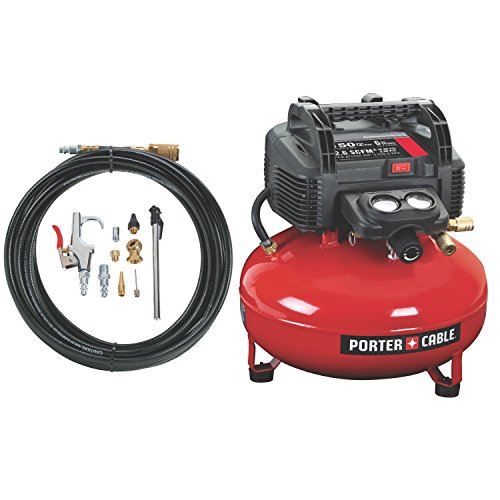
If the compressor has to live indoors or run while other people are nearby, the Makita MAC210Q publishes 60 dBA at 2.0 CFM, and for cleanup specifically the noise trade is worth more than the flow. The Porter-Cable C2002-WK sits in the middle at 2.6 CFM and arrives with a hose and a 13-piece accessory kit, which usually includes the blow gun you actually need.

Prices come live from our price layer in each buy button with the date each was checked.

Turn the pressure down, not up

Blow-down at 90 PSI moves no more dust than blow-down at 40 PSI - it just makes more noise, more mess and drains the tank faster. Set the regulator low and let the volume do the work.

The spec that matters

Why cleanup is a CFM job, not a PSI job

Dust moves because air moves. What pushes a pile of sawdust across a bench is the volume of air arriving per second, not the pressure behind it, and that is why a blow gun with a published 13 SCFM rating empties a six-gallon tank quickly even at a modest regulator setting. Our blow-gun data shows the range: the lightweight guns in our roster publish 13 SCFM and the turbo gun publishes 42 SCFM at 125 PSI.

Those are instantaneous flow figures rather than averages, so the right way to read them is against the compressor's refill rate. A 2.6 CFM machine supplying a 13 SCFM blow gun is running at a deficit the whole time the trigger is held, which is fine in two-second bursts and not fine for sweeping a whole floor. A 4.0 CFM machine simply gives you longer bursts.

This is also why the pressure instinct is backwards. People turn the regulator up when the blowing feels weak, which empties the tank faster and makes the deficit worse. Turn it down to 40 PSI, keep the nozzle close, and work in sweeps - the same tank-full goes much further.

And use a nozzle designed for the job. A bare quarter-inch outlet is a pressure jet; a proper blow-gun nozzle spreads the flow, which is what actually shifts dust rather than drilling a hole through it.

The four, on published figures
CFM at 90 PSITankMax PSIPublished noiseWeight
Metabo HPT EC914S4.06 gal200 PSINot published41 lb
Porter-Cable C2002-WK2.66 gal150 PSINot publishedNot published
Makita MAC210Q2.02 gal135 PSI60 dBA44 lb
Bostitch BTFP020122.66 gal150 PSI78.5 dBANot published

Manufacturer-published figures, attributed in the sources block. For cleanup, read the CFM column first and the tank column second - the tank is the buffer that gives you a long sweep before the pump catches up.

Published air demand at 90 PSI
ToolCFM @ 90 PSIAt loadDutyWhat the number means
Blow gun / dusting gun2.5 - 3-IntermittentIngersoll Rand lists 2.5 CFM, Engineering ToolBox 3. Held open continuously - clearing a sprinkler line, blowing out a filter - a blow gun empties a 6-gallon tank surprisingly fast.

Where two references publish different figures, both are shown rather than averaged into a number nobody published. Primary sources: Ingersoll Rand air consumption chart, Engineering ToolBox air tool consumption, and per-tool manufacturer specifications.

Ranked

The picks

Quick picks

#ProductBest forScorePrice
1
Metabo HPT EC914S (THE TANK) product photo
Metabo HPT EC914S (THE TANK)4 CFM @ 90 / 6 gal / 200 PSI4.0 CFM at 90 PSI and 200 PSI max - the only 6-gallon unit here that breaks the 2.6 CFM ceiling.
Getting real CFM without moving up to a 20-gallon footprint5.1/10★★★☆☆

#ad Disclosure - price as of November 14, 2026

2
Porter-Cable C2002-WK product photo
Porter-Cable C2002-WK2.6 CFM @ 90 / 6 gal / 150 PSIThe default 6-gallon pancake: 2.6 CFM, 150 PSI, the same machine for years, now sold as the C2002-WK with its accessory kit.
A first compressor for nailing, inflation and burst automotive work3.6/10★★☆☆☆

#ad Disclosure - price as of November 14, 2026

3
Makita MAC210Q Quiet Series product photo
Makita MAC210Q Quiet Series2 CFM @ 90 / 2 gal / 135 PSI / 60 dBA2.0 CFM at 60 dBA. The quiet option that can actually feed a framing nailer, not just a brad gun.
Quiet nailing at a real working pace3.8/10★★☆☆☆

#ad Disclosure - price as of November 14, 2026

4
Bostitch BTFP02012 product photo
Bostitch BTFP020122.6 CFM @ 90 / 6 gal / 150 PSI / 78.5 dBA2.6 CFM at 78.5 dBA published - quieter on paper than most of the pancake class at the same output.
A pancake for someone who has to work near neighbors3.2/10★★☆☆☆

#ad Disclosure - we do not publish prices we cannot verify

Scores are computed from manufacturer-published specs by the rubric on our methodology page. Nothing here has been bench-tested. Prices are Amazon's own, refreshed daily, and never shown when we cannot verify them.

Pick 1 - Metabo HPT EC914S

5.1/10★★★☆☆

Metabo HPT EC914S (THE TANK)

Best for: Getting real CFM without moving up to a 20-gallon footprint

Verdict

4.0 CFM at 90 PSI and 200 PSI max - the only 6-gallon unit here that breaks the 2.6 CFM ceiling.

What it does well

  • 4.0 CFM at 90 PSI is 54% more air than the rest of the 6-gallon class
  • 200 PSI max means the same 6 gallons holds far more usable air
  • Clears the published average demand for a 1/2-inch impact and a 3/8-inch ratchet

What it will not do

  • 41 lb, the heaviest 6-gallon unit in the roster
  • Metabo HPT does not publish a noise figure, and high-pressure pumps are not quiet
How this 5.1 was calculated
MetricScoreWeightBasis
Air flow6.240%4 CFM at 90 PSI, on a 0.7-6 CFM scale
Stored air3.225%6 gal x 200 PSI = 1200, on a 125-3,500 scale
Noise5.015%Manufacturer publishes no dBA figure - scored a neutral 5, not a guess
Portability7.010%41 lb, on a 20-90 lb scale
Spec transparency3.310%2 of 6 useful figures published (CFM at 90, CFM at 40, dBA, duty cycle, recovery, weight)
Metabo HPT EC914S (THE TANK) product photo

Product image from the Amazon listing for this model

#ad Disclosure - price as of November 14, 2026

Published specs

Metabo HPT EC914S (THE TANK) published specifications
CFM @ 90 PSI4
CFM @ 40 PSINot published
Tank6 gal
Max pressure200 PSI
NoiseNot published
Duty cycleNot published
RecoveryNot published
PumpOil-free
MotorNot published
Weight41 lb
Power120V

Source: Metabo HPT EC914S THE TANK - product specifications

Pick 2 - Porter-Cable C2002-WK

3.6/10★★☆☆☆

Porter-Cable C2002-WK

Best for: A first compressor for nailing, inflation and burst automotive work

Verdict

The default 6-gallon pancake: 2.6 CFM, 150 PSI, the same machine for years, now sold as the C2002-WK with its accessory kit.

What it does well

  • 2.6 CFM at 90 PSI and 3.7 at 40 - the most common spec in the budget class for a reason
  • 6-gallon tank at 150 PSI stores enough air for real bursts of impact work
  • Two couplers, so two people or two tools without swapping

What it will not do

  • Porter-Cable does not publish a noise figure for it; the class sits in the high 70s to low 80s dBA
  • 2.6 CFM will not run a ratchet, die grinder or sander continuously
How this 3.6 was calculated
MetricScoreWeightBasis
Air flow3.640%2.6 CFM at 90 PSI, on a 0.7-6 CFM scale
Stored air2.325%6 gal x 150 PSI = 900, on a 125-3,500 scale
Noise5.015%Manufacturer publishes no dBA figure - scored a neutral 5, not a guess
Portability5.010%No weight published - scored a neutral 5
Spec transparency3.310%2 of 6 useful figures published (CFM at 90, CFM at 40, dBA, duty cycle, recovery, weight)
Porter-Cable C2002-WK product photo

Product image from the Amazon listing for this model

#ad Disclosure - price as of November 14, 2026

Published specs

Porter-Cable C2002-WK published specifications
CFM @ 90 PSI2.6
CFM @ 40 PSI3.7
Tank6 gal
Max pressure150 PSI
NoiseNot published
Duty cycleNot published
RecoveryNot published
PumpOil-free
Motor0.8
WeightNot published
Power120V

Source: Porter-Cable C2002 - product specifications

Pick 3 - Makita MAC210Q

3.8/10★★☆☆☆

Makita MAC210Q Quiet Series

Best for: Quiet nailing at a real working pace

Verdict

2.0 CFM at 60 dBA. The quiet option that can actually feed a framing nailer, not just a brad gun.

What it does well

  • 2.0 CFM at 90 PSI clears every nailer class on our CFM chart
  • 60 dBA published, against 78-82 dBA for the pancakes at similar output
  • Fills the 2-gallon tank from empty in about 65 seconds

What it will not do

  • 44 lb - heavier than a 6-gallon pancake with more tank
  • 2 gallons of storage means automotive burst work drains it fast
How this 3.8 was calculated
MetricScoreWeightBasis
Air flow2.540%2 CFM at 90 PSI, on a 0.7-6 CFM scale
Stored air0.425%2 gal x 135 PSI = 270, on a 125-3,500 scale
Noise9.315%60 dBA, on a 58-85 dBA scale
Portability6.610%44 lb, on a 20-90 lb scale
Spec transparency6.710%4 of 6 useful figures published (CFM at 90, CFM at 40, dBA, duty cycle, recovery, weight)
Makita MAC210Q Quiet Series product photo

Product image from the Amazon listing for this model

#ad Disclosure - price as of November 14, 2026

Published specs

Makita MAC210Q Quiet Series published specifications
CFM @ 90 PSI2
CFM @ 40 PSINot published
Tank2 gal
Max pressure135 PSI
Noise60 dBA
Duty cycleNot published
Recoveryabout 65 seconds from empty
PumpOil-free
Motor1.0
Weight44 lb
Power120V

Source: Makita MAC210Q - product specifications

Pick 4 - Bostitch BTFP02012

3.2/10★★☆☆☆

Bostitch BTFP02012

Best for: A pancake for someone who has to work near neighbors

Verdict

2.6 CFM at 78.5 dBA published - quieter on paper than most of the pancake class at the same output.

What it does well

  • 78.5 dBA published, against 82 for the Craftsman at the same 2.6 CFM
  • High-efficiency cold-start motor, which matters in an unheated garage
  • 150 PSI, 6 gallons - standard useful storage

What it will not do

  • Still noticeably louder than the 58-70 dBA quiet class
  • 2.6 CFM is a nailing and inflation number, not a continuous-tool number
How this 3.2 was calculated
MetricScoreWeightBasis
Air flow3.640%2.6 CFM at 90 PSI, on a 0.7-6 CFM scale
Stored air2.325%6 gal x 150 PSI = 900, on a 125-3,500 scale
Noise2.415%78.5 dBA, on a 58-85 dBA scale
Portability5.010%No weight published - scored a neutral 5
Spec transparency3.310%2 of 6 useful figures published (CFM at 90, CFM at 40, dBA, duty cycle, recovery, weight)
Bostitch BTFP02012 product photo

Product image from the Amazon listing for this model

#ad Disclosure - we do not publish prices we cannot verify

Published specs

Bostitch BTFP02012 published specifications
CFM @ 90 PSI2.6
CFM @ 40 PSINot published
Tank6 gal
Max pressure150 PSI
Noise78.5 dBA
Duty cycleNot published
RecoveryNot published
PumpOil-free
MotorNot published
WeightNot published
Power120V

Source: Bostitch BTFP02012 pancake compressor - distributor specification listing

The highest-value upgrade

Spend on the blow gun before the compressor

The nozzle is the tool. A pistol-grip gun with an OSHA-compliant safety tip costs very little and does three things a bare hose end cannot: it spreads the flow, it gives you trigger control so you are not blowing continuously, and it limits static pressure at the nozzle if it is pressed against skin. Our accessories page covers the whole shelf under $25.

Reach matters nearly as much. An 11-inch bent nozzle gets behind a radiator, into a blind hole or around a brake assembly without putting your hand there, and extensions turn a bench gun into a floor gun so you are not bending over a slab for twenty minutes.

For heavier work - clearing a lathe bed, a saw table, an engine bay - a high-flow gun is worth having, and the trade is honest: the turbo gun in our roster publishes 42 SCFM at 125 PSI, which will outrun any compressor on this page in continuous use. Buy it for short heavy blasts, not for sweeping.

Keep one caution in mind throughout: never direct compressed air at skin, and wear eye protection. Blow-down throws grit at speed, and it is the one air job where a face full of debris is the normal failure mode rather than an unlucky one.

The part that ruins work

Keeping water and oil out of the air you blow

Blow-down is the job where air quality shows up immediately, because you are usually pointing the air at something you care about: a freshly sanded panel, a brake assembly, a circuit board, a clean bench. A compressor makes water as it runs, and without a filter that water arrives at the nozzle as a spray.

The fix is a filter and regulator between the tank and the hose. A basic unit publishes 10-micron filtration and a gauge, which is enough for shop cleanup; a sub-micronic filter is for spray work rather than blowing. Our filter pages set out the published figures and our water-in-the-lines guide explains why the water appears in the first place.

Drain the tank after every session. Water collects at the bottom of the tank and the drain takes ten seconds; skipping it rusts the tank from the inside and pushes more water into the line. On a machine used mostly for cleanup - which means short runs and lots of cycling - this matters more than on one used for a single long job.

Lastly, mind where the dust goes. Blowing a bench clean fills the air of a closed garage with fine particulate, and the compressor's own intake filter is in that air. Open a door, wear a mask for heavy work, and clean the intake filter on a schedule.

The honest alternative

When a compressor is the wrong cleanup tool

If the job is picking up dust rather than moving it, a shop vacuum is the right tool and a compressor is the wrong one. Blow-down relocates debris; it does not remove it. In a finished space, or anywhere the dust has nowhere good to go, the vacuum wins and nothing on this page changes that.

Where a compressor is unbeatable is anywhere a vacuum nozzle cannot reach: fins, threads, blind holes, brake drums, the inside of a saw, between the boards of a deck. That is the real job description, and it is why the nozzle shape matters more than the machine.

If you want the smallest possible machine for occasional blow-down and nothing else, a one or two-gallon quiet unit is enough for short bursts and far more pleasant indoors - our compact and quiet roundups cover that end. Accept that you will be waiting on the pump for anything longer than a bench.

And if you already own a compressor for tires or nailing, you do not need another one for cleanup. Buy the blow gun, fit a filter, turn the regulator down, and the machine you have is the machine for the job.

FAQ

Questions people actually ask

What size air compressor do I need for blowing dust?

Volume matters more than pressure. A six-gallon machine at 2.6 CFM at 90 PSI handles intermittent blow-down; 4.0 CFM, as published for the Metabo HPT EC914S, gives noticeably longer continuous blowing before the pump has to catch up. Tank size is the buffer that gives you a long sweep.

What PSI should I use to blow dust off?

Around 40 PSI, not 90. Dust moves with air volume rather than pressure, so a higher setting only makes more noise, more mess and empties the tank faster. Turn the regulator down, keep the nozzle close and work in sweeps.

Does the blow gun matter more than the compressor?

For this job, usually yes. A pistol-grip gun with an OSHA-compliant safety tip spreads the flow, gives trigger control and limits static pressure against skin, and it costs a fraction of a compressor. A bare hose end is a pressure jet that drills through a dust pile instead of moving it.

Why does my blow gun spit water?

Because the compressor makes water as it runs and there is no filter in the line. Fit a filter and regulator between the tank and the hose, and drain the tank after every session. On a machine used mainly for cleanup - lots of short cycles - this matters more, not less.

Is a compressor better than a shop vac for cleanup?

They do different jobs. A compressor moves debris out of places a vacuum nozzle cannot reach - fins, threads, blind holes, brake drums - and a vacuum actually removes it. In a finished space the vacuum wins. In a workshop you want both, and the compressor is the one that gets into things.

Sources

Where these numbers come from

Accessed September 2026. If a figure on this page does not match the manufacturer's current sheet, tell us at contact@psiandhose.com and we will correct and date the change - see our editorial policy.

Read next