Skip to content
Psi & Hose

Hub

Air compressors

Twelve ways into the same question: which is the cheapest compressor that genuinely does your job? Ranked by price band, by use, and by tank size.

By Ryder M.Last updated
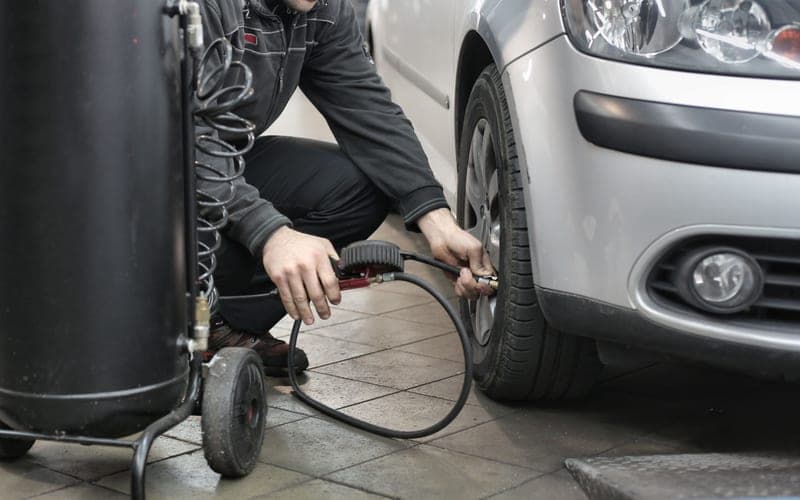
An air compressor standing on a garage floor with hose coiled beside it

Some links on this page are affiliate links. If you buy through one, Magoo Media Group earns a commission from the retailer at no extra cost to you. It never changes which product we rank first - how this site is funded.

Everything in this hub

12 pages

Orientation

How to use this section

There are three sensible ways to shop for a compressor and this hub covers all of them. By budget, if you have a number in mind and want to know what it buys. By use, if you know the job but not the machine. By tank size, if you already know roughly what format you want and need to compare within it.

Whichever route you take, the number that decides everything is CFM at 90 PSI. Tank gallons decide how long you can work before waiting; CFM decides whether the tool works at all. Every page in this section leads with the CFM figure because that is the figure the marketing buries.

If you do not yet know which tools you will run, start with our sizing pillar instead. It takes five minutes and it will save you from the two most expensive mistakes in this category: buying a 1-gallon trim unit and expecting automotive capability, or buying 30 gallons for a job a 6-gallon pancake does completely.

The value curve

What the price bands actually buy

Under $150 gets you a 1 to 2 gallon trim compressor at 0.7 to 2.0 CFM. That is a genuinely complete tool for brad and finish nailing, and a non-starter for anything automotive. It is also the lightest thing here - 20 to 25 pounds carries up a ladder in one hand.

Between $130 and $180 is the 6-gallon pancake class: 2.6 CFM, 150 PSI, oil-free. This is where the value curve peaks for most people. It runs every nailer including framing, all tire inflation, a blow gun, and a 1/2-inch impact wrench for breaking fasteners loose. If you are buying one compressor and are not sure what for, buy this.

Between $200 and $300 you choose one of three things and you cannot have all three. Flow - a 6-gallon 200 PSI design at 4.0 CFM. Quiet - an 8-gallon unit at 60 dBA that actually delivers less flow than a cheaper pancake. Storage - a 20-gallon vertical at 4.0 CFM and 175 PSI, holding roughly four times the air of a pancake.

Past $400 you are buying continuous-duty capability and pump longevity: 5.3 to 5.7 CFM, and in the 30-gallon class an oil-lubricated cast-iron pump on a belt drive rather than a direct-drive oil-free one. That is a different class of machine, not a bigger version of the same one.

Overbuying

The mistake this section is built to prevent

Almost every buying guide in this category sorts by tank size, because tank size is easy to shop for and it makes bigger look better. Gallons are storage, though, and storage is not capability. A 30-gallon tank attached to a 3 CFM pump still cannot run a 5 CFM tool - it just takes longer to disappoint you.

The specific overbuying we see most: a 20 or 30-gallon compressor bought to run a framing nailer, which publishes 2.5 CFM demand and fires in bursts measured in fractions of a second. An entry-level 6-gallon pancake does that job completely, and the several hundred dollars saved buys a genuinely good hose, a filter-regulator and the nailer itself.

The second most common: a 30-gallon unit bought because painting a car is a someday plan. A 30-gallon single-stage at 5.7 CFM does not run the 6-inch DA sander that bodywork requires, which needs 6 to 10 CFM continuously. If painting is real the purchase is a 60-gallon two-stage machine on 240V; if it is hypothetical, buy for the work you do now.

And the one that goes the other way: a 1-gallon trim compressor bought by someone who wants to use an impact wrench. 0.7 CFM will never run an automotive tool, and no amount of patience changes it. Every page in this section states what its picks cannot do, because that is the half of the information the category usually leaves out.
The basis

How our picks are chosen

Every compressor in this section is scored from manufacturer-published specifications by a formula published in full on our methodology page. Air flow at 90 PSI carries 40% of the weight, stored air 25%, noise 15%, portability 10%, and how completely the manufacturer documents the machine 10%.

We have not bench-tested any of them, and nothing here implies we have. Where a manufacturer does not publish a figure - and seven of the sixteen compressors we catalog publish no noise figure at all - we say so and score it neutrally rather than guessing.

We do not publish prices either. There is no live price feed on this site, and a number that might be months stale is worse than no number. Every buy link goes to a current search at the retailer, which is the only price that matters.

FAQ

Air Compressors: common questions

What size air compressor do I need for a home garage?

For nailing, inflation and burst impact work, a 6-gallon pancake at 2.6 CFM. For sustained burst automotive work, a 20-gallon at 4.0 CFM. For continuous tools like ratchets and die grinders, 5 CFM and up. Start from your thirstiest tool's published demand plus 25%.

Is a bigger tank better?

Only for burst tools, where it lets you draw more than the pump makes for longer. For continuous tools the tank is irrelevant after the first minute and pump output is the whole story. Compare gallons multiplied by max PSI, not gallons alone.

Oil-free or oil-lubricated?

Oil-free for burst work - nothing to maintain, and the pump will likely outlast your interest. Oil-lubricated once your use becomes continuous, because the oil bath carries away the heat that kills oil-free pumps. That is the whole decision.

Why do all the cheap compressors have the same CFM?

Because a 120V 10-amp motor driving a single-stage oil-free pump has a physical output ceiling, and the whole budget band sits at it. Five of the six 6-gallon pancakes we list publish exactly 2.6 CFM at 90 PSI.

How loud is an air compressor?

Published figures across our roster run 58 to 83 dBA. Decibels are logarithmic, so that is a large real difference - 60 dBA is conversational and 83 is disruptive through a wall. Seven of sixteen manufacturers publish no figure at all.