Every air tool falls into one of three duty classes, and the class matters more than the CFM number. Burst tools draw air for a second or two: impacts, nailers, staplers. Intermittent tools draw for several seconds with gaps: ratchets, air hammers, grease guns. Continuous tools draw for as long as the trigger is down: die grinders, sanders, cut-off tools, spray guns.
For burst tools, tank storage does most of the work and a modest pump is genuinely adequate. For intermittent tools, the pump has to be in roughly the right range or the tank drains faster than it refills. For continuous tools, the tank is irrelevant after the first thirty seconds and the pump's output is the whole story.
So the shopping rule is: identify the highest duty class on your list first, then the highest CFM within it. A garage with an impact wrench and a brad nailer is a burst garage and is cheap to supply. A garage with a die grinder is a continuous garage and is not.
Published air demand at 90 PSI| Tool | CFM @ 90 PSI | At load | Duty | What the number means |
|---|
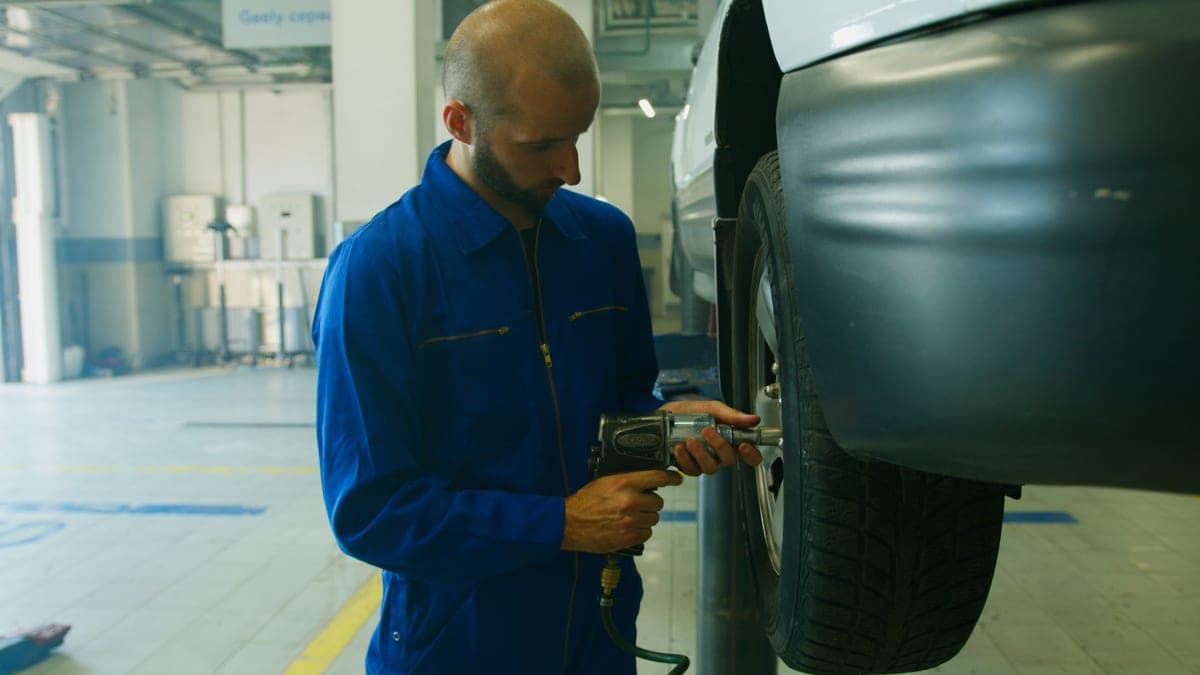
| Impact wrench, 1/2" | 4 - 5 | 22 | Burst | The most misunderstood number on this chart. Ingersoll Rand publishes 4.2 CFM average for the 231C and 22 CFM at load. The average assumes you hold the trigger for a second or two at a time. A 6-gallon pancake at 2.6 CFM does break lug nuts; it simply cannot keep the trigger down. |
|---|
| Air ratchet, 3/8" | 3 - 4 | - | Intermittent | Ingersoll Rand publishes 3 CFM average at 90 PSI for the 105-D3; Engineering ToolBox lists 4 CFM for the class. A ratchet is the sneaky one: you hold the trigger far longer than with an impact, so it punishes a small tank harder despite the lower headline number. |
|---|
| Air hammer / chisel | 4 | - | Intermittent | Used in bursts on exhaust bolts and ball joints, a 20-gallon tank copes. Used continuously on a seized assembly, it will outrun anything under about 5 CFM. |
|---|
| Die grinder, 1/4" | 5 - 6 | - | Continuous | Ingersoll Rand lists 5 CFM; Engineering ToolBox gives a 4-6 CFM band. Continuous duty, so a 6-gallon pancake gives you a handful of seconds before pressure drops and the tool slows. |
|---|
| Cut-off tool, 3 inch | 4 - 10 | - | Continuous | Engineering ToolBox publishes a wide 4-10 CFM band because cut-off tools vary enormously. Whichever end yours sits at, it runs continuously, so size for the top of the band. |
|---|
| Orbital / DA sander, 6 inch | 10 - 9 | - | Continuous | Ingersoll Rand lists 10 CFM for a body orbital sander; Engineering ToolBox gives 6-9 CFM for the class. A sander runs continuously by nature, so there is no burst allowance to hide behind. This is the job that genuinely needs a big compressor. |
|---|
| Paint spray gun, touch-up | 4 | - | Continuous | Ingersoll Rand lists 4 CFM for touch-up spraying. Continuous while the trigger is down, and the air also has to be clean and dry - see our air-prep pages. |
|---|
Where two references publish different figures, both are shown rather than averaged into a number nobody published. Primary sources: Ingersoll Rand air consumption chart, Engineering ToolBox air tool consumption, and per-tool manufacturer specifications.