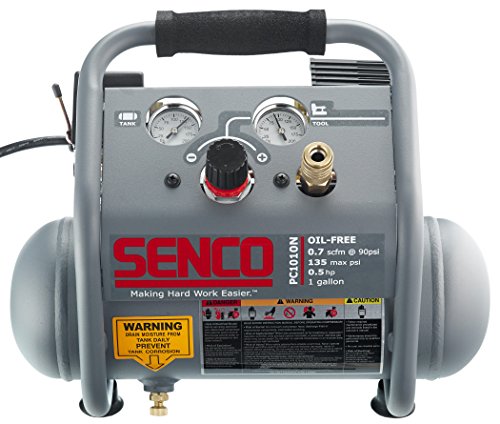
Start from the tools, because the tools are modest. A Bostitch BTFP12233 18-gauge brad nailer publishes 1.15 CFM of free air at 80 PSI at 60 fasteners a minute, and 0.58 CFM at 30 a minute. A WEN 61721 publishes 0.028 CFM per nail at 88 PSI. A Makita AF506 publishes a minimum recommended air delivery of 1.5 SCFM at 90 PSI - the highest ask of the group, and still inside what a 2-gallon machine makes.
Now apply the duty factor honestly. Nobody fires 60 brads a minute through a room of base and casing. You cut, you test-fit, you shim, you fire two or three nails, you move. Real-world average demand on a trim job sits in the fractions of a CFM, which is why a 0.7 CFM machine with a 1-gallon tank is not the compromise it looks like on paper.
The exception is a 15-gauge finish nailer driving long fasteners into hardwood jambs, or two people on two guns. A 15-gauge gun moves more air per shot than an 18-gauge brad gun, and two operators double the duty factor rather than averaging it. That is the case for the MAC210Q at 2.0 CFM or the DEWALT at 2.6, and it is the only case on this page where output rather than noise drives the decision.
What none of this needs is a big tank. A 6-gallon pancake holds more air, but for a burst tool with sub-1 CFM average demand the tank is solving a problem you do not have - and you pay for it in weight, in noise and in the fact that it does not fit behind the seat of a truck.
Published air demand at 90 PSI| Tool | CFM @ 90 PSI | At load | Duty | What the number means |
|---|
| Brad nailer, 18 gauge | 0.5 | - | Burst | The most forgiving air tool there is. A nailer draws air only at the instant it fires, so almost any tank covers it. That is why a 1-gallon compressor is a genuinely complete tool for trim work rather than a compromise. |
|---|
| Finish nailer, 15 gauge | 1.8 | - | Burst | Bostitch publishes 1.8 CFM of free air at 80 PSI for its BTFP72155 - the same tool now sold as the BTFP72156 kit - running 60 fasteners a minute - a fast, sustained trim pace, not casual use. At a realistic pace the draw is a fraction of that. |
|---|
| Upholstery / crown stapler | 2 | - | Burst | Engineering ToolBox lists 2 CFM for an upholstery stapler, measured at 30 PSI. Low pressure means low demand, and a small tank keeps up easily. |
|---|
| Framing nailer, 21 or 30 degree | 2.5 | - | Burst | Engineering ToolBox lists 2.5 CFM for a framing nailer on a 25% load factor. Metabo HPT publishes 0.09 SCFM at 100 PSI for the NR90AES1 on a per-cycle basis. The two describe the same tool at different firing rates, which is exactly why one CFM number for a nailer is misleading: nail pace sets the demand, not the badge on the tool. |
|---|
| Blow gun / dusting gun | 2.5 - 3 | - | Intermittent | Ingersoll Rand lists 2.5 CFM, Engineering ToolBox 3. Held open continuously - clearing a sprinkler line, blowing out a filter - a blow gun empties a 6-gallon tank surprisingly fast. |
|---|
Where two references publish different figures, both are shown rather than averaged into a number nobody published. Primary sources: Ingersoll Rand air consumption chart, Engineering ToolBox air tool consumption, and per-tool manufacturer specifications.