Skip to content
Psi & Hose

By Job

Best air compressor for off-road tires

Airing down takes seconds. Airing four 33-inch tires back up from 15 PSI is twenty minutes of continuous running, and that is the spec that decides this purchase.

By Ryder M.Last updated Published
A pressure gauge and air chuck held against a vehicle tire valve

Some links on this page are affiliate links. If you buy through one, Magoo Media Group earns a commission from the retailer at no extra cost to you. It never changes which product we rank first - how this site is funded.

Read this first

The short answer

If you need to air up at the trailhead, the VIAIR 88P is the pick, and the number that decides it is not CFM - it is the published 25-minute duty at 30 PSI. That is the only figure on this page that tells you whether the unit survives the actual job, because the actual job is twenty minutes of continuous running with no wall outlet in sight. VIAIR publishes 120 PSI max working pressure, about 1.25 CFM at 30 PSI, 20 A maximum draw and 4.75 lb.

If you air down in your driveway and air up in your driveway - which is how a lot of people actually use a trail rig - then buy a garage compressor instead and skip the 12V class entirely. A 20-gallon unit publishing 4.0 CFM at 90 PSI and 175 PSI max fills four tires in a fraction of the time, costs about the same, and does everything else a compressor does. The 12V premium only buys you independence from the wall.

What nobody should buy for this job is a 12V unit without a published duty cycle. Airing up is the single most duty-cycle-hostile thing you can ask of a small compressor: four tires, each going from maybe 15 PSI to 35, back to back, in summer heat, with the pump bolted to a plastic body that has nowhere to dump heat. A unit that does not state its duty either has a bad one or has not been measured, and both are the same problem on the trail.

The four, on the specs the job constrains
PowerMax PSIPublished duty / outputWeight
VIAIR 88P12V DC, 20 A max12025 min at 30 PSI; ~1.25 CFM at 30 PSI4.75 lb
Husky C201H120V, 20 gal1754.0 CFM at 90 PSI; 5.2 at 40 PSINot published
Craftsman 20-gallon120V, 20 gal1754.0 CFM at 90 PSI; 5.0 at 40 PSINot published
Porter-Cable C2002120V, 6 gal1502.6 CFM at 90 PSI; 3.7 at 40 PSINot published

All figures are manufacturer-published; the sources block links each. The 12V unit and the 120V units are not measured the same way - VIAIR rates free flow and a timed duty, the 120V makers rate delivered CFM at pressure - so the columns are not directly comparable, which is itself the point of this page.

The spec that matters, and the one that does not

Tire inflation happens at 15 to 40 PSI, not 90 PSI. That makes the 40 PSI column the honest one for this job, and it is why the Husky's 5.2 CFM at 40 PSI matters more than its 4.0 at 90. It also means max PSI is close to irrelevant here: a 120 PSI ceiling is enormous headroom for a 35 PSI tire.

The picks

The four, ranked

Quick picks

#ProductBest forScorePrice
1
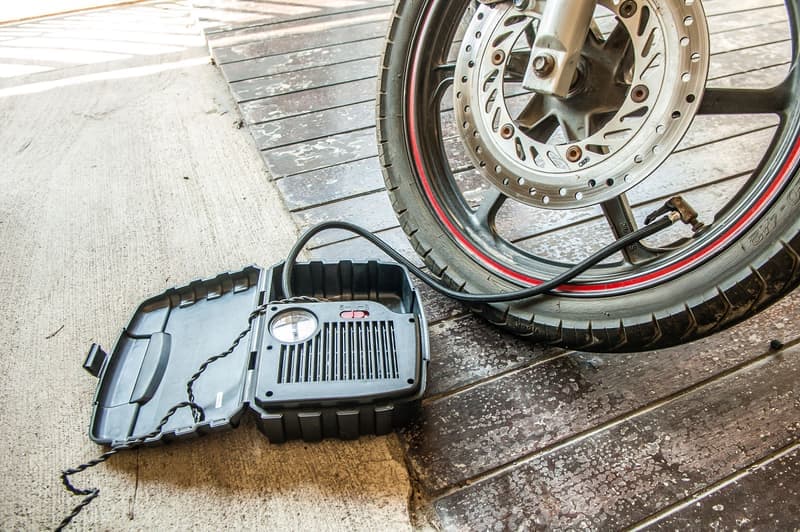
A portable 12-volt air compressor with a coiled hose beside a tire
VIAIR 88PCFM not published / no tank / 120 PSIA 12V tire inflator, not a compressor. 120 PSI max with a 25-minute duty at 30 PSI. Buy it for the car, not the garage.
Topping up and re-airing tires away from a wall outlet2.1/10★☆☆☆☆

#ad Disclosure - we do not publish prices we cannot verify

2
A twenty-gallon vertical air compressor standing against a garage wall
Husky C201H 20-gallon4 CFM @ 90 / 20 gal / 175 PSI / 83 dBA4.0 CFM with 20 gallons at 175 PSI. The cheapest way to buy STORAGE rather than flow.
Burst automotive work where tank volume, not CFM, is the limit6.3/10★★★☆☆

#ad Disclosure - we do not publish prices we cannot verify

3
A red vertical twenty-gallon air compressor with a wheeled base
Craftsman CMXECXA0232043 20-gallon4 CFM @ 90 / 20 gal / 175 PSIThe same 4.0 CFM / 175 PSI / 20-gallon formula as the Husky, from a 1.8 HP oil-free pump.
A second 20-gallon option when the first is out of stock6.6/10★★★☆☆

#ad Disclosure - we do not publish prices we cannot verify

4
A red six-gallon pancake air compressor on a garage floor
Porter-Cable C20022.6 CFM @ 90 / 6 gal / 150 PSIThe default answer to 'cheapest useful compressor'. 6 gallons, 2.6 CFM, 150 PSI, and it has been the same machine for years.
A first compressor for nailing, inflation and burst automotive work3.6/10★★☆☆☆

#ad Disclosure - we do not publish prices we cannot verify

Scores are computed from manufacturer-published specs by the rubric on our methodology page. Nothing here has been bench-tested, and we do not publish prices we cannot verify.

Pick 1 - VIAIR 88P

2.1/10★☆☆☆☆

VIAIR 88P

Best for: Topping up and re-airing tires away from a wall outlet

Verdict

A 12V tire inflator, not a compressor. 120 PSI max with a 25-minute duty at 30 PSI. Buy it for the car, not the garage.

What it does well

  • 120 PSI max working pressure covers car, truck and trailer tires
  • 1.47 CFM free flow at 0 PSI; about 1.25 CFM at 30 PSI - the pressure tires actually live at
  • 4.75 lb with a 10 ft power cord and 16 ft air hose

What it will not do

  • No tank, so it cannot run any air tool at all - not one
  • 20 A draw and a published 25-minute duty at 30 PSI: four tires, then let it cool
How this 2.1 was calculated
MetricScoreWeightBasis
Air flow0.040%No CFM at 90 PSI published - scored zero rather than guessed
Stored air0.025%0 gal x 120 PSI = 0, on a 125-3,500 scale
Noise5.015%Manufacturer publishes no dBA figure - scored a neutral 5, not a guess
Portability10.010%4.75 lb, on a 20-90 lb scale
Spec transparency3.310%2 of 6 useful figures published (CFM at 90, CFM at 40, dBA, duty cycle, recovery, weight)
A portable 12-volt air compressor with a coiled hose beside a tire

Licensed stock photo - illustrative of the category, not a photo of this unit

#ad Disclosure - we do not publish prices we cannot verify

Published specs

VIAIR 88P published specifications
CFM @ 90 PSINot published
CFM @ 40 PSINot published
TankNone (direct drive)
Max pressure120 PSI
NoiseNot published
Duty cycle25 min at 30 PSI (manufacturer-published)
RecoveryNot published
PumpOil-free
Motor12V DC, 20 A max draw
Weight4.75 lb
Power12V DC

Source: VIAIR 88P portable compressor - product specifications

Pick 2 - Husky C201H

6.3/10★★★☆☆

Husky C201H 20-gallon

Best for: Burst automotive work where tank volume, not CFM, is the limit

Verdict

4.0 CFM with 20 gallons at 175 PSI. The cheapest way to buy STORAGE rather than flow.

What it does well

  • 20 gallons at 175 PSI is roughly six times the stored air of a 6-gallon 150 PSI pancake
  • 4.0 CFM at 90 PSI and 5.2 at 40 - enough to recover between bursts instead of chasing you
  • Vertical footprint takes a corner instead of floor space

What it will not do

  • 83 dBA published and a 7-minute fill from empty - plan to switch it on before you start
  • Oil-free at 20 gallons means a shorter pump life than a cast-iron oil-lubricated unit
How this 6.3 was calculated
MetricScoreWeightBasis
Air flow6.240%4 CFM at 90 PSI, on a 0.7-6 CFM scale
Stored air10.025%20 gal x 175 PSI = 3500, on a 125-3,500 scale
Noise0.715%83 dBA, on a 58-85 dBA scale
Portability5.010%No weight published - scored a neutral 5
Spec transparency6.710%4 of 6 useful figures published (CFM at 90, CFM at 40, dBA, duty cycle, recovery, weight)
A twenty-gallon vertical air compressor standing against a garage wall

Licensed stock photo - illustrative of the category, not a photo of this unit

#ad Disclosure - we do not publish prices we cannot verify

Published specs

Husky C201H 20-gallon published specifications
CFM @ 90 PSI4
CFM @ 40 PSI5.2
Tank20 gal
Max pressure175 PSI
Noise83 dBA
Duty cycleNot published
Recoveryabout 7 minutes to fill from empty
PumpOil-free
Motor1.3 running
WeightNot published
Power120V

Source: Husky C201H 20-gallon compressor - retailer specification listing

Pick 3 - Craftsman CMXECXA0232043

6.6/10★★★☆☆

Craftsman CMXECXA0232043 20-gallon

Best for: A second 20-gallon option when the first is out of stock

Verdict

The same 4.0 CFM / 175 PSI / 20-gallon formula as the Husky, from a 1.8 HP oil-free pump.

What it does well

  • 4.0 CFM at 90 PSI, 5.0 at 40, 175 PSI max
  • 1.8 HP oil-free pump - nothing to drain but the tank
  • Two quick couplers

What it will not do

  • Craftsman does not publish a noise figure for it
  • At 4.0 CFM it still will not run a DA sander, whatever the tank says
How this 6.6 was calculated
MetricScoreWeightBasis
Air flow6.240%4 CFM at 90 PSI, on a 0.7-6 CFM scale
Stored air10.025%20 gal x 175 PSI = 3500, on a 125-3,500 scale
Noise5.015%Manufacturer publishes no dBA figure - scored a neutral 5, not a guess
Portability5.010%No weight published - scored a neutral 5
Spec transparency3.310%2 of 6 useful figures published (CFM at 90, CFM at 40, dBA, duty cycle, recovery, weight)
A red vertical twenty-gallon air compressor with a wheeled base

Licensed stock photo - illustrative of the category, not a photo of this unit

#ad Disclosure - we do not publish prices we cannot verify

Published specs

Craftsman CMXECXA0232043 20-gallon published specifications
CFM @ 90 PSI4
CFM @ 40 PSI5
Tank20 gal
Max pressure175 PSI
NoiseNot published
Duty cycleNot published
RecoveryNot published
PumpOil-free
Motor1.8
WeightNot published
Power120V

Source: Craftsman CMXECXA0232043 20-gallon compressor - retailer specification listing

Pick 4 - Porter-Cable C2002

3.6/10★★☆☆☆

Porter-Cable C2002

Best for: A first compressor for nailing, inflation and burst automotive work

Verdict

The default answer to 'cheapest useful compressor'. 6 gallons, 2.6 CFM, 150 PSI, and it has been the same machine for years.

What it does well

  • 2.6 CFM at 90 PSI and 3.7 at 40 - the most common spec in the budget class for a reason
  • 6-gallon tank at 150 PSI stores enough air for real bursts of impact work
  • Two couplers, so two people or two tools without swapping

What it will not do

  • Porter-Cable does not publish a noise figure for it; the class sits in the high 70s to low 80s dBA
  • 2.6 CFM will not run a ratchet, die grinder or sander continuously
How this 3.6 was calculated
MetricScoreWeightBasis
Air flow3.640%2.6 CFM at 90 PSI, on a 0.7-6 CFM scale
Stored air2.325%6 gal x 150 PSI = 900, on a 125-3,500 scale
Noise5.015%Manufacturer publishes no dBA figure - scored a neutral 5, not a guess
Portability5.010%No weight published - scored a neutral 5
Spec transparency3.310%2 of 6 useful figures published (CFM at 90, CFM at 40, dBA, duty cycle, recovery, weight)
A red six-gallon pancake air compressor on a garage floor

Licensed stock photo - illustrative of the category, not a photo of this unit

#ad Disclosure - we do not publish prices we cannot verify

Published specs

Porter-Cable C2002 published specifications
CFM @ 90 PSI2.6
CFM @ 40 PSI3.7
Tank6 gal
Max pressure150 PSI
NoiseNot published
Duty cycleNot published
RecoveryNot published
PumpOil-free
Motor0.8
WeightNot published
Power120V

Source: Porter-Cable C2002 - product specifications

The arithmetic

Work out your actual air-up volume first

The job is bigger than people expect, and the arithmetic is worth doing before you shop. A 33-inch all-terrain tire holds roughly 4 to 5 cubic feet of air at atmospheric volume, and taking it from 15 PSI to 35 PSI means pushing in roughly another 20 PSI worth - in the region of 6 to 7 cubic feet of free air per tire once you account for the pressure ratio. Four tires is therefore somewhere around 25 to 30 cubic feet of free air, delivered at low pressure.

At about 1.25 CFM, which is what VIAIR publishes for the 88P at 30 PSI, 25 to 30 cubic feet takes roughly twenty to twenty-five minutes of pump running time. That lines up almost exactly with the published 25-minute duty, which tells you two useful things: the unit is honestly rated for one full air-up, and it has no margin beyond that. Plan on a cool-down before you do anything else with it.

Run the same volume against a 20-gallon garage compressor publishing 5.2 CFM at 40 PSI and the job takes about five to six minutes of pump time, spread across a tank that absorbs the first chunk instantly. That is the real gap between the two classes, and it is a factor of four. If the air-up happens where there is a wall outlet, the garage compressor wins on every axis except portability.

Published air demand at 90 PSI
ToolCFM @ 90 PSIAt loadDutyWhat the number means
Tire inflation2-IntermittentBoth references agree on 2 CFM. Note the working pressure: you are filling to 35 PSI, not 90, so almost every compressor delivers more than it needs to. Tires are why so many people overbuy - the job is easy and the marketing is not.
Blow gun / dusting gun2.5 - 3-IntermittentIngersoll Rand lists 2.5 CFM, Engineering ToolBox 3. Held open continuously - clearing a sprinkler line, blowing out a filter - a blow gun empties a 6-gallon tank surprisingly fast.
Impact wrench, 1/2"4 - 522BurstThe most misunderstood number on this chart. Ingersoll Rand publishes 4.2 CFM average for the 231C and 22 CFM at load. The average assumes you hold the trigger for a second or two at a time. A 6-gallon pancake at 2.6 CFM does break lug nuts; it simply cannot keep the trigger down.

Where two references publish different figures, both are shown rather than averaged into a number nobody published. Primary sources: Ingersoll Rand air consumption chart, Engineering ToolBox air tool consumption, and per-tool manufacturer specifications.

The 12V problem

Amp draw is the constraint nobody checks

VIAIR publishes a 20 A maximum draw for the 88P, and that figure decides how you can connect it. A cigarette-lighter socket in most vehicles is fused at 10 or 15 A, which is below 20 A, which is why the 88P ships with battery clamps and a 10-foot power cord rather than a lighter plug. If you have been running a 12V inflator off the dash socket and wondering why it keeps blowing the fuse, this is the entire explanation.

Connecting to the battery directly has a second consequence that matters on the trail: twenty-odd minutes at 20 A with the engine off is a real draw on a starting battery. It is not usually enough to leave you stranded on a healthy battery, but it is enough to be careless with on a weak one or at the end of a long day with the fridge running. The standard practice is to air up with the engine idling, which keeps the alternator ahead of the pump.

This is also the reason onboard air systems exist, and we are not going to pretend a portable inflator is the same product. A hard-mounted system with its own tank gives you faster air-up and a supply for air lockers and a blow gun. It is also a weekend of installation, a wiring job and considerably more money, and it is outside what this site covers. If a portable unit will do, buy a portable unit; if you have decided it will not, you are shopping for a different category than anything on this page.

The honest limit

What the 12V unit cannot do, stated plainly

The VIAIR 88P has no tank. That is not a minor spec difference, it is a categorical one: with no stored volume there is no way to deliver a burst, which means it cannot run any air tool at all. Not an impact wrench, not a ratchet, not a brad nailer, not a blow gun in any useful way. It is a pump that pushes air directly into whatever you connect it to, and tires are the only thing on that list.

People get caught by this because the marketing word 'compressor' covers both categories. The useful distinction is tank versus no tank. Anything with a tank can do burst work, because the tank is the burst. Anything without a tank can only do continuous low-pressure work, and tire inflation is the main job in that shape. A bead seater, incidentally, is firmly in the burst category and a tankless inflator will not do it.

If you want one machine that airs up tires on the trail and runs tools in the garage, that machine does not exist in this price range and we are not going to invent it. The honest answer for someone who wants both is two purchases: a 12V inflator that lives in the vehicle, and a garage compressor that lives in the garage. They cost less together than one unit that tries to do both badly, and each one is actually good at its job.

VIAIR 88P: what it runs

Delivered flow: not published. We call a tool covered when delivered flow clears its highest published demand plus a 25% margin.

Runs it (0)

  • Nothing on this list clears the bar.

Does not run it (5)

  • Tire inflationCannot say - needs 2 CFM, intermittent duty
  • Blow gun / dusting gunCannot say - needs 3 CFM, intermittent duty
  • Impact wrench, 1/2"Cannot say - needs 5 CFM, burst duty
  • Air ratchet, 3/8"Cannot say - needs 4 CFM, intermittent duty
  • Brad nailer, 18 gaugeCannot say - needs 0.5 CFM, burst duty

Demand figures from the air tool CFM chart, which cites every one of them.

The decision

Which to buy

Buy the VIAIR 88P if you genuinely air down away from home and need to air up before driving back on pavement. That is the job it is built for, it is the only unit on this page that can do it, and the published 25-minute duty at 30 PSI matches one full four-tire air-up with no exaggeration. Keep it in the vehicle, air up with the engine running, and let it cool before asking it for anything more.

Buy a 20-gallon garage compressor - the Husky C201H or the Craftsman - if your trail days start and end in the driveway. Both publish 4.0 CFM at 90 PSI and over 5 CFM at 40 PSI, which is where tire work happens, both reach 175 PSI, and both also run an impact wrench for the tire rotations and suspension work that come with running a rig. On a cost-per-job basis they are the better buy by a wide margin.

Buy the Porter-Cable C2002 if you want one modest machine that covers driveway air-up plus general garage work and will also go in the back of the truck when needed. At 2.6 CFM at 90 PSI and 3.7 at 40 PSI it is slower than the 20-gallon pair on air-up and far faster than the 12V unit, and it is the cheapest route to a compressor that can also run a nailer. It is the compromise pick, and for a lot of people the compromise is the right call.

FAQ

Questions people actually ask

What size air compressor do I need for off-road tires?

For trailhead air-up, a 12V unit with a published duty cycle long enough for four tires - the VIAIR 88P states 25 minutes at 30 PSI, which matches one full air-up. For driveway air-up, a 20-gallon 120V compressor delivering over 5 CFM at 40 PSI does the same job in about a quarter of the time.

How long does it take to air up four 33-inch tires?

Roughly 25 to 30 cubic feet of free air in total from 15 PSI to 35 PSI. At the 88P's published ~1.25 CFM at 30 PSI that is about twenty to twenty-five minutes of running. A 20-gallon compressor at 5.2 CFM at 40 PSI does it in about five to six minutes of pump time.

Can I run a 12V air compressor from the cigarette lighter?

Not the 88P. VIAIR publishes a 20 A maximum draw, and most dash sockets are fused at 10 or 15 A. That is why it ships with battery clamps and a 10-foot cord. Air up with the engine idling so the alternator stays ahead of the pump.

Can a 12V tire inflator run air tools?

No. The 88P has no tank, and with no stored volume there is no way to deliver the burst an air tool needs - not an impact wrench, not a ratchet, not a nailer. Tankless units do continuous low-pressure work only, and tire inflation is essentially the whole list.

Is duty cycle more important than CFM for airing up tires?

Yes, for a portable unit. Air-up is continuous low-pressure running for twenty minutes or more, so the limit you hit is thermal, not volumetric. A unit with no published duty cycle either has a poor one or has not been measured, and on the trail those amount to the same thing.

Sources

Where these numbers come from

Accessed September 2026. If a figure on this page does not match the manufacturer's current sheet, tell us at contact@psiandhose.com and we will correct and date the change - see our editorial policy.

Read next