Skip to content
Psi & Hose

Guides

Best air compressor for bike tires

Bike tires are the one inflation job where pressure, not volume, is genuinely hard. A road tire at 110 PSI asks for more pressure than many portable inflators can reach, and a garage compressor asks you to be careful in a way a floor pump never does.

By Ryder M.Last updated Published
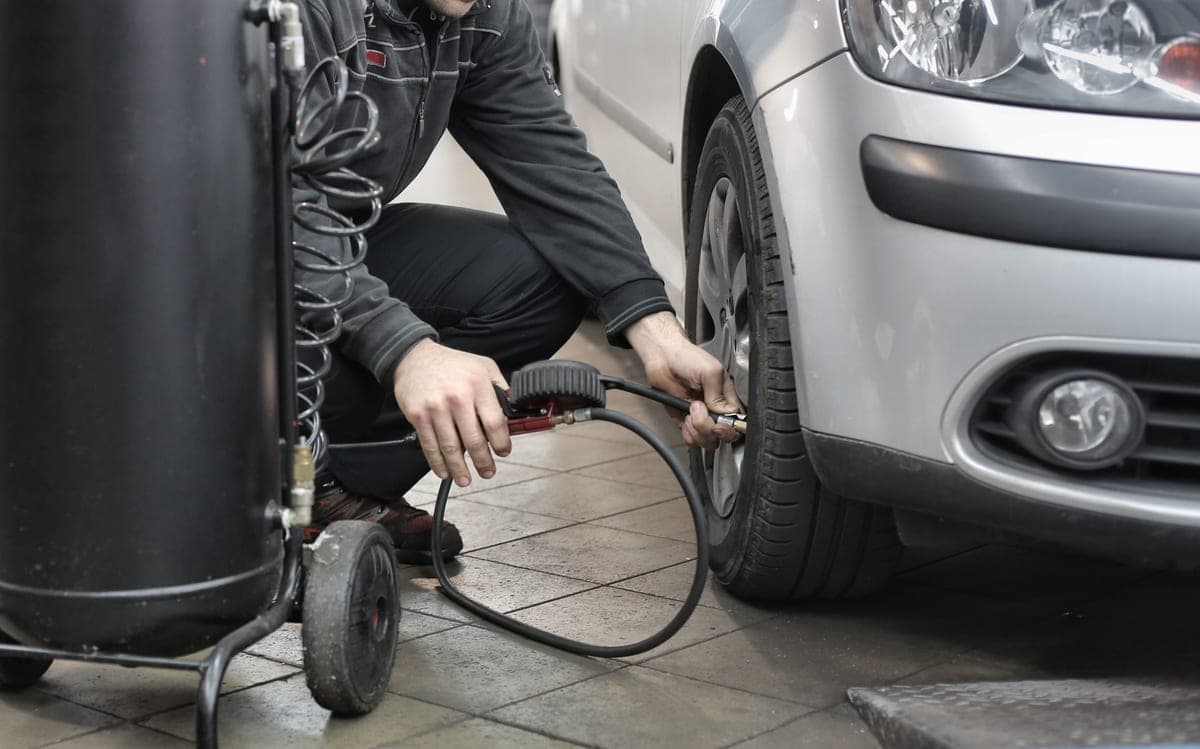
A tire being inflated with an air chuck

Some links on this page are affiliate links. If you buy through one, Magoo Media Group earns a commission from the retailer at no extra cost to you. It never changes which product we rank first - how this site is funded.

Read this first

The short answer

For bikes and cars from the same machine, a 6-gallon 150 PSI pancake is the right answer - the Porter-Cable C2002 publishes 150 PSI maximum and 2.6 CFM at 90 PSI, which gives real headroom over a 110 PSI road tire and does everything else in the garage too. For bikes only, almost any compressor is enormously overqualified on volume and the only question is whether it reaches the pressure.

That is the part that catches people. Road tires commonly run 80 to 130 PSI and some narrow high-pressure tires go higher - always use the range printed on your own tire's sidewall. A 12V inflator publishing 120 PSI maximum, like the VIAIR 88P, is working at the very top of its range on a road tire and will be slow and hot doing it. It is excellent for car and truck tires and marginal for road bikes.

Mountain and gravel tires are a different story entirely: 20 to 40 PSI, sometimes lower, and every machine on this page reaches that trivially. For those, the challenge is accuracy at low pressure rather than reaching high pressure, and a garage compressor is genuinely worse at it than a floor pump with a good gauge.

The warning that matters

A 150 PSI tank connected directly to a bicycle tube will burst it in well under a second. There is no reaction time. Always set the regulator below the tire's maximum pressure before you connect anything, inflate in short bursts, and check with a separate gauge. This is the one inflation job where the compressor is genuinely capable of destroying what you are inflating.

Three things, in order

What to look for

  1. 01Pressure ceiling above your tire's maximum, with margin. A compressor's delivery rate collapses as tank pressure closes on the pressure you want, so a 120 PSI machine filling a 110 PSI tire crawls at the end. 150 PSI and up means the fill stays brisk the whole way.
  2. 02A regulator you can actually set low and read. This is the safety-critical component for bike work. A combined filter-regulator with a 0-150 PSI gauge gives you a number to set against rather than a guess, and it takes the water out at the same time.
  3. 03A valve solution. Most bikes use Presta valves, most compressors terminate in a Schrader chuck, and the adapter is a two-dollar part that you will lose. Buy two. Schrader-valve bikes - most mountain bikes and most department-store bikes - connect directly.

The picks

Machines that cover both bikes and cars

Quick picks

#ProductBest forScorePrice
1
A red six-gallon pancake air compressor on a garage floor
Porter-Cable C20022.6 CFM @ 90 / 6 gal / 150 PSIThe default answer to 'cheapest useful compressor'. 6 gallons, 2.6 CFM, 150 PSI, and it has been the same machine for years.
A first compressor for nailing, inflation and burst automotive work3.6/10★★☆☆☆

#ad Disclosure - we do not publish prices we cannot verify

2
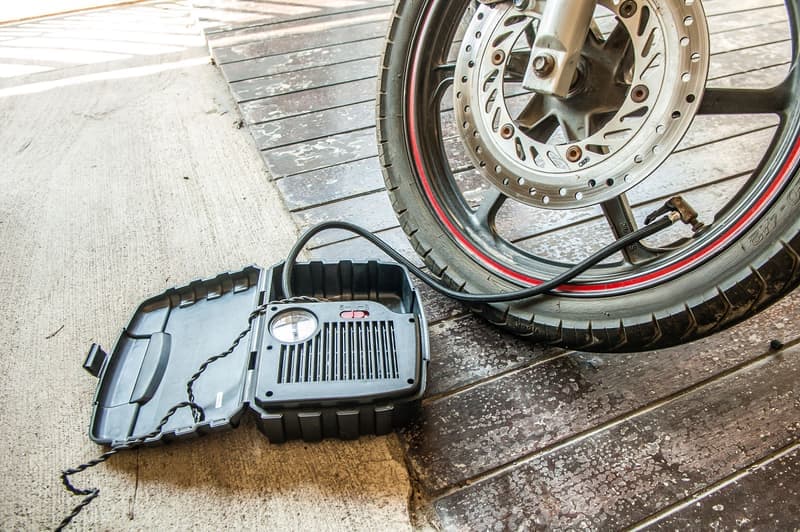
A portable 12-volt air compressor with a coiled hose beside a tire
VIAIR 88PCFM not published / no tank / 120 PSIA 12V tire inflator, not a compressor. 120 PSI max with a 25-minute duty at 30 PSI. Buy it for the car, not the garage.
Topping up and re-airing tires away from a wall outlet2.1/10★☆☆☆☆

#ad Disclosure - we do not publish prices we cannot verify

3
A compact quiet-series air compressor beside coiled air hose
Makita MAC100Q Quiet Series0.7 CFM @ 90 / 1 gal / 135 PSI / 58 dBA58 dBA published - the quietest unit in this roster. Same 0.7 CFM as the Senco, with a roll cage and a higher ceiling.
Indoor finish work where noise decides the purchase3.1/10★★☆☆☆

#ad Disclosure - we do not publish prices we cannot verify

Scores are computed from manufacturer-published specs by the rubric on our methodology page. Nothing here has been bench-tested, and we do not publish prices we cannot verify.

Pick 1 - Porter-Cable C2002

3.6/10★★☆☆☆

Porter-Cable C2002

Best for: A first compressor for nailing, inflation and burst automotive work

Verdict

The default answer to 'cheapest useful compressor'. 6 gallons, 2.6 CFM, 150 PSI, and it has been the same machine for years.

What it does well

  • 2.6 CFM at 90 PSI and 3.7 at 40 - the most common spec in the budget class for a reason
  • 6-gallon tank at 150 PSI stores enough air for real bursts of impact work
  • Two couplers, so two people or two tools without swapping

What it will not do

  • Porter-Cable does not publish a noise figure for it; the class sits in the high 70s to low 80s dBA
  • 2.6 CFM will not run a ratchet, die grinder or sander continuously
How this 3.6 was calculated
MetricScoreWeightBasis
Air flow3.640%2.6 CFM at 90 PSI, on a 0.7-6 CFM scale
Stored air2.325%6 gal x 150 PSI = 900, on a 125-3,500 scale
Noise5.015%Manufacturer publishes no dBA figure - scored a neutral 5, not a guess
Portability5.010%No weight published - scored a neutral 5
Spec transparency3.310%2 of 6 useful figures published (CFM at 90, CFM at 40, dBA, duty cycle, recovery, weight)
A red six-gallon pancake air compressor on a garage floor

Licensed stock photo - illustrative of the category, not a photo of this unit

#ad Disclosure - we do not publish prices we cannot verify

Published specs

Porter-Cable C2002 published specifications
CFM @ 90 PSI2.6
CFM @ 40 PSI3.7
Tank6 gal
Max pressure150 PSI
NoiseNot published
Duty cycleNot published
RecoveryNot published
PumpOil-free
Motor0.8
WeightNot published
Power120V

Source: Porter-Cable C2002 - product specifications

Pick 2 - VIAIR 88P

2.1/10★☆☆☆☆

VIAIR 88P

Best for: Topping up and re-airing tires away from a wall outlet

Verdict

A 12V tire inflator, not a compressor. 120 PSI max with a 25-minute duty at 30 PSI. Buy it for the car, not the garage.

What it does well

  • 120 PSI max working pressure covers car, truck and trailer tires
  • 1.47 CFM free flow at 0 PSI; about 1.25 CFM at 30 PSI - the pressure tires actually live at
  • 4.75 lb with a 10 ft power cord and 16 ft air hose

What it will not do

  • No tank, so it cannot run any air tool at all - not one
  • 20 A draw and a published 25-minute duty at 30 PSI: four tires, then let it cool
How this 2.1 was calculated
MetricScoreWeightBasis
Air flow0.040%No CFM at 90 PSI published - scored zero rather than guessed
Stored air0.025%0 gal x 120 PSI = 0, on a 125-3,500 scale
Noise5.015%Manufacturer publishes no dBA figure - scored a neutral 5, not a guess
Portability10.010%4.75 lb, on a 20-90 lb scale
Spec transparency3.310%2 of 6 useful figures published (CFM at 90, CFM at 40, dBA, duty cycle, recovery, weight)
A portable 12-volt air compressor with a coiled hose beside a tire

Licensed stock photo - illustrative of the category, not a photo of this unit

#ad Disclosure - we do not publish prices we cannot verify

Published specs

VIAIR 88P published specifications
CFM @ 90 PSINot published
CFM @ 40 PSINot published
TankNone (direct drive)
Max pressure120 PSI
NoiseNot published
Duty cycle25 min at 30 PSI (manufacturer-published)
RecoveryNot published
PumpOil-free
Motor12V DC, 20 A max draw
Weight4.75 lb
Power12V DC

Source: VIAIR 88P portable compressor - product specifications

Pick 3 - Makita MAC100Q

3.1/10★★☆☆☆

Makita MAC100Q Quiet Series

Best for: Indoor finish work where noise decides the purchase

Verdict

58 dBA published - the quietest unit in this roster. Same 0.7 CFM as the Senco, with a roll cage and a higher ceiling.

What it does well

  • 58 dBA is the lowest published figure of any compressor we list
  • 135 PSI max gives you more usable storage than the 125 PSI class
  • 1,750 RPM motor and roll-cage construction

What it will not do

  • 0.7 CFM at 90 PSI - nailers and inflation only
  • Costs meaningfully more than a 6-gallon pancake that moves four times the air
How this 3.1 was calculated
MetricScoreWeightBasis
Air flow0.040%0.7 CFM at 90 PSI, on a 0.7-6 CFM scale
Stored air0.025%1 gal x 135 PSI = 135, on a 125-3,500 scale
Noise10.015%58 dBA, on a 58-85 dBA scale
Portability9.210%25.5 lb, on a 20-90 lb scale
Spec transparency6.710%4 of 6 useful figures published (CFM at 90, CFM at 40, dBA, duty cycle, recovery, weight)
A compact quiet-series air compressor beside coiled air hose

Licensed stock photo - illustrative of the category, not a photo of this unit

#ad Disclosure - we do not publish prices we cannot verify

Published specs

Makita MAC100Q Quiet Series published specifications
CFM @ 90 PSI0.7
CFM @ 40 PSI1.2
Tank1 gal
Max pressure135 PSI
Noise58 dBA
Duty cycleNot published
RecoveryNot published
PumpOil-free
Motor0.5
Weight25.5 lb
Power120V

Source: Makita MAC100Q - product specifications

The comparison

The field, on the spec that matters here

Volume is irrelevant for this job - a bicycle tube holds a tiny amount of air and both of our cited references put general tire inflation at 2 CFM, which every machine here beats. The only column that decides anything is maximum pressure.

Pressure ceiling across the relevant machines, manufacturer-published
MachineMax PSITankCFM @ 90WeightReaches a 110 PSI road tire?
Metabo HPT EC914S2006 gal4.041 lbYes, with large margin
Husky C201H17520 gal4.0Not publishedYes, with large margin
Porter-Cable C20021506 gal2.6Not publishedYes, comfortably
Makita MAC100Q1351 gal0.725.5 lbYes, with little margin
VIAIR 88P120NoneNot published4.75 lbMarginal - at its ceiling

Manufacturer-published figures. Check your own tire's sidewall for its pressure range before using any of them.

Procedure

How to do it without wrecking a tube

  1. 01Read the sidewall first. Every bicycle tire prints a recommended pressure range, and it is the authority - not the floor pump you used to own and not a number from a forum. Mountain tires are frequently in the twenties; road tires in the high double or low triple digits.
  2. 02Set the regulator below the tire's maximum with the air flowing, and verify it on the gauge. Setting it at rest is how it ends up higher than you think under flow. This is the step that prevents the accident.
  3. 03Fit the valve adapter before you open anything. Presta valves need an adapter to meet a Schrader chuck; thread it on finger tight and open the Presta lock nut first.
  4. 04Inflate in short bursts, not one continuous blast. A bicycle tube reaches pressure almost instantly from a tank, so you want to approach the number in steps and check between them.
  5. 05Check with a separate gauge. The regulator gauge reads the line, not the tire, and across a hose they differ. A cheap pencil or dial gauge at the valve is the honest reading.
  6. 06Drain the compressor tank afterwards. Water condenses in the tank and rusts it from the inside, and it is also the thing you least want traveling down the line into a tube.

Being honest

When a floor pump is the better tool

If bikes are the only thing you inflate, buy a floor pump. It is cheaper than any compressor on this page, it has a large accurate gauge at the pressure range bikes actually use, it cannot burst a tube by accident, it needs no electricity, and it fits in a corner. We are not going to sell you a 6-gallon compressor for a job a 30-dollar pump does better.

The case for the compressor is everything else. If you also want to inflate car and truck tires, drive nails, blow out dust, run an impact on lug nuts and seat a stubborn bead, then the compressor earns its place and bikes become a job it happens to do too - carefully, with a regulator set low.

The genuinely useful middle option is a 12V inflator in the car. It publishes 120 PSI maximum, a 25-minute duty cycle at 30 PSI, 4.75 lb and a 16 ft hose, and it handles mountain and gravel pressures easily, road pressures slowly, and car and truck tires properly. It cannot run any air tool, which for this purpose is not a limitation.

The practical build

If you want one machine for bikes, cars and the garage

Buy the 150 PSI 6-gallon pancake, fit a filter-regulator at the wall with a 0-150 PSI gauge, run a 3/8-inch hose, and keep a short 1/4-inch coil with a Presta adapter permanently attached for bike work. That combination covers every inflation pressure from a gravel tire at 25 PSI to a light-truck tire at 80, plus every nailer and a blow gun.

The 1/4-inch coil is a deliberate choice rather than a compromise here. Inflation volumes are tiny so the diameter penalty is irrelevant, and a light short hose is much easier to handle around a bicycle than 50 feet of 3/8-inch. Keep the big hose for tools.

And keep a separate tire gauge. The single most common cause of mis-inflated tires is trusting a line gauge across a hose, and on bike tires - where the useful range is narrow and the consequences of 20 PSI over are real - the separate gauge is not optional.

FAQ

Questions people actually ask

Can I use an air compressor to inflate bike tires?

Yes, with the regulator set below the tire's maximum pressure before you connect it. A 150 PSI tank will burst a bicycle tube in under a second if connected unregulated, so set it under flow, verify on the gauge, and inflate in short bursts.

What PSI do bike tires need?

Use the range printed on your own tire's sidewall. Road tires commonly sit at 80 to 130 PSI, gravel lower, and mountain tires frequently in the twenties to forties. The sidewall is the authority, not a generic figure.

Will a 12V tire inflator do a road bike tire?

Marginally. A 120 PSI maximum inflator filling a 110 PSI road tire is working at the top of its range, so it is slow and it heats up - the one in our roster publishes a 25-minute duty cycle at 30 PSI, and 110 PSI is much harder work than that. It handles mountain and gravel pressures easily.

Do I need a Presta adapter?

If your bike has Presta valves, yes - compressor chucks are Schrader. The adapter is inexpensive and easy to lose, so buy two. Open the Presta lock nut before threading the adapter on.

Is a floor pump better than a compressor for bikes?

For bikes alone, yes. It is cheaper, it has an accurate gauge in the right pressure range, it cannot burst a tube by accident, and it needs no power. The compressor wins only if you also want car tires, nailers, a blow gun and air tools.

What compressor handles both bike and car tires?

A 6-gallon 150 PSI pancake with a regulator. It has comfortable headroom over a 110 PSI road tire, reaches light-truck pressures, and does every other garage job. Set the regulator low for the bike and higher for the car.

Sources

Where these numbers come from

Accessed September 2026. If a figure on this page does not match the manufacturer's current sheet, tell us at contact@psiandhose.com and we will correct and date the change - see our editorial policy.

Read next