Skip to content
Psi & Hose

Guides

How to measure your compressor's real CFM

Published CFM is measured in conditions your garage is not. The pump-up test gives you a rough delivered figure using a stopwatch and your tank's own gauge.

By Ryder M.Last updated Published
A notepad and calculator beside technical notes on a desk

Some links on this page are affiliate links. If you buy through one, Magoo Media Group earns a commission from the retailer at no extra cost to you. It never changes which product we rank first - how this site is funded.

Set expectations

Why published CFM and your CFM differ

Manufacturer CFM figures are measured under controlled conditions: a specific ambient temperature, a cool pump, no restriction downstream. Your garage in August with a pump that has been running for ten minutes is not that.

Add a hose, a coupler chain and a regulator and the air arriving at the tool is less than the air leaving the pump. This is not manufacturers lying - it is a laboratory figure meeting a real installation, and it is one of the three losses our 25% sizing margin exists to absorb.

The pump-up test will not give you a laboratory-grade number and we are not going to claim it does. It gives you a defensible estimate of what your compressor actually delivers, which is enough to answer the question that matters: is the gap between my pump and my tool real, or am I chasing a restriction?

The method

The pump-up test

  1. 01Drain the tank completely and close the drain. You need a known starting point, and 0 PSI gauge pressure is the only one you can be sure of.
  2. 02Disconnect every hose and tool. You are measuring the pump, not the system. Any leak downstream shows up as reduced CFM and confuses the result.
  3. 03Start the compressor and a stopwatch at the same moment. Record the exact time the gauge reaches a specific pressure - the cut-out pressure is the easiest to catch consistently.
  4. 04Convert tank volume from gallons to cubic feet: gallons divided by 7.48. A 6-gallon tank is 0.80 cubic feet; a 20-gallon tank is 2.67.
  5. 05Work out how many atmospheres you compressed into it: final gauge PSI divided by 14.7. Filling to 150 PSI gauge is about 10.2 atmospheres of added air.
  6. 06Multiply: tank cubic feet x atmospheres = cubic feet of free air delivered. For a 6-gallon tank to 150 PSI that is 0.80 x 10.2 = about 8.2 cubic feet.
  7. 07Divide by the fill time in minutes. If that 6-gallon tank filled in 150 seconds (2.5 minutes), delivered flow is about 3.3 CFM averaged across the fill.

The important caveat

This gives you average delivered CFM across the whole fill, from 0 PSI to cut-out. A pump delivers more at low pressure and less at high, which is why manufacturers quote CFM at 40 and at 90 separately. Your figure will land between their two numbers, and it is not directly comparable to either.

Sanity check

Checking your result against the published figures

Two manufacturers in our roster publish fill times you can check this method against. California Air Tools publishes 165 seconds from empty for its 8-gallon 8010A and 120 seconds for its 10-gallon 10020C. Husky publishes about 7 minutes for its 20-gallon C201H.

Run the arithmetic on the 10020C: 10 gallons is 1.34 cubic feet; 125 PSI is 8.5 atmospheres; that is 11.4 cubic feet of free air in 2 minutes, or about 5.7 CFM average across the fill. The manufacturer publishes 6.4 CFM at 40 PSI and 5.3 at 90. Our average lands between them, which is exactly what it should do.

That agreement is the useful part. It means the method is sound enough to trust on your own machine, and if your measured figure comes out dramatically below the published range, something is genuinely wrong - a leak, a blocked intake filter, or a worn pump.

The picks

What to fix if your number is low

Quick picks

#ProductBest forScorePrice
1
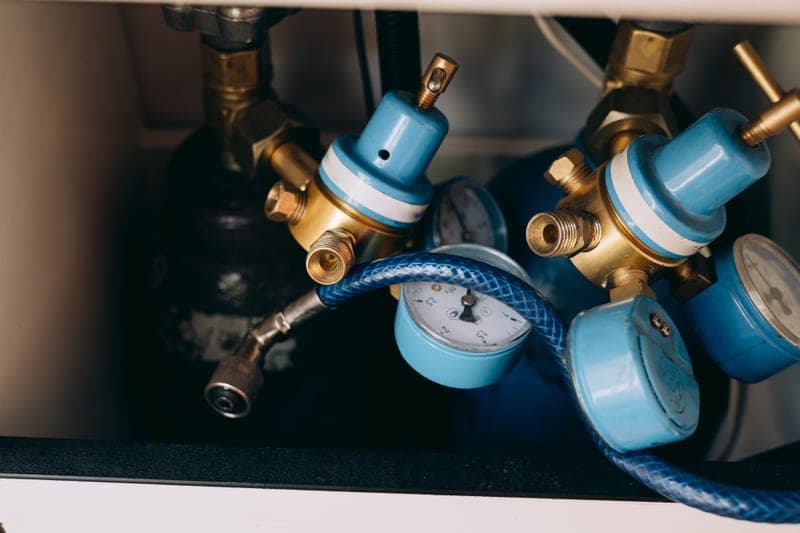
A wall-mounted compressed air filter and regulator with a pressure gauge
PneumaticPlus SAW300 filter / regulator3/8" NPT / 53 SCFM / 10 micron53 SCFM, 10 micron, with a real gauge and a metal bowl. The single most useful small purchase in a garage air system.
One combined water trap and regulator at the wall5.3/10★★★☆☆
Check price on Amazon

#ad Disclosure - we do not publish prices we cannot verify

2
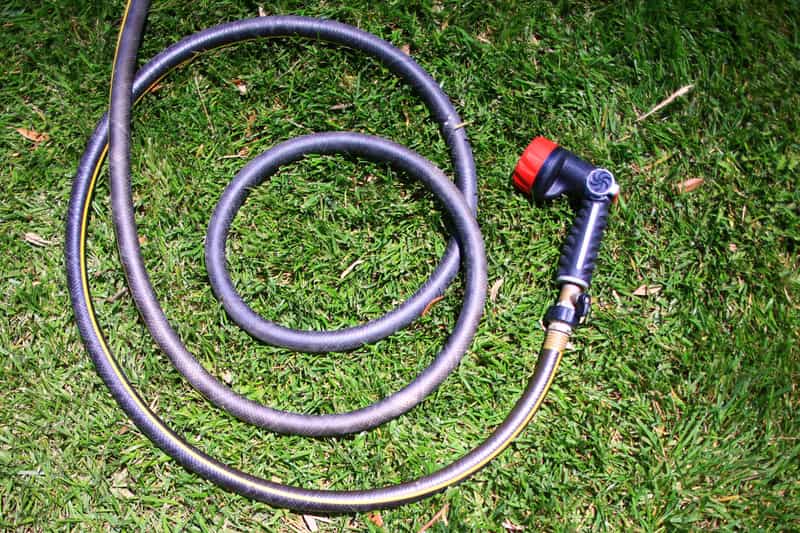
A coiled hybrid polymer air hose lying flat on a garage floor
Flexzilla HFZ3850YW23/8" / 50 ft / 300 PSI at 70F300 PSI hybrid polymer that lies flat from -40F to 140F. The upgrade that makes a cheap compressor feel expensive.
The one hose to own in a cold or unheated garage8.0/10★★★★☆
Check price on Amazon

#ad Disclosure - we do not publish prices we cannot verify

3
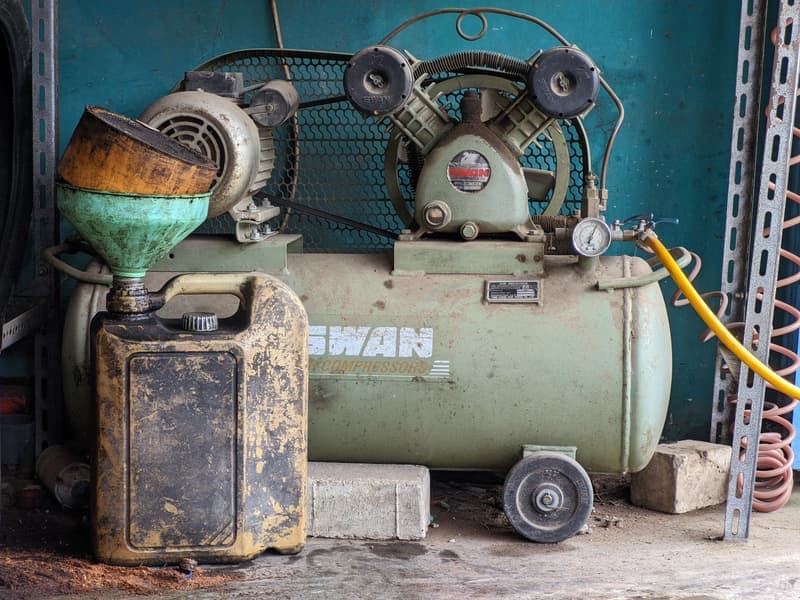
A ten-gallon vertical oil-free air compressor on wheels in a workshop
California Air Tools 10020C5.3 CFM @ 90 / 10 gal / 125 PSI / 70 dBA5.3 CFM at 70 dBA with a published 70/30 duty cycle. The first unit here that runs a continuous-duty tool.
Running a ratchet, die grinder or touch-up gun without waiting6.2/10★★★☆☆
Check price on Amazon

#ad Disclosure - we do not publish prices we cannot verify

Scores are computed from manufacturer-published specs by the rubric on our methodology page. Nothing here has been bench-tested, and we do not publish prices we cannot verify.

Pick 1 - PneumaticPlus SAW300-N03BG-MEP

5.3/10★★★☆☆

PneumaticPlus SAW300 filter / regulator

Best for: One combined water trap and regulator at the wall

Verdict

53 SCFM, 10 micron, with a real gauge and a metal bowl. The single most useful small purchase in a garage air system.

What it does well

  • 53 SCFM at 3/8-inch NPT - it will not restrict any compressor on this site
  • 10 micron element plus a regulator in one piggyback body, so one mount does both jobs
  • Metal bowl and a 0-150 PSI gauge, with bracket included

What it will not do

  • 10 micron catches water and rust, NOT oil aerosol - it is not enough on its own for paint
  • Max operating pressure is 150 PSI, so it cannot sit upstream of a 175 PSI tank outlet
How this 5.3 was calculated
MetricScoreWeightBasis
Pressure headroom7.140%250 PSI rating, on a 125-300 PSI scale
Flow capacity2.240%53 SCFM, on a 40-100 SCFM scale
Spec transparency8.020%6 published specification figures
A wall-mounted compressed air filter and regulator with a pressure gauge

Licensed stock photo - illustrative of the category, not a photo of this unit

Check price on Amazon

#ad Disclosure - we do not publish prices we cannot verify

Published specs

PneumaticPlus SAW300 filter / regulator published specifications
Port size3/8" NPT
Flow53 SCFM
Filtration10 micron
Max supply pressure250 PSI
Max operating pressure150 PSI
Gauge0-150 PSI, bracket included

Source: PneumaticPlus SAW300 filter/regulator - product specifications

Pick 2 - Flexzilla HFZ3850YW2

8.0/10★★★★☆

Flexzilla HFZ3850YW2

Best for: The one hose to own in a cold or unheated garage

Verdict

300 PSI hybrid polymer that lies flat from -40F to 140F. The upgrade that makes a cheap compressor feel expensive.

What it does well

  • 300 PSI maximum working pressure at 70F - higher than any compressor on this site produces
  • -40F to 140F flexibility: it still uncoils in an unheated garage in February
  • Zero-memory construction means it lies flat instead of fighting you, and 3/8" ID does not throttle an impact

What it will not do

  • Costs multiples of the PVC hose bundled in a compressor kit
  • The bright green is not subtle, which matters to precisely nobody using it
How this 8.0 was calculated
MetricScoreWeightBasis
Pressure headroom10.040%30070 PSI rating, on a 125-300 PSI scale
Flow capacity6.040%Flow not published for this class - scored a 6, which is what a correctly sized hose or fitting does not restrict
Spec transparency8.020%6 published specification figures
A coiled hybrid polymer air hose lying flat on a garage floor

Licensed stock photo - illustrative of the category, not a photo of this unit

Check price on Amazon

#ad Disclosure - we do not publish prices we cannot verify

Published specs

Flexzilla HFZ3850YW2 published specifications
Inside diameter3/8"
Length50 ft
Max working pressure300 PSI at 70F
Temperature range-40F to 140F
Fittings1/4" MNPT, anodized aluminum ends
MaterialHybrid polymer

Source: Flexzilla HFZ3850YW2 air hose - distributor specification listing

Pick 3 - California Air Tools 10020C

6.2/10★★★☆☆

California Air Tools 10020C

Best for: Running a ratchet, die grinder or touch-up gun without waiting

Verdict

5.3 CFM at 70 dBA with a published 70/30 duty cycle. The first unit here that runs a continuous-duty tool.

What it does well

  • 5.3 CFM at 90 PSI clears every published figure for ratchets, die grinders and touch-up spraying
  • 70 dBA at that output is unusual - most 5+ CFM units are far louder
  • Publishes a real 70/30 duty cycle and a 25-second recovery from 95 to 125 PSI

What it will not do

  • 82.5 lb and 14 A - it needs its own circuit and it is not a carry-it-upstairs machine
  • 125 PSI max, so a bigger tank at higher pressure still stores more per fill
How this 6.2 was calculated
MetricScoreWeightBasis
Air flow8.740%5.3 CFM at 90 PSI, on a 0.7-6 CFM scale
Stored air3.325%10 gal x 125 PSI = 1250, on a 125-3,500 scale
Noise5.615%70 dBA, on a 58-85 dBA scale
Portability1.110%82.5 lb, on a 20-90 lb scale
Spec transparency10.010%6 of 6 useful figures published (CFM at 90, CFM at 40, dBA, duty cycle, recovery, weight)
A ten-gallon vertical oil-free air compressor on wheels in a workshop

Licensed stock photo - illustrative of the category, not a photo of this unit

Check price on Amazon

#ad Disclosure - we do not publish prices we cannot verify

Published specs

California Air Tools 10020C published specifications
CFM @ 90 PSI5.3
CFM @ 40 PSI6.4
Tank10 gal
Max pressure125 PSI
Noise70 dBA
Duty cycle70/30 (manufacturer-published)
Recovery120 s empty to full; 25 s recovery 95 to 125 PSI
PumpOil-free
Motor2.0
Weight82.5 lb
Power110V, 14 A

Source: California Air Tools 10020C - product specifications

Honest limits

What this test cannot tell you

It cannot give you CFM at a specific pressure. For that you need a calibrated flow meter and a controlled discharge, which is laboratory equipment rather than a stopwatch.

It ignores temperature and humidity, both of which affect air density and therefore the true volume of free air delivered. That is precisely what the S in SCFM corrects for, and this method does not.

It measures the pump with nothing attached, which is the point - but it therefore tells you nothing about what reaches your tool. If your measured pump output is healthy and the tool still feels weak, the problem is downstream and our undersized-compressor guide walks through it.

FAQ

Questions people actually ask

How do you measure air compressor CFM?

The pump-up test: drain the tank, disconnect everything, time the fill from 0 PSI to cut-out, then compute tank cubic feet x (final PSI / 14.7) / fill time in minutes. It gives average delivered CFM across the fill, not CFM at a specific pressure.

How is CFM calculated?

Volume of free air per minute. For a tank fill: gallons divided by 7.48 gives cubic feet, final gauge PSI divided by 14.7 gives the atmospheres added, multiply the two for total free air, then divide by minutes.

Why is my measured CFM different from the rating?

Your figure averages the whole fill from 0 PSI to cut-out, while manufacturers quote CFM at specific pressures - usually 40 and 90 PSI. Your average should land between their two figures. If it is far below both, suspect a leak, a blocked intake or a worn pump.

Do I need special equipment to measure CFM?

Not for the pump-up test - a stopwatch and the tank's own gauge are enough. Measuring CFM at a specific pressure requires a calibrated flow meter and a controlled discharge, which is laboratory equipment.

Does temperature affect CFM?

Yes. Air density varies with temperature and humidity, which is exactly what SCFM corrects for. The pump-up test ignores it, so treat the result as a good estimate rather than a measurement.

Sources

Where these numbers come from

Accessed September 2026. If a figure on this page does not match the manufacturer's current sheet, tell us at contact@psiandhose.com and we will correct and date the change - see our editorial policy.

Read next