Skip to content
Psi & Hose

Air Compressors

Best 12V air compressors

A 12V air compressor is a tire tool. Judge it on duty cycle at a stated pressure, not on the free-flow CFM printed on the box - and the cheapest unit here covers most of what the dearest one does.

By Ryder M.Last updated Published
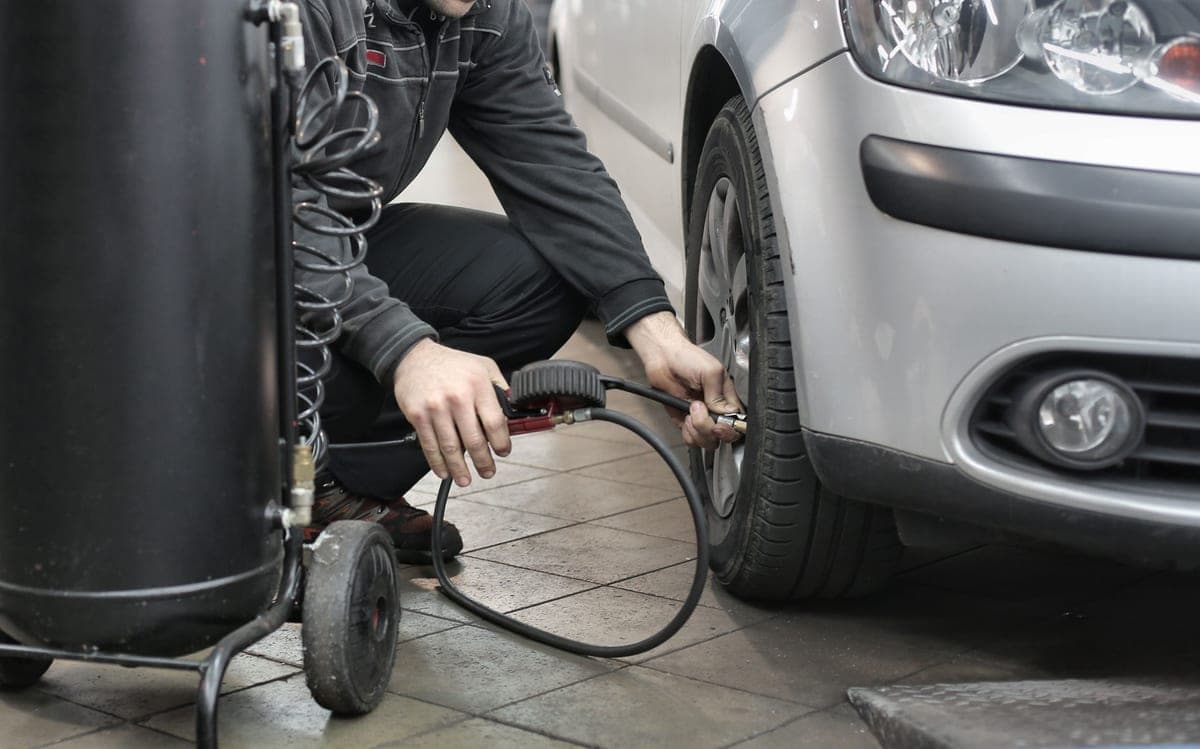
A tire being inflated with an air hose at the wheel

Some links on this page are affiliate links. If you buy through one, Magoo Media Group earns a commission from the retailer at no extra cost to you. It never changes which product we rank first - how this site is funded.

Read this first

What a 12V air compressor is, and what it is not

A 12V air compressor is a direct-drive pump that runs off a vehicle's electrical system and has no tank. It inflates things. It will not run an air tool - not an impact wrench, not a nailer, not a blow gun for more than a second - because there is no stored air for a tool to draw on and the flow is a fraction of what any tool asks for. If you have arrived here wanting to run tools away from a wall outlet, the honest answer is a generator or a cordless tool, and we say the same thing on our portable compressor page.

That sounds like a put-down and it is not. The thing a 12V unit does better than every garage compressor on this site is be in the vehicle when the tire goes soft, which is the only moment a tire actually needs air. Our own CFM chart puts tire inflation at 2 CFM at a working pressure of 30 to 60 PSI at the tire - a trivially easy job that people routinely buy a 30-gallon machine for. A 5-pound pump in the trunk does it in the parking lot instead.

So the buying question is not how much air. It is how long can it run, at what pressure, before it has to stop. That is the duty cycle, and it is the single spec that separates the four units below - which is awkward, because it is also the spec most brands in this category decline to publish.

The one sentence that sorts this category

Tires need moving air at low pressure; tools need stored air at 90 PSI. A 12V unit does the first job well and the second job not at all, at any price.

The criteria

How we ranked these four

Every figure on this page is the manufacturer's own, taken from its own product page and linked in the sources block below. We did not test these units, we do not own them, and we are not going to pretend otherwise. What we did do is read the four spec sheets side by side, which is more than the retail listings let you do.

The ranking runs on four criteria, in this order of importance for a person buying one 12V pump.

One thing to expect before you read the cards: our published score reads low for every unit on this page, and it is supposed to. The rubric puts 40% of its weight on CFM at 90 PSI and 25% on stored air, and a tankless 12V pump has neither - no manufacturer in the category publishes a 90 PSI figure and none of them has a tank. The formula is on our methodology page and it is the same formula applied to a 60-gallon machine, so the numbers stay comparable across the site rather than being quietly rescaled to flatter this category. Within the page, rank the four against each other on the criteria below.

  1. 01Published duty cycle, tied to a stated pressure. "25 minutes at 30 PSI" or "33% at 100 PSI" is a usable figure. A bare percentage with no pressure, or no figure at all, is not - a pump's endurance collapses as pressure rises, so a duty cycle without a pressure is a number you cannot plan around.
  2. 02Maximum working pressure, against the tires you own. Car tires sit near 32-36 PSI, light truck and trailer tires run 65-80 PSI, and some LT and RV tires are specified higher still. A 120 PSI ceiling covers all of those; a 60 PSI ceiling - which some budget units publish - covers cars only.
  3. 03The reach that comes in the box. Air hose and power cord length decide whether you hook up once and walk around the vehicle, or unclip and re-clip at every corner. This is the most underrated spec in the category and the easiest one to check before you buy.
  4. 04Weight and how it draws power. Four pounds lives in a glovebox off an accessory socket; ten pounds with a 30-amp draw and battery clamps lives in a bed box and wants the battery directly. Both are legitimate; they are not the same purchase.
The four, on their manufacturers' published figures
Max working pressurePublished flowPublished duty cycleWeightHose + cord
VIAIR 88P (00088)120 PSI1.97 CFM at 0 PSI25 min at 30 PSI4.75 lb16 ft + 10 ft
Smittybilt 2780150 PSI2.5 CFM / 72 LPM max outputNot published13 lb24 ft + 10 ft
VIAIR 300P (30033)150 PSI2.30 CFM at 0 PSI33% at 100 PSI8.70 lb25 ft + 8 ft
VIAIR 400P-Automatic (40045)150 PSI2.30 CFM at 0 PSI33% at 100 PSI10.70 lb30 ft + 8 ft

Every figure is from the manufacturer's own product page, fetched 2026-11-06 and linked in the sources block. Note that the flow column is not comparable across brands: VIAIR states CFM at 0 PSI, Smittybilt states a maximum output, and neither is the CFM-at-90-PSI figure a tank compressor is rated on. Prices move daily and are shown live on each card below rather than written into this text.

The spec trap

Why the CFM number on the box is close to useless here

Everywhere else on this site the number that decides a purchase is CFM at 90 PSI, because that is what an air tool draws and the figure is measured the same way by everyone. In the 12V category nobody publishes it. VIAIR publishes CFM at 0 PSI - free flow, with nothing pushing back - and Smittybilt publishes a maximum output. Those are different measurements of different things, and a 2.5 CFM headline does not beat a 2.30 CFM headline in any way you can rely on.

The physics is why. A direct-drive pump with no tank delivers less and less air as the pressure it is pushing against climbs, so its output at 35 PSI into a car tire and its output at 80 PSI into a trailer tire are not the same number, and neither is the 0 PSI figure on the box. That is also why a duty cycle without a pressure attached is meaningless: the same pump that runs happily for 25 minutes filling car tires will overheat far sooner working against 100 PSI.

This is the whole reason the 300P and the 400P-Automatic are worth their step up in price while reading as identical to the 88P on the flow line. VIAIR publishes 33% at 100 PSI for both. That is a statement about working hard, not working at all - and it is the only figure in this category that tells you what happens on the fourth tire of a 35-inch set rather than the first tire of a sedan.

Our standing advice elsewhere on the site is to buy on CFM at 90 PSI and ignore horsepower. Here, with no comparable flow figure published by anyone, buy on published duty cycle at a stated pressure, maximum working pressure, and the length of the hose. Those three are real, stated and checkable.

Published air demand at 90 PSI
ToolCFM @ 90 PSIAt loadDutyWhat the number means
Tire inflation2-IntermittentBoth references agree on 2 CFM. Note the working pressure: you are filling to 35 PSI, not 90, so almost every compressor delivers more than it needs to. Tires are why so many people overbuy - the job is easy and the marketing is not.

Where two references publish different figures, both are shown rather than averaged into a number nobody published. Primary sources: Ingersoll Rand air consumption chart, Engineering ToolBox air tool consumption, and per-tool manufacturer specifications.

Ranked

The picks

Quick picks

#ProductBest forScorePrice
1
VIAIR 88P product photo
VIAIR 88PCFM not published / no tank / 120 PSI / 81 dBAA 12V tire inflator, not a compressor. 120 PSI max with a 25-minute duty at 30 PSI. Buy it for the car, not the garage.
Topping up and re-airing tires away from a wall outlet1.7/10★☆☆☆☆

#ad Disclosure - price as of November 14, 2026

2
Smittybilt 2780 product photo
Smittybilt 2780CFM not published / no tank / 150 PSI150 PSI and 2.5 CFM published from a 1/3 HP direct-drive motor, with a 24 ft coil hose in the box. Smittybilt publishes no duty cycle at all, which is the trade.
Re-airing a set of off-road tires when you would rather not pay VIAIR money1.9/10★☆☆☆☆

#ad Disclosure - we do not publish prices we cannot verify

3
VIAIR 300P product photo
VIAIR 300PCFM not published / no tank / 150 PSI / 78 dBAThe cheapest 12V unit here that publishes a duty cycle tied to a pressure: 33% at 100 PSI. That one figure is what you are paying the step up for.
A 33-inch tire set that gets aired down and back up regularly1.9/10★☆☆☆☆

#ad Disclosure - price as of November 14, 2026

4
VIAIR 400P-Automatic product photo
VIAIR 400P-AutomaticCFM not published / no tank / 150 PSI / 78 dBASame pump figures as the 300P with a 30 ft hose, an automatic shutoff and a 37-inch tire rating. Buy it for the reach and the walk-away, not for more air.
37-inch tires, or airing up without standing over the gauge1.9/10★☆☆☆☆

#ad Disclosure - price as of November 14, 2026

Scores are computed from manufacturer-published specs by the rubric on our methodology page. Nothing here has been bench-tested. Prices are Amazon's own, refreshed daily, and never shown when we cannot verify them.

Pick 1 - VIAIR 88P

1.7/10★☆☆☆☆

VIAIR 88P

Best for: Topping up and re-airing tires away from a wall outlet

Verdict

A 12V tire inflator, not a compressor. 120 PSI max with a 25-minute duty at 30 PSI. Buy it for the car, not the garage.

What it does well

  • 120 PSI max working pressure covers car, truck and trailer tires
  • 1.97 CFM at 0 PSI published, with a 25-minute duty at 30 PSI - the pressure tires live at
  • 4.75 lb with a 10 ft power cord and 16 ft air hose

What it will not do

  • No tank, so it cannot run any air tool at all - not one
  • 20 A draw and a published 25-minute duty at 30 PSI: four tires, then let it cool
How this 1.7 was calculated
MetricScoreWeightBasis
Air flow0.040%No CFM at 90 PSI published - scored zero rather than guessed
Stored air0.025%0 gal x 120 PSI = 0, on a 125-3,500 scale
Noise1.515%81 dBA, on a 58-85 dBA scale
Portability10.010%4.75 lb, on a 20-90 lb scale
Spec transparency5.010%3 of 6 useful figures published (CFM at 90, CFM at 40, dBA, duty cycle, recovery, weight)
VIAIR 88P product photo

Product image from the Amazon listing for this model

#ad Disclosure - price as of November 14, 2026

Published specs

VIAIR 88P published specifications
CFM @ 90 PSINot published
CFM @ 40 PSINot published
TankNone (direct drive)
Max pressure120 PSI
Noise81 dBA
Duty cycle25 min at 30 PSI (manufacturer-published)
RecoveryNot published
PumpOil-free
Motor12V DC, 20 A max draw
Weight4.75 lb
Power12V DC

Source: VIAIR 88P portable compressor - product specifications

Pick 2 - Smittybilt 2780

1.9/10★☆☆☆☆

Smittybilt 2780

Best for: Re-airing a set of off-road tires when you would rather not pay VIAIR money

Verdict

150 PSI and 2.5 CFM published from a 1/3 HP direct-drive motor, with a 24 ft coil hose in the box. Smittybilt publishes no duty cycle at all, which is the trade.

What it does well

  • 2.5 CFM / 72 LPM and 150 PSI maximum output published - the highest free-flow figure here
  • 24 ft quick-release coil hose and a 10 ft power cord, so you reach four tires from one hookup
  • 1/3 horsepower oil-less direct drive motor; 13 lb with the nylon bag

What it will not do

  • No duty cycle published anywhere on the spec sheet, so how long it can run is genuinely unknown
  • 13 lb is nearly three times the weight of a glovebox inflator, and there is no tank
  • The 30 A inline fuse tells you it wants battery clamps, not an accessory socket
How this 1.9 was calculated
MetricScoreWeightBasis
Air flow0.040%No CFM at 90 PSI published - scored zero rather than guessed
Stored air0.025%0 gal x 150 PSI = 0, on a 125-3,500 scale
Noise5.015%Manufacturer publishes no dBA figure - scored a neutral 5, not a guess
Portability10.010%13 lb, on a 20-90 lb scale
Spec transparency1.710%1 of 6 useful figures published (CFM at 90, CFM at 40, dBA, duty cycle, recovery, weight)
Smittybilt 2780 product photo

Product image from the Amazon listing for this model

#ad Disclosure - we do not publish prices we cannot verify

Published specs

Smittybilt 2780 published specifications
CFM @ 90 PSINot published
CFM @ 40 PSINot published
TankNone (direct drive)
Max pressure150 PSI
NoiseNot published
Duty cycleNot published
RecoveryNot published
PumpOil-free
Motor1/3 HP, 12V DC
Weight13 lb
Power12V DC

Source: Smittybilt 2780 universal air compressor - product specifications

Pick 3 - VIAIR 300P

1.9/10★☆☆☆☆

VIAIR 300P

Best for: A 33-inch tire set that gets aired down and back up regularly

Verdict

The cheapest 12V unit here that publishes a duty cycle tied to a pressure: 33% at 100 PSI. That one figure is what you are paying the step up for.

What it does well

  • 33% duty cycle at 100 PSI published - a real figure at a real pressure, not a free-flow number
  • 150 PSI max working pressure and 2.30 CFM at 0 PSI, with a 25 ft air hose in the kit
  • IP54 and a sand tray with vibration isolators: built to sit on a trail, not in a glovebox

What it will not do

  • 8.70 lb and a 30 A draw - this is a battery-clamp tool, and it is no longer pocketable
  • Still has no tank, so it runs no air tool regardless of the 150 PSI on the box
  • Costs roughly double an 88P to fill the same 33-inch tires, just faster and for longer
How this 1.9 was calculated
MetricScoreWeightBasis
Air flow0.040%No CFM at 90 PSI published - scored zero rather than guessed
Stored air0.025%0 gal x 150 PSI = 0, on a 125-3,500 scale
Noise2.615%78 dBA, on a 58-85 dBA scale
Portability10.010%8.7 lb, on a 20-90 lb scale
Spec transparency5.010%3 of 6 useful figures published (CFM at 90, CFM at 40, dBA, duty cycle, recovery, weight)
VIAIR 300P product photo

Product image from the Amazon listing for this model

#ad Disclosure - price as of November 14, 2026

Published specs

VIAIR 300P published specifications
CFM @ 90 PSINot published
CFM @ 40 PSINot published
TankNone (direct drive)
Max pressure150 PSI
Noise78 dBA
Duty cycle33% at 100 PSI (manufacturer-published)
RecoveryNot published
PumpOil-free
Motor12V DC, 30 A max draw
Weight8.7 lb
Power12V DC

Source: VIAIR 300P portable compressor (part 30033) - product specifications

Pick 4 - VIAIR 40045

1.9/10★☆☆☆☆

VIAIR 400P-Automatic

Best for: 37-inch tires, or airing up without standing over the gauge

Verdict

Same pump figures as the 300P with a 30 ft hose, an automatic shutoff and a 37-inch tire rating. Buy it for the reach and the walk-away, not for more air.

What it does well

  • Rated for tires up to 37 in, with a 30 ft air hose - the longest supplied hose of the four
  • Automatic shutoff at pressure, so you set it and walk to the next corner
  • 33% duty cycle at 100 PSI and IP54, both published, same as the 300P

What it will not do

  • 2.30 CFM at 0 PSI is identical to the 300P - the extra money buys reach and convenience, not flow
  • 10.70 lb, the heaviest here, and still tankless so it runs no air tool
  • The supplied hose is not recommended in freezing conditions, per VIAIR's own page
How this 1.9 was calculated
MetricScoreWeightBasis
Air flow0.040%No CFM at 90 PSI published - scored zero rather than guessed
Stored air0.025%0 gal x 150 PSI = 0, on a 125-3,500 scale
Noise2.615%78 dBA, on a 58-85 dBA scale
Portability10.010%10.7 lb, on a 20-90 lb scale
Spec transparency5.010%3 of 6 useful figures published (CFM at 90, CFM at 40, dBA, duty cycle, recovery, weight)
VIAIR 400P-Automatic product photo

Product image from the Amazon listing for this model

#ad Disclosure - price as of November 14, 2026

Published specs

VIAIR 400P-Automatic published specifications
CFM @ 90 PSINot published
CFM @ 40 PSINot published
TankNone (direct drive)
Max pressure150 PSI
Noise78 dBA
Duty cycle33% at 100 PSI (manufacturer-published)
RecoveryNot published
PumpOil-free
Motor12V DC, 30 A max draw
Weight10.7 lb
Power12V DC

Source: VIAIR 400P-Automatic portable compressor (part 40045) - product specifications

Match it to the vehicle

Which one your tires actually call for

If your vehicle is a car, a crossover or a half-ton truck on factory-size tires, the 88P is the whole answer. 120 PSI of working pressure is roughly double the highest pressure you will ever set, 25 minutes at 30 PSI covers four tires with room to spare, and 4.75 pounds means it lives in the vehicle permanently instead of in the garage where it is no use. Buying more than this for street tires is buying speed you will use four times a year.

If you air down for trails and back up at the pavement, the duty cycle stops being academic. Four 33-inch tires from 15 PSI back to 35 PSI is a long continuous run, and this is where a published 33% at 100 PSI and an IP54 rating earn the 300P its place. The sand tray with vibration isolators in that kit is not marketing either - it is an admission that the thing gets set on dirt, which is a more honest piece of design than most of this category manages.

If your tires are bigger than 33 inches, VIAIR's own rating puts you on the 400P-Automatic, which it specifies up to 37 inches. Be clear about what the extra money buys, because the flow line does not move: 2.30 CFM at 0 PSI on both, 33% at 100 PSI on both. You are paying for 30 feet of hose instead of 25, an automatic shutoff so you are not standing over a gauge, and a larger pump assembly rated for the bigger tire. If your tires are 33 inches, the 300P does the same work for less.

And if you simply do not want to pay VIAIR prices, the Smittybilt 2780 publishes the highest output figure of the four and a 24-foot coil hose, for less than the 300P. The reason it is not ranked above the VIAIR units is one absence rather than any measured shortfall: Smittybilt publishes no duty cycle anywhere on the spec sheet, so how long it can run is a question nobody at the brand has answered in writing. For a unit you use twice a year that may not matter to you. We are not going to rank an unstated figure above a stated one, but we are also not going to pretend 2.5 CFM and 150 PSI for that money is bad value.

The part nobody mentions

How to power one without cooking the wiring

Look at the amp draw before you look at anything else, because it decides how you are allowed to connect the thing. VIAIR publishes a 20-amp maximum draw for the 88P and 30 amps for both the 300P and the 400P-Automatic. Smittybilt does not publish a draw but ships a 30-amp inline fuse, which tells you the same story. Those are big numbers for a vehicle accessory.

All four units in this roundup come with battery clamps rather than an accessory-socket plug, and that is a design decision, not a cost saving. A cigarette-lighter or 12V accessory socket is a convenience circuit on a comparatively thin wire, and sustained current at that level is not what it was built for. The cheap glovebox pumps that do plug into one are the units with the lower pressure ceilings and the shorter run times - that is the trade they made to fit the socket.

Two practical consequences. First, run the engine while you work, or at least accept that you are drawing hard on a battery that is not being charged; a long air-up on a cold battery is how a trail recovery turns into a jump start. Second, clamp directly to the battery posts and keep the supplied inline fuse in the circuit. The 300P and the 400P-Automatic ship a 40-amp fuse holder for exactly this reason, and it is not an optional accessory.

The thermal protection in these pumps is the other half of the duty-cycle figure. VIAIR lists a thermal overload protector in the 300P kit and an ambient ceiling of 158 F; if you work past the duty cycle on a hot day, the pump stops on its own and you wait. That is the pump defending itself, not a fault - but it is also why the stated duty cycle is worth paying for when you are the person standing at the fourth tire.

The honest alternative

What to buy instead, if tools are the real goal

If what you actually want is to use air tools, none of these four is the purchase, and no amount of stated pressure changes that. A 6-gallon pancake compressor delivers 2.6 CFM at 90 PSI and holds six gallons of air at 150 PSI, which is why it breaks lug nuts with a 1/2-inch impact wrench while a 12V pump rated 150 PSI cannot turn the same wrench once. The difference is the tank, not the pressure on the label.

The two purchases are not in competition and a lot of people sensibly own both: a 12V pump that lives in the vehicle for tires, and a pancake in the garage for tools. The 12V unit is the cheaper of the two and it is the one that is with you when a tire is soft on a Sunday. If you can only buy one and you own air tools, buy the tank compressor and a tire chuck.

There is a middle option worth knowing about: a small tank compressor that runs off an inverter or a generator on site. It is heavier, slower to set up and needs a power source, and for tires alone it is strictly worse than a 12V pump. Where it earns its keep is jobsite nailing away from an outlet, which is a different problem from the one this page solves.

If you are not sure which side of that line you are on, start with our sizing pillar. Five minutes with your actual tool list is what stops people buying a 30-gallon machine to inflate tires, which the CFM chart on this page shows is a 2 CFM job at well under half the pressure a tool needs.

FAQ

Questions people actually ask

What is the best 12V air compressor?

For street tires on a car or half-ton truck, the VIAIR 88P: 120 PSI maximum working pressure, a published 25 minutes at 30 PSI, and 4.75 lb so it stays in the vehicle. For 33-inch off-road tires, the VIAIR 300P, which publishes a 33% duty cycle at 100 PSI. Beyond 33 inches, VIAIR rates the 400P-Automatic to 37 inches.

Can a 12V air compressor run air tools?

No. There is no tank, so there is no stored air for a tool to draw on, and the flow is far below what any air tool needs. A 6-gallon pancake compressor at 2.6 CFM at 90 PSI will run an impact wrench in bursts; a tankless 12V pump rated to 150 PSI will not turn it once.

Which 12V air compressor has the highest CFM?

The published figures are not comparable, which is the honest answer. Smittybilt states 2.5 CFM / 72 LPM maximum output for the 2780; VIAIR states 2.30 CFM at 0 PSI for both the 300P and the 400P-Automatic and 1.97 CFM at 0 PSI for the 88P. Free flow at zero pressure is not the CFM-at-90-PSI figure tank compressors are rated on, so rank these on published duty cycle and maximum working pressure instead.

Do I need a 150 PSI 12V compressor or is 120 PSI enough?

120 PSI is enough for every street tire. Car tires sit near 32-36 PSI and light truck and trailer tires run 65-80 PSI, so a 120 PSI ceiling leaves margin on all of them. The 150 PSI units matter for large off-road tires, where the extra headroom and the bigger pump shorten a long air-up rather than unlocking a pressure you could not reach.

Can I plug a 12V air compressor into the cigarette lighter?

Not these four - they all ship with battery clamps, because VIAIR publishes a 20-amp draw for the 88P and 30 amps for the 300P and 400P-Automatic, and Smittybilt ships a 30-amp inline fuse. A 12V accessory socket is a light-duty circuit. The small pumps that do use one are the ones with lower pressure ceilings and shorter run times.

How long can a 12V air compressor run continuously?

Only as long as its maker states, and at the pressure stated. VIAIR publishes 25 minutes at 30 PSI for the 88P and 33% at 100 PSI for the 300P and 400P-Automatic. Smittybilt publishes no duty cycle for the 2780 at all. Endurance drops sharply as working pressure rises, so a figure quoted without a pressure tells you nothing you can plan around.

Sources

Where these numbers come from

Accessed September 2026. If a figure on this page does not match the manufacturer's current sheet, tell us at contact@psiandhose.com and we will correct and date the change - see our editorial policy.

Read next