Skip to content
Psi & Hose

CFM & Sizing

Air tool PSI chart

Nearly every air tool in a garage works at 90 PSI or below. Your tank holds 150 to 200. The regulator between them is doing more work than you think.

By Ryder M.Last updated Published
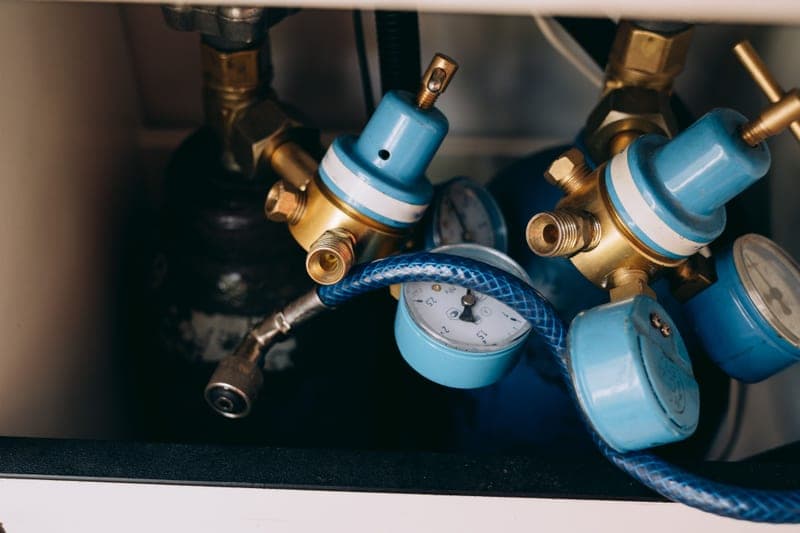
A pressure gauge on an air compressor manifold showing line pressure

Some links on this page are affiliate links. If you buy through one, Magoo Media Group earns a commission from the retailer at no extra cost to you. It never changes which product we rank first - how this site is funded.

Read this first

The short answer

Set the regulator to 90 PSI and you are correct for most of the garage: impact wrenches, ratchets, die grinders, cut-off tools, drills and sanders are all rated and measured at 90 PSI. Nailers want 70 to 120 PSI and are set by drive depth within that band rather than by a single number. Tire inflation happens at 30 to 60 PSI at the tire. Upholstery stapling is around 30 PSI. Those four rows cover nearly everything a home shop does.

The single most important thing to understand is that tank pressure and tool pressure are different numbers that happen to appear on gauges next to each other. Your tank sits at 125 to 200 PSI depending on the machine - the Metabo HPT EC914S reaches 200, a typical pancake 150. None of that is what reaches the tool. The regulator steps it down, and the number on the regulator gauge is the only one that matters to the tool.

Higher is not better and it is not harmless. Over-pressuring a nailer drives brads through trim and shortens the life of the driver and bumper. Over-pressuring an impact wrench does not add meaningful torque - it is rated at 90 PSI - but it does increase air consumption. Over-pressuring a spray gun atomizes badly and produces orange peel. The chart below is not a set of minimums to beat; it is where the tools were designed to work.

Published working pressure by tool class
Tool classWorking pressureHow the figure is set
Brad nailer, 18 gauge70-120 PSIWithin the band by drive depth in your material - start low
Finish nailer, 15 gauge70-120 PSISame band; heavier stock usually wants the upper half
Framing nailer70-120 PSISet so the nail head sits flush, not proud and not sunk
Roofing / coil nailer70-120 PSIFlush to the shingle surface; too high cuts the mat
Upholstery / crown staplerAbout 30 PSILow by design - the fastener is tiny and the substrate soft
Impact wrench, any drive90 PSIRated and measured at 90 PSI; more does not add usable torque
Air ratchet90 PSIRated at 90 PSI; torque is controlled at the trigger, not the gauge
Air hammer / chisel90-100 PSIRated band; the tool is designed for sustained impact at it
Grease gun70-90 PSILower end is usually enough and is kinder to the seals
Tire inflation30-60 PSI at the tireSet by the tire placard, never by the compressor
Orbital / DA sander90 PSIRated at 90 PSI; flow is the constraint, not pressure
Die grinder, cut-off tool90 PSIRated at 90 PSI; free speed is specified at that pressure
Air drill90-100 PSIRated band
Blow gun70-90 PSILower is safer and usually sufficient for dusting
Paint spray gunVaries by gunSet at the gun inlet per the gun's own sheet - HVLP figures differ widely
Sandblaster / blast cabinet80-100 PSIMedia and nozzle dependent within the band

Every figure is the published working pressure carried in this site's shared tool-demand dataset, attributed to Ingersoll Rand's service-shop consumption chart and Engineering ToolBox. Where a class has no single figure - spray guns - we say so rather than inventing one, because HVLP inlet pressures genuinely vary by gun.

The gauge that is lying to you

The tank gauge. It reads stored pressure, which falls as you work and rises when the pump runs. The regulator gauge reads what is going down the hose. If you have been setting tool pressure from the tank gauge, you have been setting a different number every time the pump cycles.

Where the standard came from

Why 90 PSI is the number everything is rated at

Air tool specifications are overwhelmingly stated at 90 PSI, and it is a convention rather than a physical constant - but it is a convention with real consequences. When Ingersoll Rand publishes 600 ft-lb of torque and 4.2 CFM average for the 231C, both figures are measured at 90 PSI at the tool inlet. When a compressor maker publishes delivered CFM, it is almost always at 90 PSI too. That shared basis is what makes compressor and tool specs comparable at all.

It also means that running below 90 PSI costs you performance in a way the spec sheet does not warn you about. A tool fed at 70 PSI does not simply run a bit slower - torque and free speed both fall off, and on an impact wrench the difference between 70 and 90 PSI at the tool is the difference between a lug nut coming off and the hammer rattling against it. Most of the time when someone says their impact wrench is weak, the measured pressure at the tool is well under 90 PSI.

The two reasons the tool rarely sees what the regulator shows are both plumbing. First, pressure drop along the hose and through every coupler and adapter - which is why we care so much about coupler flow figures elsewhere on this site. Second, the regulator itself sagging under flow: a small regulator passing more air than it is rated for drops its output pressure the moment the tool opens. The fix for both is the same, and it is not turning the dial up.

Published air demand at 90 PSI, every tool class
ToolCFM @ 90 PSIAt loadDutyWhat the number means
Brad nailer, 18 gauge0.5-BurstThe most forgiving air tool there is. A nailer draws air only at the instant it fires, so almost any tank covers it. That is why a 1-gallon compressor is a genuinely complete tool for trim work rather than a compromise.
Finish nailer, 15 gauge1.8-BurstBostitch publishes 1.8 CFM of free air at 80 PSI for its BTFP72155 running 60 fasteners a minute - a fast, sustained trim pace, not casual use. At a realistic pace the draw is a fraction of that.
Framing nailer, 21 or 30 degree2.5-BurstEngineering ToolBox lists 2.5 CFM for a framing nailer on a 25% load factor. Metabo HPT publishes 0.09 SCFM at 100 PSI for the NR90AES1 on a per-cycle basis. The two describe the same tool at different firing rates, which is exactly why one CFM number for a nailer is misleading: nail pace sets the demand, not the badge on the tool.
Roofing / coil nailerNot published-IntermittentNeither published chart carries a separate roofing-nailer line. Roofing is fired far faster and for far longer than framing, so treat it as the top of the framing range and size for recovery rather than peak. We will not print a number no source publishes.
Upholstery / crown stapler2-BurstEngineering ToolBox lists 2 CFM for an upholstery stapler, measured at 30 PSI. Low pressure means low demand, and a small tank keeps up easily.
Impact wrench, 3/8"3 - 5-BurstIngersoll Rand's service-shop chart says 3 CFM; Engineering ToolBox gives a 2-5 CFM band. Both describe short bursts on fasteners, not continuous running.
Impact wrench, 1/2"4 - 522BurstThe most misunderstood number on this chart. Ingersoll Rand publishes 4.2 CFM average for the 231C and 22 CFM at load. The average assumes you hold the trigger for a second or two at a time. A 6-gallon pancake at 2.6 CFM does break lug nuts; it simply cannot keep the trigger down.
Impact wrench, 3/4"6-BurstPast the point where a portable garage compressor is the right answer. If you genuinely need 3/4-inch drive, budget for the compressor before the wrench.
Impact wrench, 1"12 - 10-IntermittentTruck and heavy-equipment territory. 12 CFM average is more than most 30-gallon single-stage compressors produce, let alone anything portable.
Air ratchet, 3/8"3 - 4-IntermittentIngersoll Rand publishes 3 CFM average at 90 PSI for the 105-D3; Engineering ToolBox lists 4 CFM for the class. A ratchet is the sneaky one: you hold the trigger far longer than with an impact, so it punishes a small tank harder despite the lower headline number.
Air ratchet, 1/4"3-IntermittentEngineering ToolBox lists 3 CFM. Ingersoll Rand does not publish an air-consumption figure for its 105-D2, so there is no second number to give you.
Air hammer / chisel4-IntermittentUsed in bursts on exhaust bolts and ball joints, a 20-gallon tank copes. Used continuously on a seized assembly, it will outrun anything under about 5 CFM.
Grease gun3 - 4-IntermittentModest and intermittent. Not a sizing constraint for any compressor on this site.
Tire inflation2-IntermittentBoth references agree on 2 CFM. Note the working pressure: you are filling to 35 PSI, not 90, so almost every compressor delivers more than it needs to. Tires are why so many people overbuy - the job is easy and the marketing is not.
Orbital / DA sander, 6 inch10 - 9-ContinuousIngersoll Rand lists 10 CFM for a body orbital sander; Engineering ToolBox gives 6-9 CFM for the class. A sander runs continuously by nature, so there is no burst allowance to hide behind. This is the job that genuinely needs a big compressor.
Vertical disc sander / polisher20-Continuous20 CFM continuous. No portable garage compressor of any tank size will run this. If body work is the plan, price a 60-gallon two-stage before anything else.
Die grinder, 1/4"5 - 6-ContinuousIngersoll Rand lists 5 CFM; Engineering ToolBox gives a 4-6 CFM band. Continuous duty, so a 6-gallon pancake gives you a handful of seconds before pressure drops and the tool slows.
Cut-off tool, 3 inch4 - 10-ContinuousEngineering ToolBox publishes a wide 4-10 CFM band because cut-off tools vary enormously. Whichever end yours sits at, it runs continuously, so size for the top of the band.
Air drill, 3/8"4-IntermittentBoth references agree on 4 CFM. Honest answer: a cordless drill is better for almost every home-garage drilling job, and needs no compressor at all.
Blow gun / dusting gun2.5 - 3-IntermittentIngersoll Rand lists 2.5 CFM, Engineering ToolBox 3. Held open continuously - clearing a sprinkler line, blowing out a filter - a blow gun empties a 6-gallon tank surprisingly fast.
Paint spray gun, touch-up4-ContinuousIngersoll Rand lists 4 CFM for touch-up spraying. Continuous while the trigger is down, and the air also has to be clean and dry - see our air-prep pages.
Paint spray gun, production / HVLP8 - 7-ContinuousIngersoll Rand lists 8 CFM for production spraying; Engineering ToolBox gives 3-7 CFM for small hand-operated sprayers. Check the gun's own spec sheet - HVLP demand varies more than any other tool class on this chart.
Paint spray gun, undercoat19-Continuous19 CFM. Undercoating and bedliner guns are not home-garage compressor territory on any budget.
Sandblaster / blast cabinetNot published-ContinuousEngineering ToolBox gives 6-400 CFM - a range so wide it is really a statement that the nozzle orifice sets the demand, not the cabinet. A small siphon gun sits near the bottom; a pressure pot with a 1/4-inch nozzle is industrial. We publish no single number because no source does.

Where two references publish different figures, both are shown rather than averaged into a number nobody published. Primary sources: Ingersoll Rand air consumption chart, Engineering ToolBox air tool consumption, and per-tool manufacturer specifications.

The picks

The gear that makes this chart usable

Quick picks

#ProductBest forScorePrice
1
A wall-mounted compressed air filter and regulator with a pressure gauge
PneumaticPlus SAW300 filter / regulator3/8" NPT / 53 SCFM / 10 micron53 SCFM, 10 micron, with a real gauge and a metal bowl. The single most useful small purchase in a garage air system.
One combined water trap and regulator at the wall5.3/10★★★☆☆

#ad Disclosure - we do not publish prices we cannot verify

2
A high-capacity pancake air compressor with a roll cage
Metabo HPT EC914S (THE TANK)4 CFM @ 90 / 6 gal / 200 PSI4.0 CFM at 90 PSI and 200 PSI max - the only 6-gallon unit here that breaks the 2.6 CFM ceiling.
Getting real CFM without moving up to a 20-gallon footprint5.1/10★★★☆☆

#ad Disclosure - we do not publish prices we cannot verify

3
A three-stage compressed air filtration and regulation assembly mounted on a wall
PneumaticPlus SAU430 three-stage1/2" NPT / 10 micron particulate filter / 0.1 micron mist separator10 micron, then 0.1 micron mist separator, then regulator. The honest minimum before a spray gun.
Spraying paint or clear coat from a garage compressor5.6/10★★★☆☆

#ad Disclosure - we do not publish prices we cannot verify

Scores are computed from manufacturer-published specs by the rubric on our methodology page. Nothing here has been bench-tested, and we do not publish prices we cannot verify.

Pick 1 - PneumaticPlus SAW300-N03BG-MEP

5.3/10★★★☆☆

PneumaticPlus SAW300 filter / regulator

Best for: One combined water trap and regulator at the wall

Verdict

53 SCFM, 10 micron, with a real gauge and a metal bowl. The single most useful small purchase in a garage air system.

What it does well

  • 53 SCFM at 3/8-inch NPT - it will not restrict any compressor on this site
  • 10 micron element plus a regulator in one piggyback body, so one mount does both jobs
  • Metal bowl and a 0-150 PSI gauge, with bracket included

What it will not do

  • 10 micron catches water and rust, NOT oil aerosol - it is not enough on its own for paint
  • Max operating pressure is 150 PSI, so it cannot sit upstream of a 175 PSI tank outlet
How this 5.3 was calculated
MetricScoreWeightBasis
Pressure headroom7.140%250 PSI rating, on a 125-300 PSI scale
Flow capacity2.240%53 SCFM, on a 40-100 SCFM scale
Spec transparency8.020%6 published specification figures
A wall-mounted compressed air filter and regulator with a pressure gauge

Licensed stock photo - illustrative of the category, not a photo of this unit

#ad Disclosure - we do not publish prices we cannot verify

Published specs

PneumaticPlus SAW300 filter / regulator published specifications
Port size3/8" NPT
Flow53 SCFM
Filtration10 micron
Max supply pressure250 PSI
Max operating pressure150 PSI
Gauge0-150 PSI, bracket included

Source: PneumaticPlus SAW300 filter/regulator - product specifications

Pick 2 - Metabo HPT EC914S

5.1/10★★★☆☆

Metabo HPT EC914S (THE TANK)

Best for: Getting real CFM without moving up to a 20-gallon footprint

Verdict

4.0 CFM at 90 PSI and 200 PSI max - the only 6-gallon unit here that breaks the 2.6 CFM ceiling.

What it does well

  • 4.0 CFM at 90 PSI is 54% more air than the rest of the 6-gallon class
  • 200 PSI max means the same 6 gallons holds far more usable air
  • Clears the published average demand for a 1/2-inch impact and a 3/8-inch ratchet

What it will not do

  • 41 lb, the heaviest 6-gallon unit in the roster
  • Metabo HPT does not publish a noise figure, and high-pressure pumps are not quiet
How this 5.1 was calculated
MetricScoreWeightBasis
Air flow6.240%4 CFM at 90 PSI, on a 0.7-6 CFM scale
Stored air3.225%6 gal x 200 PSI = 1200, on a 125-3,500 scale
Noise5.015%Manufacturer publishes no dBA figure - scored a neutral 5, not a guess
Portability7.010%41 lb, on a 20-90 lb scale
Spec transparency3.310%2 of 6 useful figures published (CFM at 90, CFM at 40, dBA, duty cycle, recovery, weight)
A high-capacity pancake air compressor with a roll cage

Licensed stock photo - illustrative of the category, not a photo of this unit

#ad Disclosure - we do not publish prices we cannot verify

Published specs

Metabo HPT EC914S (THE TANK) published specifications
CFM @ 90 PSI4
CFM @ 40 PSINot published
Tank6 gal
Max pressure200 PSI
NoiseNot published
Duty cycleNot published
RecoveryNot published
PumpOil-free
MotorNot published
Weight41 lb
Power120V

Source: Metabo HPT EC914S THE TANK - product specifications

Pick 3 - PneumaticPlus SAU430-N04G

5.6/10★★★☆☆

PneumaticPlus SAU430 three-stage

Best for: Spraying paint or clear coat from a garage compressor

Verdict

10 micron, then 0.1 micron mist separator, then regulator. The honest minimum before a spray gun.

What it does well

  • 0.1 micron mist separator stage is the one that actually removes oil aerosol and sub-micron mist
  • Three stages in one modular body with a bracket and gauge
  • 1/2" NPT, so it is not the restriction in a spray setup

What it will not do

  • Three elements to buy and replace instead of one
  • Does not dry air the way a refrigerated dryer or desiccant column does - it separates, it does not chill
How this 5.6 was calculated
MetricScoreWeightBasis
Pressure headroom5.040%No pressure rating published - scored a neutral 5
Flow capacity6.040%Flow not published for this class - scored a 6, which is what a correctly sized hose or fitting does not restrict
Spec transparency6.020%5 published specification figures
A three-stage compressed air filtration and regulation assembly mounted on a wall

Licensed stock photo - illustrative of the category, not a photo of this unit

#ad Disclosure - we do not publish prices we cannot verify

Published specs

PneumaticPlus SAU430 three-stage published specifications
Port size1/2" NPT
Stage 110 micron particulate filter
Stage 20.1 micron mist separator
Stage 3Pressure regulator
IncludedBracket and gauge

Source: PneumaticPlus SAU430 three-stage air drying system - product specifications

Doing it properly

Setting pressure so it stays set

The first step is the one that fixes most complaints. A regulator is a flow-control device, and its set point under no flow is not its set point under load - the gap is called droop, and on a small regulator feeding a hungry tool it can be twenty or thirty PSI. Setting it with the trigger held open is a free fix that costs nothing and solves a problem people routinely try to solve by buying a larger compressor.

The third step is worth a note because it is the one people argue with. There is no correct PSI for a brad nailer in the abstract - the correct pressure is the one that sets the fastener flush in the material in front of you, and that genuinely differs between pine, oak and MDF. The published band exists to tell you the tool's limits, not to give you a setting. Starting low and working up also means your mistakes are proud nails you can tap in, rather than nails driven through the face of the trim.

  1. 01Set the pressure with air flowing, not static. A regulator set to 90 PSI with the tool idle will read considerably less the moment the trigger opens. Hold the trigger and adjust until it reads 90 PSI under flow.
  2. 02Measure at the tool end of the hose if you can, not at the compressor. A cheap inline gauge at the coupler tells you what the tool actually sees, which is the only number the tool responds to.
  3. 03Set nailers by result, not by number. Start at the low end of the 70-120 PSI band, drive a fastener into a scrap of the same material, and raise pressure until the head sits flush. Then stop.
  4. 04Re-check after changing hose length or adding a coupler. Both change the pressure drop between the regulator and the tool, which means the setting that was right yesterday is not right today.
  5. 05For tires, ignore every number on the compressor and use the placard in the door jamb. The tank gauge, the regulator gauge and the inflator gauge are three different readings and only the tire matters.
  6. 06Drain the tank before you trust any of it. Water in the tank changes nothing about pressure but everything about what arrives at the tool, and a wet regulator reads erratically.

The other side of the gauge

Tank PSI, and when a higher ceiling is worth paying for

If every tool runs at 90 PSI or less, why do compressors advertise 150, 165 and 200 PSI? Because tank pressure is storage, not delivery. A 6-gallon tank filled to 200 PSI holds substantially more usable air than the same tank filled to 150, because you draw it down through a wider band before the pump has to start. The tools still see 90 PSI; you just get more work between pump cycles.

That is the honest case for the Metabo HPT EC914S and its 200 PSI ceiling, and it is why it appears on this page rather than only on the compressor roundups. On a day of trim work, a wider draw-down band means the pump cycles noticeably less often, which matters for noise, for motor life, and for how much the machine intrudes on the work. It is one of the few compressor specs that delivers exactly what it implies.

There is a plumbing consequence, and it catches people. Air-prep gear carries its own pressure limits, and they are frequently below tank pressure. The PneumaticPlus SAW300 publishes a 150 PSI maximum operating pressure; the Motor Guard M-60 sub-micronic filter publishes 125 PSI. Neither can sit on a 175 or 200 PSI tank outlet. On a high-pressure machine the air prep goes downstream of the tank regulator, which is a two-dollar detail that destroys the filter when you get it wrong.

FAQ

Questions people actually ask

What PSI should I set my air compressor to?

90 PSI covers most of the garage - impacts, ratchets, die grinders, drills and sanders are all rated at 90 PSI. Nailers want 70 to 120 PSI set by drive depth in your material. Tire inflation is 30 to 60 PSI at the tire, per the placard. Upholstery stapling is around 30 PSI.

Why are air tools rated at 90 PSI?

It is the industry convention for stating tool performance, and it is what makes compressor and tool specs comparable. Ingersoll Rand's 600 ft-lb and 4.2 CFM figures for the 231C are both measured at 90 PSI at the tool inlet, and compressor CFM is published at 90 PSI for the same reason.

Is my tank pressure the same as my tool pressure?

No, and confusing them is the most common pressure mistake. The tank sits at 125 to 200 PSI depending on the machine; the regulator steps that down to what goes down the hose. Only the regulator gauge is relevant to the tool, and the tank gauge changes constantly as the pump cycles.

Why does my impact wrench feel weak at 90 PSI?

Because it probably is not seeing 90 PSI. A regulator set to 90 with the tool idle droops under flow, and every coupler and adapter adds pressure drop. Set the regulator with the trigger held open, and measure at the tool end of the hose rather than at the compressor.

What PSI should a brad nailer be set to?

Start at the low end of the 70-120 PSI band and raise it until a test fastener in the same material sits flush, then stop. There is no single correct number - pine, oak and MDF genuinely differ. Starting low means your errors are proud nails you can tap in rather than nails driven through the face.

Does a 200 PSI compressor give me more power?

Not at the tool - that still runs at 90 PSI. What it gives you is more stored air in the same tank, so you draw down through a wider band and the pump cycles less often. Note that filter-regulators are often rated to 150 PSI or less, so air prep must sit downstream of the tank regulator.

Sources

Where these numbers come from

Accessed September 2026. If a figure on this page does not match the manufacturer's current sheet, tell us at contact@psiandhose.com and we will correct and date the change - see our editorial policy.

Read next