Best impact wrench
Best air impact wrenches
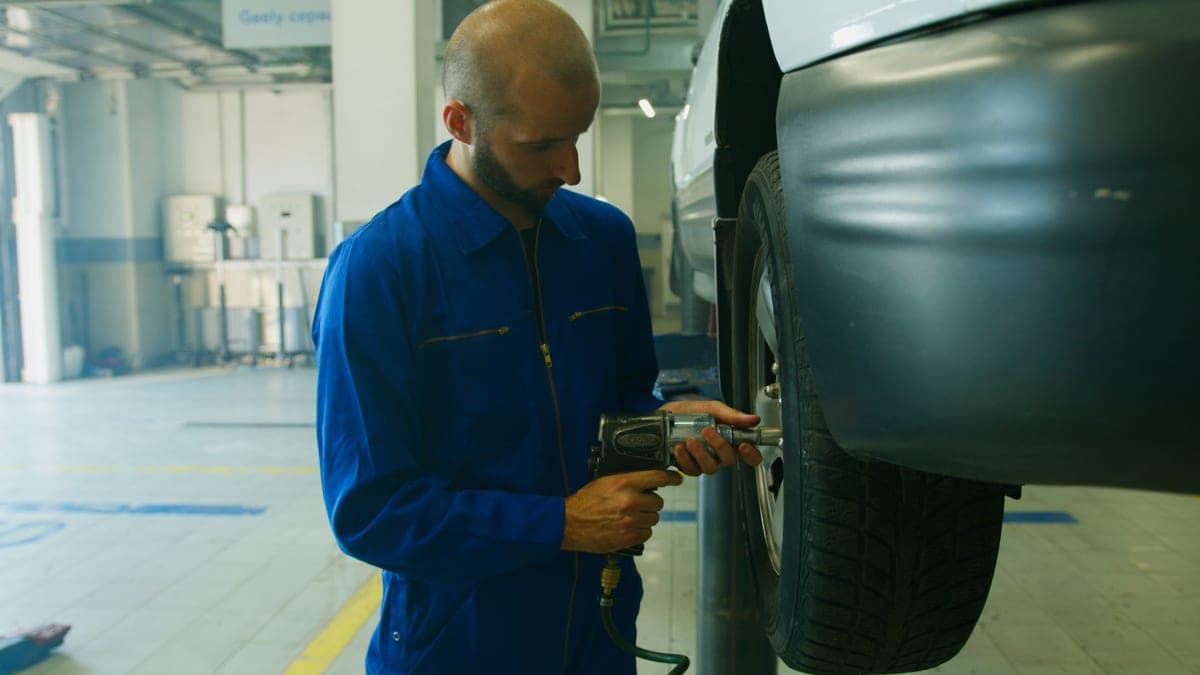
Two 1/2-inch wrenches on published air consumption, torque and noise - and why the hose matters more than either.
Top pick
Ingersoll Rand 231C
#ad Disclosure - we do not publish prices we cannot verify
Hub
An air tool is only as good as the compressor behind it, so every tool here is presented with the published CFM it needs and what that means on a budget machine.

Some links on this page are affiliate links. If you buy through one, Magoo Media Group earns a commission from the retailer at no extra cost to you. It never changes which product we rank first - how this site is funded.
Everything in this hub

Best impact wrench
Two 1/2-inch wrenches on published air consumption, torque and noise - and why the hose matters more than either.
Top pick
Ingersoll Rand 231C
#ad Disclosure - we do not publish prices we cannot verify

Best air ratchet
Lower published CFM than an impact wrench, much harder on a small tank - because of trigger time, not flow.
Top pick
Ingersoll Rand 105-D3
#ad Disclosure - we do not publish prices we cannot verify
Orientation
Every air tool has a published air consumption figure, usually at 90 PSI, and it is the first thing to check against your compressor rather than the last. A tool that needs more than your pump supplies will work for a few seconds and then slow down, and no hose, fitting or technique fixes it.
The figure is almost always a duty-cycle average rather than running flow. Ingersoll Rand publishes both for its 231C impact wrench: 4.2 CFM average and 22 CFM at load. Both are correct; the first is what you size a compressor against and the second is what the tank covers during the burst.
So the useful question is not how much air a tool needs but how long you hold its trigger. An impact wrench is a one-second tool and lives comfortably on stored air. A ratchet is a twenty-second tool and drains a small tank despite a lower headline number. A die grinder is a continuous tool and needs the pump to supply it outright.
Scope
We cover impact wrenches and air ratchets, because those are the tools a home garage genuinely benefits from owning in air form. They are lighter than cordless equivalents, far cheaper, and close to unkillable - an air motor has no electronics, no battery chemistry, and nothing that degrades on a shelf.
We do not recommend air drills, and we will say why plainly: both of our published references list 4 CFM for one, which is a real demand for a job a cordless drill does better with no compressor at all. There is no good reason to own an air drill in a home garage.
We do not recommend air sanders either. A 6-inch orbital needs 6 to 10 CFM continuously and a vertical disc sander needs 20. No portable garage compressor supplies either, and an electric random-orbit sander does the same job from a wall outlet. Recommending one would be selling a tool that cannot work.
Buying advice
Not into torque. The two impact wrenches we cover publish 500 and 600 ft-lb maximum, and a passenger-car lug nut is torqued around 100. Both have several times the torque any home garage needs, and choosing between them on that number is choosing on the wrong one.
Into access and air economy. One publishes a 3.85-inch body at 3 pounds, which reaches into engine bays a full-size tool cannot, at the cost of 4.8 CFM average against 4.2. That is a real trade and it is the trade that should decide the purchase.
And into the plumbing, which is where the money is best spent of all. Ingersoll Rand specifies a 3/8-inch minimum hose ID for its impact wrench; most kit hoses are 1/4-inch. A proper hose and one matched pair of couplers frequently does more for how a tool feels than several hundred dollars of extra compressor - and it is the first thing we tell you to check on every page here.
One safety note
The Ingersoll Rand 231C publishes 99 dBA. That is louder than any compressor on this site - the loudest of those is 83 dBA - and decibels are logarithmic, so the gap is far larger than the numbers suggest. The nano-bodied alternative publishes 86 dB, which is quieter and still loud.
We are not a safety site and we are not going to lecture. But a tool that publishes 99 dBA is telling you something specific, and it is the one genuine advantage cordless tools have in this comparison that nobody mentions.
FAQ
Impacts 4 to 5 CFM average, ratchets 3 to 4, die grinders 5 to 6, cut-off tools 4 to 10, sanders 6 to 20. Add 25% to whichever is highest on your list. Every figure on this site is published and cited rather than estimated.
An impact wrench, because it does the job nothing else substitutes for - breaking a torqued or seized fastener. A breaker bar covers what a ratchet does, slowly. Buy the capability you cannot replicate by hand.
For nailing, blow guns and high-frequency automotive work, air is lighter, cheaper and longer-lived. For drilling, sanding, occasional use and anywhere away from power, cordless wins. The compressor is a one-time cost that only pays back across several air tools.
The tank has dropped to cut-in pressure and you are now on pump output, which is below the tool's demand. Check the hose diameter first though - a 1/4-inch hose produces the identical symptom on an adequate compressor.
Only once you have hit the frustration it solves - a bolt you can reach but cannot swing a wrench at. And check your compressor first: a ratchet needs about 5 CFM to run comfortably, which excludes every pancake.