Skip to content
Psi & Hose

By Job

Best air compressor for a nail gun

This is the one job where the cheapest compressor on the shelf is genuinely the right answer. A brad nailer needs half a CFM. Everything else is convenience.

By Ryder M.Last updated Published
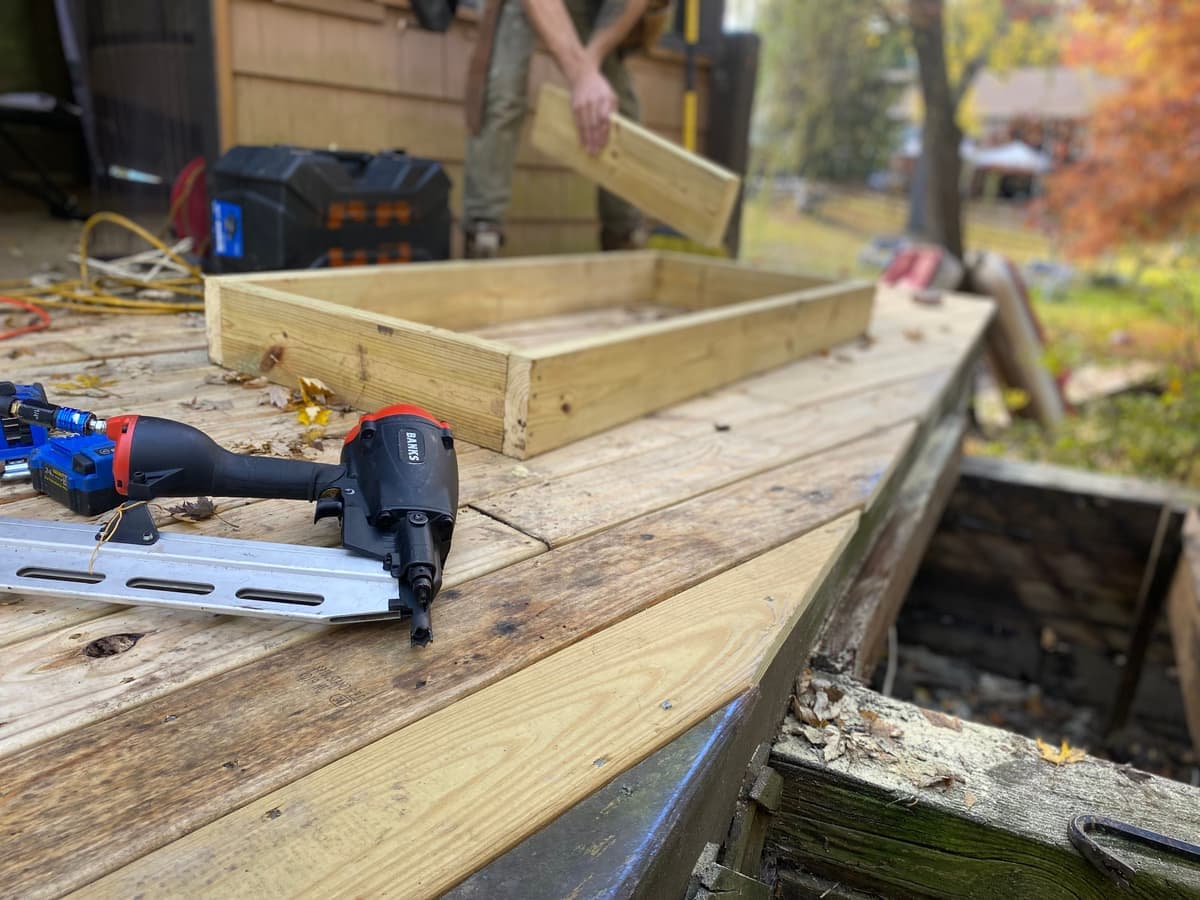
A pneumatic nail gun being used on timber

Some links on this page are affiliate links. If you buy through one, Magoo Media Group earns a commission from the retailer at no extra cost to you. It never changes which product we rank first - how this site is funded.

The demand

Why nailers barely register

Engineering ToolBox lists 0.5 CFM for an 18-gauge brad nailer and 2.5 CFM for a framing nailer. Bostitch publishes 1.8 CFM of free air at 80 PSI for a 15-gauge finish nailer firing 60 nails a minute - a genuinely fast trim pace. Metabo HPT publishes 0.09 SCFM at 100 PSI per cycle for a framing nailer.

The reason all these numbers are small is that a nailer only draws air at the instant it fires. Between nails it consumes nothing. Even at a professional pace you are asking the compressor for a fraction of a second of air several times a minute, which any tank covers.

Which means the smallest compressor in our roster - 1 gallon, 0.7 CFM, 20 pounds - is a genuinely complete tool for trim nailing rather than a compromise. That is unusual in this category and worth saying plainly.

Published air demand at 90 PSI
ToolCFM @ 90 PSIAt loadDutyWhat the number means
Brad nailer, 18 gauge0.5-BurstThe most forgiving air tool there is. A nailer draws air only at the instant it fires, so almost any tank covers it. That is why a 1-gallon compressor is a genuinely complete tool for trim work rather than a compromise.
Finish nailer, 15 gauge1.8-BurstBostitch publishes 1.8 CFM of free air at 80 PSI for its BTFP72155 running 60 fasteners a minute - a fast, sustained trim pace, not casual use. At a realistic pace the draw is a fraction of that.
Framing nailer, 21 or 30 degree2.5-BurstEngineering ToolBox lists 2.5 CFM for a framing nailer on a 25% load factor. Metabo HPT publishes 0.09 SCFM at 100 PSI for the NR90AES1 on a per-cycle basis. The two describe the same tool at different firing rates, which is exactly why one CFM number for a nailer is misleading: nail pace sets the demand, not the badge on the tool.
Roofing / coil nailerNot published-IntermittentNeither published chart carries a separate roofing-nailer line. Roofing is fired far faster and for far longer than framing, so treat it as the top of the framing range and size for recovery rather than peak. We will not print a number no source publishes.
Upholstery / crown stapler2-BurstEngineering ToolBox lists 2 CFM for an upholstery stapler, measured at 30 PSI. Low pressure means low demand, and a small tank keeps up easily.

Where two references publish different figures, both are shown rather than averaged into a number nobody published. Primary sources: Ingersoll Rand air consumption chart, Engineering ToolBox air tool consumption, and per-tool manufacturer specifications.

Ranked

The picks

Quick picks

#ProductBest forScorePrice
1
A small portable oil-free trim compressor on a workshop bench
Senco PC10100.7 CFM @ 90 / 1 gal / 125 PSI / 68 dBAThe cheapest compressor on this site that is genuinely complete for one job: trim nailing. 0.7 CFM and 20 pounds.
Trim, cabinets and punch-list nailing2.6/10★☆☆☆☆
Check price on Amazon

#ad Disclosure - we do not publish prices we cannot verify

2
A compact quiet-series air compressor beside coiled air hose
Makita MAC100Q Quiet Series0.7 CFM @ 90 / 1 gal / 135 PSI / 58 dBA58 dBA published - the quietest unit in this roster. Same 0.7 CFM as the Senco, with a roll cage and a higher ceiling.
Indoor finish work where noise decides the purchase3.1/10★★☆☆☆
Check price on Amazon

#ad Disclosure - we do not publish prices we cannot verify

3
A red six-gallon pancake air compressor on a garage floor
Porter-Cable C20022.6 CFM @ 90 / 6 gal / 150 PSIThe default answer to 'cheapest useful compressor'. 6 gallons, 2.6 CFM, 150 PSI, and it has been the same machine for years.
A first compressor for nailing, inflation and burst automotive work3.6/10★★☆☆☆
Check price on Amazon

#ad Disclosure - we do not publish prices we cannot verify

4
A twin-stack style air compressor in a home garage
Makita MAC210Q Quiet Series2 CFM @ 90 / 2 gal / 135 PSI / 60 dBA2.0 CFM at 60 dBA. The quiet option that can actually feed a framing nailer, not just a brad gun.
Quiet nailing at a real working pace3.8/10★★☆☆☆
Check price on Amazon

#ad Disclosure - we do not publish prices we cannot verify

5
A 15-gauge angled finish nailer next to trim molding
Bostitch BTFP721551.8 CFM free air at 80 PSI at 60 fasteners/min; 70-120 PSI operating range1.8 CFM of free air at 80 PSI at 60 nails a minute - the most honestly documented nailer figure we found.
Casing, baseboard and door trim4.3/10★★☆☆☆
Check price on Amazon

#ad Disclosure - we do not publish prices we cannot verify

Scores are computed from manufacturer-published specs by the rubric on our methodology page. Nothing here has been bench-tested, and we do not publish prices we cannot verify.

Pick 1 - Senco PC1010

2.6/10★☆☆☆☆

Senco PC1010

Best for: Trim, cabinets and punch-list nailing

Verdict

The cheapest compressor on this site that is genuinely complete for one job: trim nailing. 0.7 CFM and 20 pounds.

What it does well

  • 0.7 CFM at 90 PSI is more than a brad nailer needs, and the tool weighs 20 lb
  • 68 dBA published - quiet enough to run indoors without ear protection being the issue
  • Nothing to maintain: oil-free, one gauge, one regulator

What it will not do

  • 1 gallon and 0.7 CFM will not run any automotive tool, and we will not pretend otherwise
  • 125 PSI max is the lowest ceiling in the roster, so tank storage is limited
How this 2.6 was calculated
MetricScoreWeightBasis
Air flow0.040%0.7 CFM at 90 PSI, on a 0.7-6 CFM scale
Stored air0.025%1 gal x 125 PSI = 125, on a 125-3,500 scale
Noise6.315%68 dBA, on a 58-85 dBA scale
Portability10.010%20 lb, on a 20-90 lb scale
Spec transparency6.710%4 of 6 useful figures published (CFM at 90, CFM at 40, dBA, duty cycle, recovery, weight)
A small portable oil-free trim compressor on a workshop bench

Licensed stock photo - illustrative of the category, not a photo of this unit

Check price on Amazon

#ad Disclosure - we do not publish prices we cannot verify

Published specs

Senco PC1010 published specifications
CFM @ 90 PSI0.7
CFM @ 40 PSINot published
Tank1 gal
Max pressure125 PSI
Noise68 dBA
Duty cycleNot published
Recovery128 second pump-up time
PumpOil-free
Motor0.5 running / 1.0 peak
Weight20 lb
Power115V

Source: Senco PC1010 - product specifications

Pick 2 - Makita MAC100Q

3.1/10★★☆☆☆

Makita MAC100Q Quiet Series

Best for: Indoor finish work where noise decides the purchase

Verdict

58 dBA published - the quietest unit in this roster. Same 0.7 CFM as the Senco, with a roll cage and a higher ceiling.

What it does well

  • 58 dBA is the lowest published figure of any compressor we list
  • 135 PSI max gives you more usable storage than the 125 PSI class
  • 1,750 RPM motor and roll-cage construction

What it will not do

  • 0.7 CFM at 90 PSI - nailers and inflation only
  • Costs meaningfully more than a 6-gallon pancake that moves four times the air
How this 3.1 was calculated
MetricScoreWeightBasis
Air flow0.040%0.7 CFM at 90 PSI, on a 0.7-6 CFM scale
Stored air0.025%1 gal x 135 PSI = 135, on a 125-3,500 scale
Noise10.015%58 dBA, on a 58-85 dBA scale
Portability9.210%25.5 lb, on a 20-90 lb scale
Spec transparency6.710%4 of 6 useful figures published (CFM at 90, CFM at 40, dBA, duty cycle, recovery, weight)
A compact quiet-series air compressor beside coiled air hose

Licensed stock photo - illustrative of the category, not a photo of this unit

Check price on Amazon

#ad Disclosure - we do not publish prices we cannot verify

Published specs

Makita MAC100Q Quiet Series published specifications
CFM @ 90 PSI0.7
CFM @ 40 PSI1.2
Tank1 gal
Max pressure135 PSI
Noise58 dBA
Duty cycleNot published
RecoveryNot published
PumpOil-free
Motor0.5
Weight25.5 lb
Power120V

Source: Makita MAC100Q - product specifications

Pick 3 - Porter-Cable C2002

3.6/10★★☆☆☆

Porter-Cable C2002

Best for: A first compressor for nailing, inflation and burst automotive work

Verdict

The default answer to 'cheapest useful compressor'. 6 gallons, 2.6 CFM, 150 PSI, and it has been the same machine for years.

What it does well

  • 2.6 CFM at 90 PSI and 3.7 at 40 - the most common spec in the budget class for a reason
  • 6-gallon tank at 150 PSI stores enough air for real bursts of impact work
  • Two couplers, so two people or two tools without swapping

What it will not do

  • Porter-Cable does not publish a noise figure for it; the class sits in the high 70s to low 80s dBA
  • 2.6 CFM will not run a ratchet, die grinder or sander continuously
How this 3.6 was calculated
MetricScoreWeightBasis
Air flow3.640%2.6 CFM at 90 PSI, on a 0.7-6 CFM scale
Stored air2.325%6 gal x 150 PSI = 900, on a 125-3,500 scale
Noise5.015%Manufacturer publishes no dBA figure - scored a neutral 5, not a guess
Portability5.010%No weight published - scored a neutral 5
Spec transparency3.310%2 of 6 useful figures published (CFM at 90, CFM at 40, dBA, duty cycle, recovery, weight)
A red six-gallon pancake air compressor on a garage floor

Licensed stock photo - illustrative of the category, not a photo of this unit

Check price on Amazon

#ad Disclosure - we do not publish prices we cannot verify

Published specs

Porter-Cable C2002 published specifications
CFM @ 90 PSI2.6
CFM @ 40 PSI3.7
Tank6 gal
Max pressure150 PSI
NoiseNot published
Duty cycleNot published
RecoveryNot published
PumpOil-free
Motor0.8
WeightNot published
Power120V

Source: Porter-Cable C2002 - product specifications

Pick 4 - Makita MAC210Q

3.8/10★★☆☆☆

Makita MAC210Q Quiet Series

Best for: Quiet nailing at a real working pace

Verdict

2.0 CFM at 60 dBA. The quiet option that can actually feed a framing nailer, not just a brad gun.

What it does well

  • 2.0 CFM at 90 PSI clears every nailer class on our CFM chart
  • 60 dBA published, against 78-82 dBA for the pancakes at similar output
  • Fills the 2-gallon tank from empty in about 65 seconds

What it will not do

  • 44 lb - heavier than a 6-gallon pancake with more tank
  • 2 gallons of storage means automotive burst work drains it fast
How this 3.8 was calculated
MetricScoreWeightBasis
Air flow2.540%2 CFM at 90 PSI, on a 0.7-6 CFM scale
Stored air0.425%2 gal x 135 PSI = 270, on a 125-3,500 scale
Noise9.315%60 dBA, on a 58-85 dBA scale
Portability6.610%44 lb, on a 20-90 lb scale
Spec transparency6.710%4 of 6 useful figures published (CFM at 90, CFM at 40, dBA, duty cycle, recovery, weight)
A twin-stack style air compressor in a home garage

Licensed stock photo - illustrative of the category, not a photo of this unit

Check price on Amazon

#ad Disclosure - we do not publish prices we cannot verify

Published specs

Makita MAC210Q Quiet Series published specifications
CFM @ 90 PSI2
CFM @ 40 PSINot published
Tank2 gal
Max pressure135 PSI
Noise60 dBA
Duty cycleNot published
Recoveryabout 65 seconds from empty
PumpOil-free
Motor1.0
Weight44 lb
Power120V

Source: Makita MAC210Q - product specifications

Pick 5 - Bostitch BTFP72155

4.3/10★★☆☆☆

Bostitch BTFP72155

Best for: Casing, baseboard and door trim

Verdict

1.8 CFM of free air at 80 PSI at 60 nails a minute - the most honestly documented nailer figure we found.

What it does well

  • Bostitch publishes the demand AND the firing rate it was measured at, which almost no brand does
  • Drives 1-1/4 to 2-1/2 inch DA-style angled nails
  • 70-120 PSI operating range, with 70 PSI enough for softwood trim

What it will not do

  • 15 gauge leaves a bigger hole than an 18-gauge brad nailer - wrong tool for delicate work
  • Angled magazines cost more per nail than straight 16-gauge
How this 4.3 was calculated
MetricScoreWeightBasis
Air economy5.040%No average CFM published - scored a neutral 5
Handling5.025%No weight published - scored a neutral 5
Noise5.020%No dBA published - scored a neutral 5
Spec transparency0.015%0 of 5 useful figures published (average CFM, CFM at load, dBA, weight, minimum hose)
A 15-gauge angled finish nailer next to trim molding

Licensed stock photo - illustrative of the category, not a photo of this unit

Check price on Amazon

#ad Disclosure - we do not publish prices we cannot verify

Published specs

Bostitch BTFP72155 published specifications
Average air @ 90 PSINot published as a CFM figure
Performance1.8 CFM free air at 80 PSI at 60 fasteners/min; 70-120 PSI operating range
NoiseNot published
WeightNot published
Minimum hoseNot published

Source: Bostitch BTFP72155 finish nailer - operation and maintenance manual

The real criteria

Choose on weight and noise, not air

Since every compressor on this page has more than enough flow for any nailer, the decision comes down to the things that affect how you work. Weight, because you carry it up ladders and into rooms. Noise, because trim work happens inside occupied buildings.

A 20-pound 1-gallon unit at 68 dBA carries in one hand alongside the nailer. A 25.5-pound unit at 58 dBA is the quietest figure published in our roster and is the right tool for finishing a room in a house where people are living.

A 6-gallon pancake at 30 pounds gives you four times the air you need for nailing plus the ability to break a lug nut later, at 75.5 to 82 dBA. If the compressor will also do other jobs, that is the better buy. If it is purely a nailer companion, the extra tank is dead weight.

Nailer companions on published specs
CompressorWeightCFM @ 90dBATank
Senco PC101020 lb0.7681 gal
Makita MAC100Q25.5 lb0.7581 gal
DEWALT DWFP5512630 lb2.675.56 gal
Craftsman CMEC6150K30 lb2.6826 gal
Makita MAC210Q44 lb2.0602 gal

A brad nailer needs 0.5 CFM published. Every unit here clears it several times over.

The exception

Where nail pace does matter

Roofing. Neither published chart carries a separate roofing-nailer figure, and the reason is that roofing is fired far faster and for far longer than any other nailing job. A coil nailer running flat out on a roof deck is the one nailing task that can genuinely outrun a small compressor.

We will not print a CFM number for it because no source publishes one. The practical guidance is to treat it as the top of the framing range and size for recovery rather than peak: a 6-gallon tank with 2.6 CFM will keep up with one person roofing at a sustainable pace and will not keep up with two.

Framing at production speed sits in the same territory. A single framer on a 6-gallon pancake is fine. Two nailers off one pancake is not, and that is a flow problem the tank cannot solve.

Senco PC1010: what it runs

Delivered flow: 0.7 CFM at 90 PSI. We call a tool covered when delivered flow clears its highest published demand plus a 25% margin.

Runs it (1)

  • Brad nailer, 18 gaugeYes - needs 0.5 CFM, burst duty

Does not run it (5)

  • Finish nailer, 15 gaugeNo - needs 1.8 CFM, burst duty
  • Upholstery / crown staplerNo - needs 2 CFM, burst duty
  • Framing nailer, 21 or 30 degreeNo - needs 2.5 CFM, burst duty
  • Tire inflationNo - needs 2 CFM, intermittent duty
  • Impact wrench, 1/2"No - needs 5 CFM, burst duty

Demand figures from the air tool CFM chart, which cites every one of them.

FAQ

Questions people actually ask

What size air compressor do I need for a brad nailer?

Any of them. A brad nailer needs about 0.5 CFM published, and the smallest compressor we list delivers 0.7 CFM from a 1-gallon tank. A 1-gallon trim unit is a complete answer for brad and finish nailing rather than a compromise.

Can a 1 gallon compressor run a framing nailer?

For occasional framing at a moderate pace, yes - Engineering ToolBox lists 2.5 CFM for a framing nailer on a 25% load factor, and the burst duration is a fraction of a second. For sustained production framing, a 6-gallon tank is the better match.

Do I need a bigger compressor for a framing nailer than a brad nailer?

Slightly, on paper - 2.5 CFM against 0.5. In practice both are burst tools and the difference only shows at a fast sustained pace. Nail pace matters far more than which nailer you own.

What PSI should I run a nail gun at?

Inside the tool's published operating range, which is typically 70 to 120 PSI. Bostitch and Metabo HPT both publish 70 to 120 for their nailers. Start at the low end for softwood trim and increase only if nails are not seating fully.

Is a quiet compressor worth it for trim work?

For indoor finish work in an occupied building, genuinely yes. 58 dBA against 82 dBA is the difference between a compressor you can run in a hallway and one that clears the room. For nailing, you give up no useful flow to get it.

Sources

Where these numbers come from

Accessed September 2026. If a figure on this page does not match the manufacturer's current sheet, tell us at contact@psiandhose.com and we will correct and date the change - see our editorial policy.

Read next