Skip to content
Psi & Hose

Air Tools

Best air tools for mechanics

A mechanic needs three air tools and four accessories, and the accessories get used more often than the tools. Here is the whole list on published figures, in the order to buy it.

By Ryder M.Last updated Published
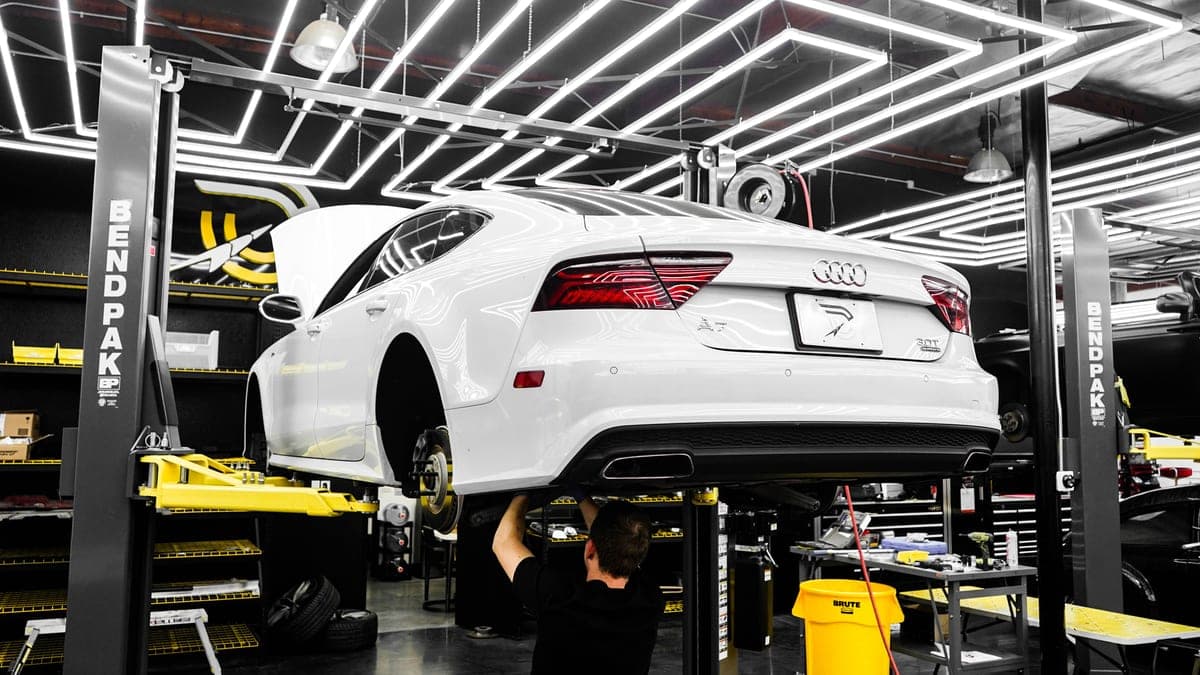
A mechanic working under a vehicle in a well-equipped shop bay

Some links on this page are affiliate links. If you buy through one, Magoo Media Group earns a commission from the retailer at no extra cost to you. It never changes which product we rank first - how this site is funded.

Read this first

The verdict, before the specs

Buy the Ingersoll Rand 231C. It is for the mechanic turning lug nuts, suspension bolts and seized fasteners on a normal garage compressor: a published 600 ft-lb of maximum torque, 8,000 RPM free speed, 1,200 blows per minute, 4.2 CFM average consumption at 90 PSI with 22 CFM at load, and a stated minimum hose size of 3/8-inch ID. It is also the only tool in this category that publishes both an average and an at-load air figure, which is what makes it possible to size a compressor against it rather than hope.

On price, the 231C is also the cheapest 1/2-inch impact wrench in our registry with a live price at the last check, so the top pick and the budget pick are the same tool. If the budget is genuinely tight, the cheapest tool on this page that earns its keep daily is the Milton S-693 dual-head air chuck - a closed, sealing, straight-foot chuck rated to 150 PSI, which turns any compressor into a tire tool for the price of a sandwich.

The second tool to buy is the Ingersoll Rand 105-D3 3/8-inch air ratchet: 25 ft-lb of maximum torque, a 5 to 20 ft-lb recommended working range, 250 RPM free speed, 3 CFM average at 90 PSI, and 1.8 pounds. It is not a substitute for the impact and it is not supposed to be - it is for accessory bolts, bell housings, intake fasteners and anywhere a socket wrench cannot swing. Twenty-five ft-lb is a quarter of a wheel nut's torque, and we would rather say that than imply otherwise.

The third is the Astro Pneumatic ONYX 1822 at 3.0 pounds, 500 ft-lb maximum and 350 ft-lb working torque, 10,000 RPM free speed, a published 86 dBA and 4.8 CFM average at 90 PSI. Its job is tight engine-bay and suspension access where a full-size 231C physically will not fit. Prices come from the price layer in each buy button with the date each was read.

What decides this, in one line

CFM at load, not average. An impact wrench's average figure describes a trigger pull with gaps; the at-load figure describes the second it is actually breaking a bolt. The 231C publishes 4.2 average and 22 at load, and both numbers are true.

The list

Three tools, four accessories, in buying order

A 1/2-inch impact wrench is the tool a mechanic buys first and uses hardest. Wheels, suspension, exhaust hangers, subframe bolts - anything seized. It is a burst tool: one second of trigger per fastener, which is why a 6-gallon tank at 150 PSI holds enough stored air for a full wheel before the pump even matters.

A 3/8-inch air ratchet is the second purchase and the one people skip. At 1.8 pounds and 250 RPM it spins off accessory bolts in places a socket wrench cannot swing, and the time it saves on an intake or a valve cover is where it pays for itself. It is a low-torque tool and buying it to replace the impact is the classic mistake.

A compact impact is the third tool, not the first. The ONYX 1822 at 3.0 pounds exists because engine bays have places a 600 ft-lb full-size body cannot reach, and 350 ft-lb of working torque is still more than any accessory fastener needs.

Then the accessories, which get used more days than any of the three. A dual-head air chuck for tires, a long-reach chuck for dually rears and tandem trailers, and a blow gun that lives on the hose for brake dust, machined surfaces and clearing a channel. These cost a fraction of the tools and they are the items a mechanic touches daily.

What is not on this list: a die grinder, a cut-off tool and an orbital sander. All three are continuous-draw tools in the 4 to 10 CFM band, and no 120V garage compressor sustains them. We size those jobs separately rather than sell you a tool your compressor cannot feed.

Published air demand at 90 PSI
ToolCFM @ 90 PSIAt loadDutyWhat the number means
Impact wrench, 1/2"4 - 522BurstThe most misunderstood number on this chart. Ingersoll Rand publishes 4.2 CFM average for the 231C and 22 CFM at load. The average assumes you hold the trigger for a second or two at a time. A 6-gallon pancake at 2.6 CFM does break lug nuts; it simply cannot keep the trigger down.
Air ratchet, 3/8"3 - 4-IntermittentIngersoll Rand publishes 3 CFM average at 90 PSI for the 105-D3; Engineering ToolBox lists 4 CFM for the class. A ratchet is the sneaky one: you hold the trigger far longer than with an impact, so it punishes a small tank harder despite the lower headline number.
Blow gun / dusting gun2.5 - 3-IntermittentIngersoll Rand lists 2.5 CFM, Engineering ToolBox 3. Held open continuously - clearing a sprinkler line, blowing out a filter - a blow gun empties a 6-gallon tank surprisingly fast.
Tire inflation2-IntermittentBoth references agree on 2 CFM. Note the working pressure: you are filling to 35 PSI, not 90, so almost every compressor delivers more than it needs to. Tires are why so many people overbuy - the job is easy and the marketing is not.
Die grinder, 1/4"5 - 6-ContinuousIngersoll Rand lists 5 CFM; Engineering ToolBox gives a 4-6 CFM band. Continuous duty, so a 6-gallon pancake gives you a handful of seconds before pressure drops and the tool slows.

Where two references publish different figures, both are shown rather than averaged into a number nobody published. Primary sources: Ingersoll Rand air consumption chart, Engineering ToolBox air tool consumption, and per-tool manufacturer specifications.

The table

The six, on published figures

Ranked for a working bay, on manufacturer figures
What it isPublished air figureHeadline figureWeightNote
Ingersoll Rand 231C1/2 in impact wrench4.2 CFM avg at 90 PSI; 22 CFM at load600 ft-lb max torque, 1,200 BPMNot published99 dBA; 3/8 in hose minimum stated
Astro Pneumatic ONYX 18221/2 in compact impact4.8 CFM avg at 90 PSI500 ft-lb max / 350 ft-lb working3.0 lb86 dBA published
Ingersoll Rand 105-D33/8 in air ratchet3 CFM avg at 90 PSI25 ft-lb max, 5-20 ft-lb range1.8 lb250 RPM free speed
Milton S-693Dual-head air chuckClosed / sealing typeStraight foot, inner dual tiresNot published150 PSI; 1/4 in FNPT
Milton S-690-12Dual-head chuck, 12 in reachClosed / sealing type12 in overall lengthNot published150 PSI; 1/4 in FNPT
Milton S-160Pistol grip blow gunFlow not published by MiltonOSHA-compliant safety tipNot published150 PSI; extensions available

Manufacturer-published figures only, each attributed in the sources block. The 231C's two air figures describe different conditions - average consumption over a trigger pull and consumption at load - and both come from Ingersoll Rand. Prices are live in the buy buttons, not in this table.

Quick picks

#ProductBest forScorePrice
1
Ingersoll Rand 231C product photo
Ingersoll Rand 231C4.2 CFM avg / 22 CFM at load600 ft-lb at 4.2 CFM average - and 22 CFM at load. The tool that teaches you what 'average CFM' really means.
Lug nuts and suspension bolts on a normal garage compressor4.3/10★★☆☆☆

#ad Disclosure - price as of November 28, 2026

2
Astro Pneumatic ONYX 1822 product photo
Astro Pneumatic ONYX 18224.8 CFM avg / 3 lb500 ft-lb from a 3.85-inch body at 3 lb. The one to buy when access, not torque, is the problem.
Tight engine-bay and suspension work where a full-size impact will not fit5.5/10★★★☆☆

#ad Disclosure - price as of November 28, 2026

3
Ingersoll Rand 105-D3 product photo
Ingersoll Rand 105-D33 CFM avg / 1.8 lb3 CFM average and 1.8 lb. Lower demand than an impact on paper, harder on your tank in practice.
Fast bolt removal in places a socket wrench cannot swing7.0/10★★★★☆

#ad Disclosure - price as of November 28, 2026

4
Milton S-693 straight-foot dual-head air chuck product photo
Milton S-693 straight-foot dual-head air chuck1/4" FNPT / Dual head, straight foot, closed / sealing / 150 PSIThe dual head seats on a valve stem pointing the wrong way, and unlike the S-690 it works on an inflator gauge too. 150 PSI.
Inflating anything whose valve stem is not conveniently square to you4.2/10★★☆☆☆

#ad Disclosure - price as of November 28, 2026

5
Milton S-690-12 12" extended-reach dual-head air chuck product photo
Milton S-690-12 12" extended-reach dual-head air chuck1/4" FNPT / Dual head, closed / sealing / 12"Twelve inches of reach to an inner dual or a deep-dish wheel, at the same 150 PSI. Buy it only if you own that problem.
Dually rear wheels, trailer inner duals and deep-dish rims3.8/10★★☆☆☆

#ad Disclosure - price as of November 28, 2026

6
Milton S-160 pistol grip blow gun product photo
Milton S-160 pistol grip blow gun1/4" NPT / 150 PSI / Not published by MiltonZinc die-cast, chrome plated, 150 PSI and an OSHA-compliant tip. The blow gun that outlives the compressor it came with.
The one blow gun that lives on the hose permanently2.2/10★☆☆☆☆

#ad Disclosure - price as of November 28, 2026

Scores are computed from manufacturer-published specs by the rubric on our methodology page. Nothing here has been bench-tested. Prices are Amazon's own, refreshed daily, and never shown when we cannot verify them.

Pick 1 - Ingersoll Rand 231C

4.3/10★★☆☆☆

Ingersoll Rand 231C

Best for: Lug nuts and suspension bolts on a normal garage compressor

Verdict

600 ft-lb at 4.2 CFM average - and 22 CFM at load. The tool that teaches you what 'average CFM' really means.

What it does well

  • 600 ft-lb max torque at 8,000 RPM, which is more than any lug nut needs
  • 4.2 CFM average at 90 PSI - a 4 CFM compressor keeps up with real-world use
  • The long-running industry default, so parts and service kits are everywhere

What it will not do

  • 22 CFM at load. Hold the trigger down and no garage compressor on this site will keep up
  • 99 dBA - wear hearing protection, this is not optional
  • Wants a 3/8" minimum hose ID; a 1/4" hose will throttle it
How this 4.3 was calculated
MetricScoreWeightBasis
Air economy4.340%4.2 CFM average at 90 PSI, on a 1.8-6 CFM scale (lower is better)
Handling5.025%No weight published - scored a neutral 5
Noise0.520%99 dBA, on an 80-100 dBA scale
Spec transparency8.015%4 of 5 useful figures published (average CFM, CFM at load, dBA, weight, minimum hose)
Ingersoll Rand 231C product photo

Product image from the Amazon listing for this model

#ad Disclosure - price as of November 28, 2026

Published specs

Ingersoll Rand 231C published specifications
Average air @ 90 PSI4.2 CFM
Air at load22 CFM
Performance600 ft-lb max torque, 8,000 RPM, 1,200 BPM
Noise99 dBA
WeightNot published
Minimum hose3/8" ID minimum

Source: Ingersoll Rand 231C impact wrench - product specifications

Pick 2 - Astro Pneumatic 1822

5.5/10★★★☆☆

Astro Pneumatic ONYX 1822

Best for: Tight engine-bay and suspension work where a full-size impact will not fit

Verdict

500 ft-lb from a 3.85-inch body at 3 lb. The one to buy when access, not torque, is the problem.

What it does well

  • 3.85 inches long and 3.0 lb, with 500 ft-lb max / 350 ft-lb working torque
  • 86 dB published - 13 dB quieter than the full-size class reference
  • Three forward and three reverse power settings

What it will not do

  • 4.8 CFM average is higher than the 4.2 CFM class reference, so it is slightly harder on a small compressor
  • Short bodies trade some hammer mass for access; on badly seized fasteners you will feel it
How this 5.5 was calculated
MetricScoreWeightBasis
Air economy2.940%4.8 CFM average at 90 PSI, on a 1.8-6 CFM scale (lower is better)
Handling8.125%3 lb, on a 1.8-8 lb scale
Noise7.020%86 dBA, on an 80-100 dBA scale
Spec transparency6.015%3 of 5 useful figures published (average CFM, CFM at load, dBA, weight, minimum hose)
Astro Pneumatic ONYX 1822 product photo

Product image from the Amazon listing for this model

#ad Disclosure - price as of November 28, 2026

Published specs

Astro Pneumatic ONYX 1822 published specifications
Average air @ 90 PSI4.8 CFM
Performance500 ft-lb max / 350 ft-lb working torque, 10,000 RPM free speed
Noise86 dBA
Weight3 lb
Minimum hoseNot published

Source: Astro Pneumatic ONYX 1822 impact wrench - product specifications

Pick 3 - Ingersoll Rand 105-D3

7.0/10★★★★☆

Ingersoll Rand 105-D3

Best for: Fast bolt removal in places a socket wrench cannot swing

Verdict

3 CFM average and 1.8 lb. Lower demand than an impact on paper, harder on your tank in practice.

What it does well

  • 3 CFM average at 90 PSI is the lowest automotive-tool figure Ingersoll Rand publishes
  • 1.8 lb and 7.3 inches long - it goes where your hand barely does
  • 25 ft-lb max with a 5-20 ft-lb working range, which is the right range for accessory bolts

What it will not do

  • You hold a ratchet trigger for far longer than an impact trigger, so a 2.6 CFM pancake will fall behind
  • 25 ft-lb will not break a lug nut - this is a removal tool, not a breaker
How this 7.0 was calculated
MetricScoreWeightBasis
Air economy7.140%3 CFM average at 90 PSI, on a 1.8-6 CFM scale (lower is better)
Handling10.025%1.8 lb, on a 1.8-8 lb scale
Noise5.020%No dBA published - scored a neutral 5
Spec transparency4.015%2 of 5 useful figures published (average CFM, CFM at load, dBA, weight, minimum hose)
Ingersoll Rand 105-D3 product photo

Product image from the Amazon listing for this model

#ad Disclosure - price as of November 28, 2026

Published specs

Ingersoll Rand 105-D3 published specifications
Average air @ 90 PSI3 CFM
Performance25 ft-lb max torque, 250 RPM free speed, 5-20 ft-lb recommended range
NoiseNot published
Weight1.8 lb
Minimum hoseNot published

Source: Ingersoll Rand 105 Series mini ratchet - product specifications

Pick 4 - Milton S-693

4.2/10★★☆☆☆

Milton S-693 straight-foot dual-head air chuck

Best for: Inflating anything whose valve stem is not conveniently square to you

Verdict

The dual head seats on a valve stem pointing the wrong way, and unlike the S-690 it works on an inflator gauge too. 150 PSI.

What it does well

  • Dual head seats on a valve facing inward - the case that defeats every straight single-head chuck
  • Milton states it works on an airline OR with an inflator gauge, which the S-690 does not
  • 150 PSI maximum, covering every passenger, light-truck and trailer pressure you will meet

What it will not do

  • Closed/sealing type means it only passes air when seated, so you cannot use it as a quick deflator
  • A dual head is bulkier than a single head, and on a tight alloy wheel the bulk is what stops you seating it
How this 4.2 was calculated
MetricScoreWeightBasis
Pressure headroom1.440%150 PSI rating, on a 125-300 PSI scale
Flow capacity6.040%Flow not published for this class - scored a 6, which is what a correctly sized hose or fitting does not restrict
Spec transparency6.020%5 published specification figures
Milton S-693 straight-foot dual-head air chuck product photo

Product image from the Amazon listing for this model

#ad Disclosure - price as of November 28, 2026

Published specs

Milton S-693 straight-foot dual-head air chuck published specifications
Thread1/4" FNPT
TypeDual head, straight foot, closed / sealing
Max pressure150 PSI
Designed forInner dual tires, valve facing inward
Works withAirline or inflator gauge

Source: Milton S-693 straight-foot dual-head air chuck, 1/4 in FNPT - product page

Pick 5 - Milton S-690-12

3.8/10★★☆☆☆

Milton S-690-12 12" extended-reach dual-head air chuck

Best for: Dually rear wheels, trailer inner duals and deep-dish rims

Verdict

Twelve inches of reach to an inner dual or a deep-dish wheel, at the same 150 PSI. Buy it only if you own that problem.

What it does well

  • 12 in overall length reaches an inner dual valve without removing anything
  • Same closed/sealing design and 150 PSI rating as the short S-690
  • Turns a two-person inflation job on a dually into a one-person job

What it will not do

  • Milton states it is not compatible with Milton inflator gauges, which rules out the most obvious pairing
  • On a car it is pure nuisance - the extra length fouls every wheel you can already reach
How this 3.8 was calculated
MetricScoreWeightBasis
Pressure headroom1.440%150 PSI rating, on a 125-300 PSI scale
Flow capacity6.040%Flow not published for this class - scored a 6, which is what a correctly sized hose or fitting does not restrict
Spec transparency4.020%4 published specification figures
Milton S-690-12 12" extended-reach dual-head air chuck product photo

Product image from the Amazon listing for this model

#ad Disclosure - price as of November 28, 2026

Published specs

Milton S-690-12 12" extended-reach dual-head air chuck published specifications
Thread1/4" FNPT
TypeDual head, closed / sealing
Overall length12"
Max pressure150 PSI

Source: Milton S-690-12 12 in extended-reach dual-head air chuck - product page

Pick 6 - Milton S-160

2.2/10★☆☆☆☆

Milton S-160 pistol grip blow gun

Best for: The one blow gun that lives on the hose permanently

Verdict

Zinc die-cast, chrome plated, 150 PSI and an OSHA-compliant tip. The blow gun that outlives the compressor it came with.

What it does well

  • OSHA-compliant safety tip, which is the only tip design the cleaning rule in 29 CFR 1910.242(b) leaves room for
  • 150 PSI maximum - the highest rating of the three standard-flow Milton guns here, so it survives being hung off a tank outlet
  • Takes Milton's 6 in (#122) and 10 in (#123) extensions, so one body covers short and long reach

What it will not do

  • Milton publishes no SCFM figure for this model, so you cannot size a line against it the way you can the S-163 or S-167
  • Zinc die-cast is heavier in the hand than a composite body, and the chrome shows every drop of tool oil
How this 2.2 was calculated
MetricScoreWeightBasis
Pressure headroom1.440%150 PSI rating, on a 125-300 PSI scale
Flow capacity0.040%0 SCFM, on a 40-100 SCFM scale
Spec transparency8.020%6 published specification figures
Milton S-160 pistol grip blow gun product photo

Product image from the Amazon listing for this model

#ad Disclosure - price as of November 28, 2026

Published specs

Milton S-160 pistol grip blow gun published specifications
Air inlet1/4" NPT
Max pressure150 PSI
Air flowNot published by Milton
TipOSHA-compliant safety tip
BodyZinc die-cast, chrome plated
ExtensionsMilton 6" (#122) and 10" (#123)

Source: Milton S-160 pistol grip blow gun with OSHA-compliant safety tip - product page, 29 CFR 1910.242(b) - Compressed air used for cleaning (eCFR)

The criteria

How we ranked these six

  1. 01A published air figure, weighted first, because an impact wrench is the tool most likely to outrun a garage compressor. Three of the six publish one and the 231C publishes two.
  2. 02Torque against the real job. Six hundred ft-lb breaks a seized suspension bolt; 350 ft-lb of working torque handles everything in an engine bay; 25 ft-lb is an accessory-bolt figure and we rank the ratchet on that basis rather than pretending it is a wheel tool.
  3. 03Weight and access, because half of a mechanic's fasteners are in places your arm barely reaches. The ONYX at 3.0 pounds and the ratchet at 1.8 pounds are on this list for access, not for power.
  4. 04Published noise where it exists. The 231C publishes 99 dBA and the ONYX publishes 86 dBA - a real difference across a working day, and a reason to own ear protection with either.
  5. 05Daily usefulness per dollar for the accessories, which is why two air chucks and a blow gun rank alongside three power tools. They are the cheapest items here and the most frequently used.

What people get wrong

The compressor and the hose decide whether these work

The 231C's 22 CFM at load is not a reason to buy a 22 CFM compressor. It is the load during the second you are breaking a fastener, supplied by stored air in the tank, and a 6-gallon machine at 150 PSI covers a full wheel before the pump becomes the limit. What you cannot do on a 6-gallon tank is run an impact continuously - and nobody does.

If your impact work is a brake job rather than four wheels in an afternoon, buy storage instead of pump output: a 20-gallon tank at 175 PSI holds roughly double the usable air of a 6-gallon tank at 150 PSI, and that is what keeps the pace up through a long session.

Ingersoll Rand states a 3/8-inch ID minimum hose for the 231C, and that is not a suggestion. A long 1/4-inch hose behind an impact wrench throws away pressure before the tool sees it, and the tool then feels weak in a way that looks like a defect. Three-eighths-inch, 50 feet, and a high-flow coupler at both ends.

Put a water separator between the tank and the tool as well. An impact wrench and a ratchet are oil-lubricated air motors, and condensate carries the oil out and the rust in. A 10-micron filter-regulator at the wall is the whole fix and it costs a fraction of the tool it protects.

FAQ

Questions people actually ask

What air tools does a mechanic need?

Three tools and four accessories: a 1/2-inch impact wrench, a 3/8-inch air ratchet, a compact impact for tight access, plus a dual-head air chuck, a long-reach chuck, a blow gun and a water separator. The accessories cost a fraction of the tools and get used on more days than any of them.

What is the best air impact wrench for a mechanic?

The Ingersoll Rand 231C: a published 600 ft-lb of maximum torque, 8,000 RPM, 1,200 BPM, 4.2 CFM average consumption at 90 PSI with 22 CFM at load, and a stated 3/8-inch minimum hose. It was also the cheapest 1/2-inch impact in our registry with a live price at the last check, which makes it the value pick as well as the capability pick.

Can a 6-gallon compressor run an impact wrench?

For one-second bursts, which is how wheels and suspension bolts are actually done - a 6-gallon tank at 150 PSI holds enough stored air for a full wheel before the pump matters. It cannot run an impact continuously. If your work is full brake jobs rather than wheel swaps, buy a 20-gallon tank at 175 PSI instead.

Do I need an air ratchet if I have an impact wrench?

They do different jobs. The 105-D3 publishes 25 ft-lb of maximum torque with a 5 to 20 ft-lb recommended range - accessory bolts, intake and valve-cover fasteners, anywhere a socket wrench cannot swing. It will not break a lug nut and it is not meant to. Buy it second, not instead.

What hose size for air tools in a shop?

Three-eighths-inch ID. Ingersoll Rand states that as the minimum for the 231C, and a 1/4-inch hose behind any impact wrench gives away pressure before the tool sees it. Fifty feet of 3/8-inch with high-flow couplers at both ends is the standard shop setup.

Are air tools still better than cordless for a mechanic?

For sustained impact work, pneumatic tools are lighter for the torque and have no battery to go flat mid-job, and a 3.0-pound compact impact at 350 ft-lb working torque has no cordless equivalent at that weight. Cordless wins when you carry the tool to the vehicle. We cover the trade in full on its own page.

Sources

Where these numbers come from

Accessed September 2026. If a figure on this page does not match the manufacturer's current sheet, tell us at contact@psiandhose.com and we will correct and date the change - see our editorial policy.

Read next